Lease or Own Your Dental Office? Run the Numbers Before You Sign
Every dentist I know who built an office remembers the moment the numbers moved. The estimate said one thing, the contractor's bid said another, and the lender's letter said something else entirely.
I spent twenty-five years on the equipment side of these projects, which gave me a front-row seat. Some offices opened on budget and filled their schedules inside a year. Others opened beautiful and spent the next three years paying for it. The difference rarely came down to design or location. It came down to whether the owner ran the numbers before signing.
The question under lease or own
Leasing keeps cash in your pocket on day one. Owning builds equity, and it also hands you a mortgage, a roof, and every surprise that comes with them. Neither wins by default. What decides it is how your specific numbers behave over ten years, and that's hard to see on the back of a proposal.
Rent is the sneaky variable. A lease that looks friendly in year one can look very different in year five, after the escalations have done their quiet work. Plenty of owners model the first twelve months carefully and wave at everything after that. I get it. The first year is loud, and year five feels like someone else's problem. It's still your problem.
The three tests a lender runs
Lenders keep this simpler than most doctors expect. They look at three things, and we walk through each in Will Your New Dental Office Pencil Out? Here's the short version.
Debt service coverage comes first. Lenders and operators want to see $1.25 of cash flow for every $1.00 of new debt payment, or better. Next is new patient flow, where 15 to 25 or more new patients per month, sustained, is the range that keeps new rooms full. Then comes production per operatory. The median runs roughly $28,000 to $32,000 per room per month, and anything under $18,000 signals trouble.
Miss any one of those and the building can be gorgeous, the loan can close, and the practice can still struggle under the weight of it.
What the Build Tool does with your numbers
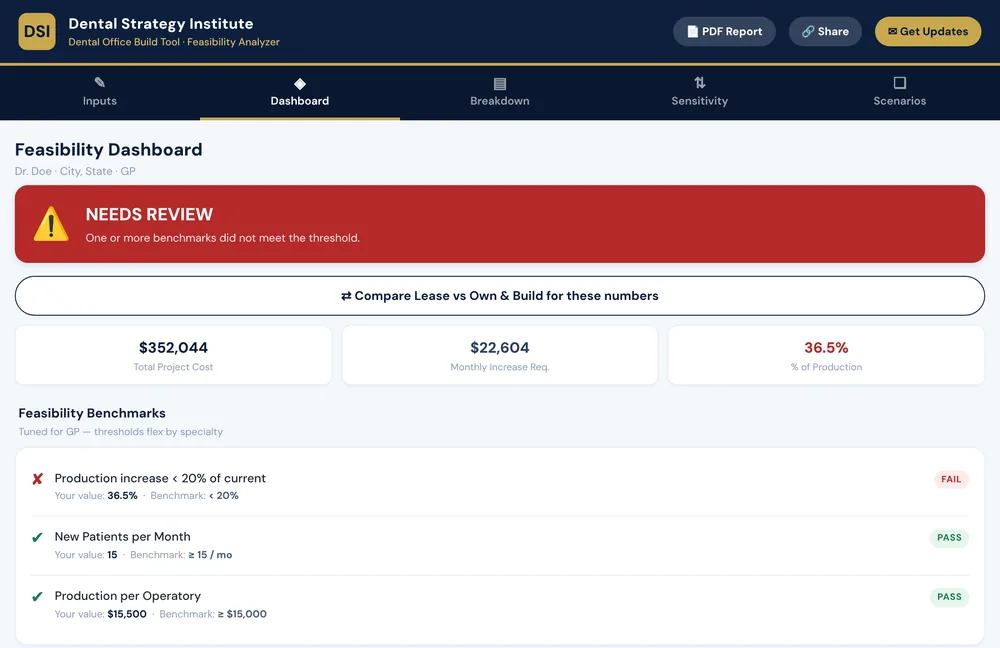
We built the Dental Office Build Tool so you can run those three tests yourself, before a banker does it for you. It's free and it runs in your browser.
You pick your scenario: lease with a build-out, or own and build. You can model a brand-new practice with a patient ramp or add rooms to an existing one. The tool brings in regional cost differences and equipment tiers, so a basic package and a premium package don't get treated as the same thing. It also models rent as it climbs, which means the year-five number shows up before the lease does.
Then it gives you a verdict. Go, or not yet.
When the answer is not yet
A flat "no" doesn't help anyone, so the tool works backward. Say your coverage comes up short. It shows you what has to change to reach a go: a smaller build-out, a stronger ramp, a different lease structure, fewer premium finishes. I've sat across the table from owners making this call with a napkin and a hunch. Seeing the path to yes on a screen is a better way to spend an evening.
One note on the cost figures. They come from a regional index, so treat the output as a planning number and get real bids before you commit. The tool tells you where to look. Your contractor and your lender still do the final math.
Who should run it
New practice owners should, obviously. So should doctors adding an operatory, since expanding in place versus building new comes down to the same three tests. Anyone weighing a relocation belongs in that group too. DSO operators comparing sites will find it useful as a quick first screen before the expensive diligence starts.
When you finish, you can download a clean PDF report. Hand it to your banker, your CPA, or your spouse. Each of them will have questions, and you'll already have the answers on paper.
If you're curious about the build-out side, two more reads help: what it really costs to build a dental office in 2026 and how the financing works. Then open the tool, enter your real numbers, and see what the verdict says. Better to hear "not yet" from a screen than from a lender.