Repair or replace your dental equipment? Run the numbers first.
The service tech says $2,200 and the chair is nine years old. Everyone in the room looks at you. Most owners answer by gut and a little guilt. This calculator scores the decision from 0 to 100 and lays repair and replacement side by side over five years, so the answer has math behind it.
The short rule: if a repair costs more than 50 percent of a comparable new unit, replace it. Over 40 percent of an older unit's fair market value is the stricter second test. The 50 percent rule is a general equipment rule of thumb (Caterpillar calls it conventional wisdom), and the fair market value tests are DSI planning rules.
Operatory, utility room, sterilization and imaging, each with its own expected life and replacement cost. Suction is covered by the vacuum guide, and the utility room by the compressor and vacuum guides.
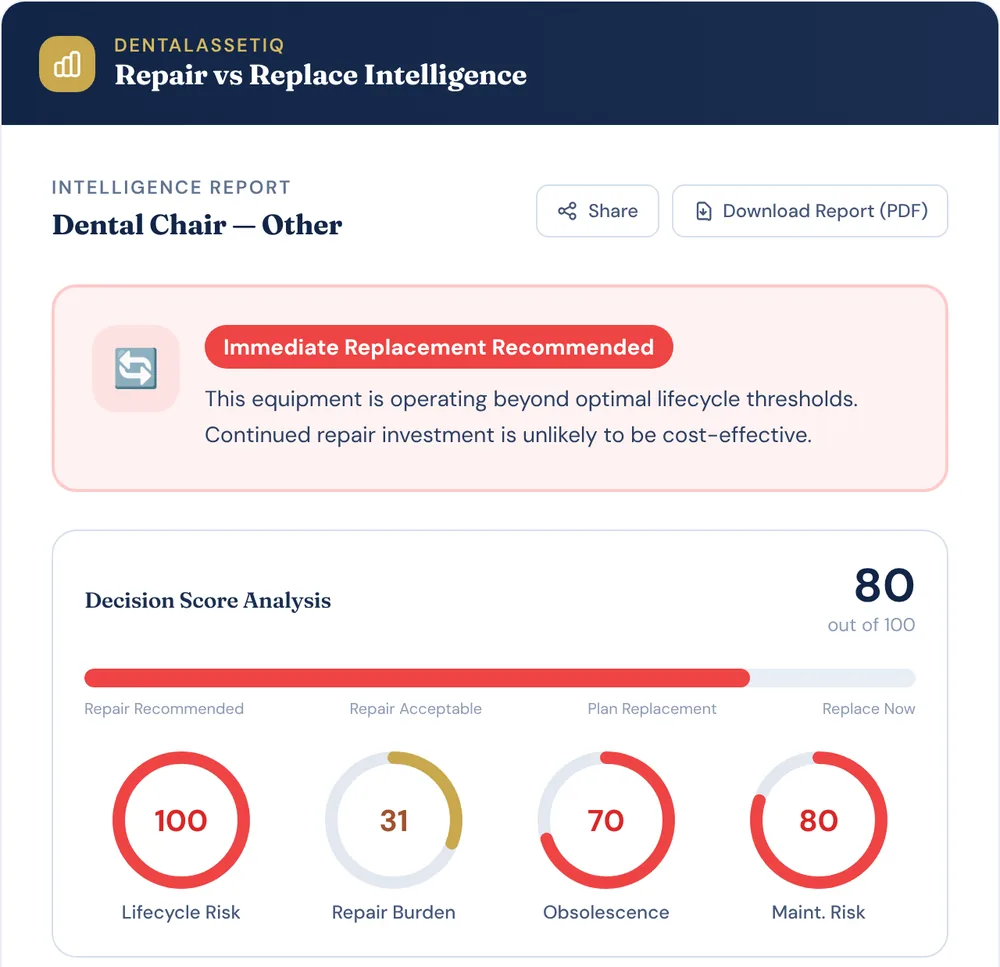
One number from 0 to 100, four plain-English verdicts, and the inputs behind it.
Repair and downtime spending against the annualized cost of a new unit, plus a PDF report.
Four short steps. About three minutes.
Pick the equipment, describe its condition, add the financial picture, then the maintenance history.
Short on screen space? Open the calculator full screen. The calculator runs on DentalAssetIQ, our equipment platform. If the verdict is replace, the results page suggests an upgrade path and offers a quote request. Treat that as a starting point for comparing two or three distributors.
“The Repair or Replace Calculator gave me a second set of numbers to look at alongside the service tech’s quote.”
Four verdicts, from fix it to replace it now.
Repair recommended
Repair economics are still favorable. The equipment sits inside acceptable age and cost limits.
Repair acceptable, monitor closely
Repair still works, though rising costs say to plan for replacement within 12 to 24 months.
Plan replacement in 12 to 24 months
The equipment is nearing the end of its cost-effective life. Start pricing replacements.
Immediate replacement recommended
Continued repair spending is unlikely to pay back. Replace it.
Six inputs, weighted.
Where it sits on its lifespan
Install year against the expected life for that category. The tool tells you the percentage of life already used.
The quote against the price of new
This carries the most weight in the score, and repeat failures in the last 24 months push it higher.
What a dead operatory costs
Your daily production, the days lost per failure and whether you have a backup room all feed a downtime cost.
Can anyone still fix it?
Discontinued or hard-to-find parts raise the obsolescence score, whatever the quote says.
Your PM history
Regular preventive maintenance and an active service contract improve the score. Skipped PM and no contract work against it.
Repair path against replace path
Cumulative repair and downtime cost, escalating each year, against the annualized cost of owning a new unit.
Looking at one piece of equipment?
Each guide gives the lifespan, the usual failures and the decision rule for that category, then points back to the calculator. The calculator also scores suction, the utility room and a general other category. Suction follows the vacuum guide, and the utility room follows the compressor and vacuum guides.
Operatory
Dental Chair
Hydraulic and electromechanical platforms age on different clocks.
Repair or replace? →OperatoryDelivery Unit
Hoses and valves decide the timeline after year 10.
Repair or replace? →OperatoryOperatory Light
Halogen lights are a bulb habit. LED lights are a decade-plus fixture.
Repair or replace? →OperatoryHandpiece
Repair first. How often it comes back tells you when to stop.
Repair or replace? →OperatoryCabinetry
Cabinets rarely fail. Water, delamination and a layout you outgrew are what end them.
Repair or replace? →Utility room
Sterilization
Imaging
Panoramic X-Ray
When the detector goes on an older pan, the repair usually outruns the machine's value.
Repair or replace? →ImagingCBCT / Cone Beam
Software goes obsolete before hardware does.
Repair or replace? →ImagingDigital X-Ray Sensor
The cord usually fails before the sensor does.
Repair or replace? →ImagingIntraoral X-Ray Unit
The tubehead and the arm decide the repair, and age on the data plate decides the rest.
Repair or replace? →ImagingIntraoral Scanner
Support ends before the optics wear out.
Repair or replace? →ImagingCAD/CAM System
The mill wears with use. The software decides when it is obsolete.
Repair or replace? →The benchmarks and the framework.
Repair vs. Replace: The Dental Equipment Decision Framework
The 50 percent rule, the fair market value test and category-specific decision rules.
Read it →BenchmarksHow Long Does Dental Equipment Actually Last?
Lifespan benchmarks by category and the three factors that shorten them.
Read it →ValuesDental Equipment Fair Market Value
What fair market value means, how it differs from book and liquidation value, and planning ranges by age.
Read it →SellingWhat a Buyer Pays For When Your Equipment Is on the Table
How equipment age and condition show up in a practice sale.
Read it →Questions people ask
How do I decide whether to repair or replace dental equipment?
Start with the 50 percent rule: if the repair costs more than half of what a comparable new unit costs, replace it. Older equipment faces a stricter second test, because its fair market value sits well below replacement cost. If the repair is over 40 percent of fair market value, replace. If it is under 20 percent of fair market value and the equipment has real life left, repair. The 50 percent rule is a general equipment rule of thumb, not a dental standard, and the fair market value tests are DSI planning rules.
How long does dental equipment last?
Hydraulic chairs run 15 to 20 years and electromechanical chairs 7 to 12. Delivery units run 12 to 18. Compressors run 7 to 15, vacuum systems 8 to 15 depending on type, sterilizers 7 to 15, digital sensors 7 to 10, CBCT units 10 to 15, and panoramic units 12 to 18. Cabinetry is rated up to 20 years by at least one manufacturer, intraoral x-ray units run about 10 to 15, and intraoral scanners about 5 to 8. These ranges assume reasonable preventive maintenance. The calculator uses a single average per category, which tends to be more conservative.
What does the Repair or Replace Calculator score?
It combines equipment age, the repair quote against replacement cost, how many repairs you have had in 24 months, the downtime cost, parts availability and your maintenance history into one score from 0 to 100. The score maps to four verdicts, from repair recommended to immediate replacement.
Which equipment does it cover?
Seventeen categories: dental chair, delivery unit, operatory light, cabinetry, compressor, vacuum system, utility room, CBCT, intraoral x-ray, digital sensor, panoramic, CAD/CAM, intraoral scanner, sterilizer, suction system, handpiece system and a general other category. The calculator scores all seventeen. Fourteen have a full guide on this site: chair, delivery unit, light, cabinetry, handpiece, compressor, vacuum system, sterilizer, panoramic x-ray, intraoral x-ray, CBCT, digital sensor, intraoral scanner and CAD/CAM. Suction systems follow the vacuum system guide, and utility room questions are covered by the compressor and vacuum guides. The general other category has no guide because it has no single answer.
Is it free, and do I need to log in?
It is free and needs no login. The results page includes an optional form for requesting a replacement quote. You can ignore it and still keep your score, the cost comparison and the PDF report.
Does a failed spore test change the answer for a sterilizer?
Yes, and the calculator will not catch it for you. A recurring failed spore test is a patient safety problem and overrides the cost math. Treat the score as the financial half of the decision and your spore test log as the safety half.
What if the manufacturer no longer makes parts?
Mark parts availability as difficult or discontinued. Both raise the obsolescence score and flag the equipment, because a cheap quote for a part you cannot get is not a quote.
Does this replace my service technician's opinion?
No. It gives you a defensible number to hold up next to the tech's recommendation. It cannot see the equipment, so a hands-on diagnosis still matters, and so does the advice of your accountant for tax questions.
Can DSOs use it across a fleet?
Yes. Run each piece of equipment on the same inputs and you get comparable scores for every location, which is the start of a replacement forecast for the next 12 to 36 months.
Get equipment and capital-planning updates
A short note when lifespan data, pricing or replacement economics move.