
How Long Does Dental Equipment Actually Last? Lifespan Benchmarks by Category
May 25, 2026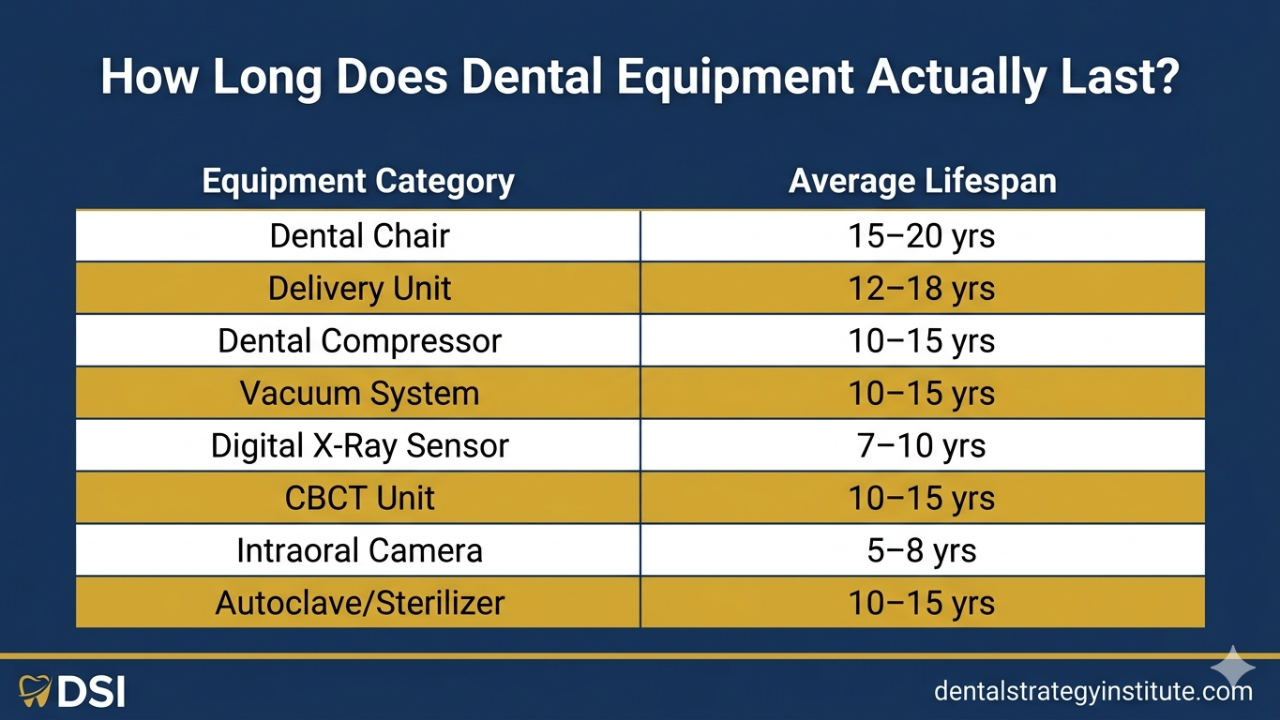
There's a piece of equipment in almost every dental practice that's older than it should be. Sometimes it's the compressor, running warm and loud in the utility room. Sometimes it's a delivery unit that the rep keeps telling you is "totally fine" even though the chair-side assistant is holding the handpiece adapter together with a prayer. Sometimes it's a sensor that the team has quietly stopped using on the left side because the image quality went soft two years ago.
Nobody replaced it because nobody could point to a number and say: this is past its service life. That number should exist. For most practices, it doesn't.
That's the gap this post fills. After twenty-five years in and around dental equipment — manufacturing, specification, DSO fleet management, and now equipment valuation through DentalAssetIQ — these are the lifespan benchmarks that matter.
The Benchmark Table
| Equipment Category | Average Lifespan | Notes |
|---|---|---|
| Dental Chair (hydraulic) | 15–20 years | With PM; hydraulic seals typically fail 12–15 yrs |
| Dental Chair (electromechanical) | 7–12 years | Shorter effective service life than hydraulic platforms |
| Delivery Unit | 12–18 years | Hose and valve failure accelerates after year 10 |
| Dental Compressor | 7–15 years | Oil-free units typically run 7–10 years; oil-lubricated run longer |
| Vacuum System (wet-ring) | 8–12 years | Major service typically starts around year 8; separator maintenance critical, mineral buildup and impeller wear are the limiting factors |
| Vacuum System (dry) | 10–15 years | Higher initial cost; lower maintenance demand; major component failure typically around years 10–12 |
| Digital X-Ray Sensor | 7–10 years | Sensor cord is usually the failure point, not the sensor |
| CBCT Unit | 10–15 years | Software obsolescence often triggers replacement before hardware failure |
| Panoramic X-Ray | 12–18 years | Digital conversion often done mid-life |
| Intraoral Camera | 5–8 years | Image quality degrades before outright failure |
| Autoclave/Sterilizer | 7–15 years | Tabletop units typically 7–10 years; larger chamber and cassette units 10–15; chamber integrity is the limiting factor |
| Ultrasonic Scaler | 8–12 years | Tip wear ongoing; unit itself runs long |
| Curing Light | 5–8 years | Battery-dependent units fail faster |
| Dental Cabinetry | 20–30 years | Surface wear and hardware before structural failure |
These ranges assume reasonable preventive maintenance. Practices that skip annual PM service compress these numbers. Practices in high-humidity environments or with hard water tend to see compressor and vacuum failures on the early end of the range. DSO groups with standardized PM protocols consistently get the longer end.
Why the Numbers Matter More Than You Think
The lifespan number by itself isn't the point. The point is what the number tells you about when to start planning — not when to start panicking.
A dental chair at year twelve isn't broken. But a practice owner who doesn't have a replacement budget line in their three-year capital plan for that chair is going to face a cash-flow event they didn't plan for. At $8,000 to $18,000 per operatory chair depending on manufacturer and configuration, an unplanned replacement is a different financial experience than a planned one.
For DSO groups, this problem multiplies by location count. A group with forty locations and an average of five chairs per location has two hundred chairs in service. If the average age across that fleet is twelve years, there are chairs in that fleet that are going to start failing — and the CFO probably doesn't know which ones or when.
That's the fleet intelligence problem. Most groups are managing it reactively, with service calls as the data source. The smart ones are moving to proactive lifecycle modeling — using age, service history, and failure patterns to forecast replacement demand twelve to thirty-six months out.
The Three Factors That Compress Lifespan
Deferred maintenance is the biggest one. A compressor that misses two consecutive annual PM services will fail earlier than the benchmark suggests. The PM isn't just about cleaning filters — it's about catching early indicators of wear before they become failure events.
Environmental conditions matter more than most manufacturers will tell you. Hard water destroys vacuum systems. High-humidity utility rooms accelerate compressor wear. Practices in coastal markets tend to see corrosion-related failures earlier than inland equivalents.
Usage volume is the third variable. A single-doctor practice running twenty-five patients per day puts different stress on equipment than a four-doctor practice running ninety. The benchmarks above reflect average-load practices. High-volume environments should shave two to three years off the expected lifespan.
The Replacement Decision Framework
When equipment approaches the end of its expected lifespan, the question isn't just "is it broken" — it's "what does keeping it cost versus replacing it now?" That's a repair-versus-replace analysis, which we cover in depth in Repair vs. Replace: The Dental Equipment Decision Framework. But the first step is knowing where your equipment sits on its lifecycle curve.
The DSI catalog includes the Dental Office Appraisal Tool for practice-level equipment valuation, and DentalAssetIQ provides AI-powered fair market valuation and lifecycle tracking for individual equipment items and full practice fleets. Both tools start with the same foundation: knowing what you own, how old it is, and where it sits on its expected service life.
FAQ
How long do dental chairs last? Most hydraulic dental chairs have a service life of 15–20 years with proper preventive maintenance. Hydraulic systems typically show wear between years 12 and 15. High-quality chairs from manufacturers like A-dec, Midmark, and Belmont commonly reach 20 years in well-maintained environments. Electromechanical chairs generally have a shorter effective service life, in the range of 7–12 years.
When should a dental compressor be replaced? Dental compressors generally last 7–15 years, and oil-free units, the most common type, typically run 7–10 years. Key replacement indicators include rising operating temperature, increased noise, declining pressure recovery time, and moisture in the air lines — all of which can appear before outright failure.
How long do digital X-ray sensors last? Digital intraoral sensors generally last 7–10 years. The cord and connector are typically the failure point rather than the sensor itself. Image quality degradation — softness, artifacts, or inconsistent contrast — usually signals end of service life before the sensor stops working entirely.
What is the lifespan of a dental autoclave? Tabletop dental autoclaves typically last 7–10 years, while larger chamber and cassette sterilizers can run 10–15 years. Chamber gasket integrity and heating element condition are the primary lifecycle factors. Spore testing failure and inconsistent cycle completion are the key warning indicators.
How does equipment age affect dental practice value? Equipment age is a direct factor in dental practice appraisal. Older equipment reduces the fair market value of a practice and can increase buyer risk discounts in DSO acquisition scenarios. Practices with equipment at or past average service life typically receive lower valuations unless replacement capital is explicitly negotiated in the transaction. See DentalAssetIQ for equipment-specific valuation data.
Stay connected with news, offers and updates!
Join our mailing list to receive the latest news, offers and updates from our team.
Don't worry, your information will not be shared.
We hate SPAM. We will never sell your information, for any reason.