Beyond the Bench
The operational blueprint for building a dental lab that runs without you.
- Decide on purpose which lab archetype you are and who you are built to serve
- Tier your accounts and audit your client mix against that choice
- Cut incomplete cases with a prescription system and a universal digital intake
What this book is about
Mark had been running his lab for nineteen years. His porcelain was the kind that made dentists call other dentists. He was also losing three to five accounts a year to cheaper offshore labs and a digital shop that had opened four years earlier. His answer, like most lab owners', was to drop prices on routine cases. He didn't want to. The book opens with what Mark finally saw: he'd entered a price competition he had no structural way to win.
Beyond the Bench follows that thread through twenty chapters in six parts. It starts with identity and positioning, because a lab that serves everyone optimizes for nothing. Then it builds a clean intake system to cut what the book calls the communication tax. Then a digital infrastructure, and a people and knowledge system that doesn't depend on your one hero technician. It finishes with pricing, remakes and cash flow, and the road to DSO readiness and a sellable business.
Every chapter opens with what you'll find in it and closes with working tools. Appendices A through K give you the self-assessments, worksheets and templates to start the work the same week you read about it.
Written for the reader in your chair.
- Dental lab owners who are the bottleneck in their own business
- Production managers and lab leaders building the systems that let the owner step back
- Labs preparing for DSO accounts, or for a sale someday
Fair warning. The book is about running the business side of a lab. It doesn't teach bench technique, and it doesn't replace legal, tax or financial advice.
After you've read it, you can:
- Decide on purpose which lab archetype you are and who you are built to serve
- Tier your accounts and audit your client mix against that choice
- Cut incomplete cases with a prescription system and a universal digital intake
- Build the knowledge-transfer system and training ladder that frees you from the hero tech trap
- Price for margin, treat every remake as a diagnostic, and manage cash flow before it manages you
- Assess whether your lab is ready for DSO partnership, and what makes a lab worth buying
Straight from the pages.
Most dental labs answered that question by accident. A founding technician opened a shop, took every account that called, built relationships through sheer quality and reliability, and watched a business grow around the natural gravity of good work. That is a beautiful origin story. It is also, over time, a strategic liability.
He was trying to be everything. And in trying to be everything, he was becoming nothing distinct.
There is no single correct answer to the question of what kind of lab yours should be. But there are three coherent archetypes, each with a distinct operating model, client base, and competitive advantage.
The full table of contents
Part I: Identity and Positioning
Who you are and who you serve.
- 1The Commodity TrapWhy competing on price is a race you cannot win, and the framework that gets you out of it.
- 2Client ArchitectureA framework for knowing which accounts deserve your best work.
- 3The Lab BrandEvery phone call, shipment and email already carries a brand. Make it deliberate.
Part II: The Clean Intake System
Eliminating the communication tax.
- 4The Communication TaxNaming the problem that is costing your lab hours every day.
- 5The Prescription ArchitectureDesigning a prescription system that makes incomplete cases the exception.
- 6The Universal Digital IntakeReplacing a tangle of portals and logins with one intake.
- 7Client Onboarding as a SystemThe first thirty days of a new client relationship shape the next ten years.
Part III: Digital Infrastructure
Building the hybrid lab.
- 8Technology Strategy Before TechnologyDeciding what to buy before you spend a dollar.
- 9The Hybrid Workflow DesignBlending digital and traditional work deliberately.
- 10Lab Management Software as Your Operating SystemMaking your software the backbone of the lab.
Part IV: People and Knowledge Architecture
The anti-hero tech system.
- 11The Hero Tech TrapWhy your best technician can be your greatest asset and your most serious dependency.
- 12The Knowledge Transfer SystemA practical system for moving know-how out of one head and into the lab.
- 13Hiring, Training, and Retaining in a Talent ShortageBuilding a training ladder people stay on.
- 14The Org Chart That ScalesThe structure that works at ten people breaks at twenty-five.
Part V: Financial Operating Systems
From revenue to profit.
- 15Pricing ArchitectureMost dental labs are underpriced, and usually not on purpose.
- 16The Remake ProblemEvery remake is a financial event, a data point and a diagnostic.
- 17Cash Flow ArchitectureA profitable lab can still run out of cash.
Part VI: Growth, Scale and Exit
Becoming DSO-ready or market-ready.
- 18The DSO OpportunityFor labs that are operationally ready, DSOs are a major opportunity.
- 19Growing Without BreakingSustainable growth, and how to tell the difference.
- 20The Sellable LabYou may never sell. Build as if you will.
Appendices and tools
- ALab archetype self-assessment
- BClient tier matrix worksheet
- CLab brand audit checklist
- DCommunication tax calculator
- EPrescription completeness checklist
- FDigital intake SOP template
- GHero tech dependency risk assessment
- HSOP template library
- ILab training ladder framework
- JCost-per-case calculator
- KDSO partnership readiness assessment
- Edition
- First Edition
- Structure
- 20 chapters in 6 parts
- Tools
- 11 appendices of assessments, worksheets and templates
- Clinical review
- Susan Volk, RDH
- Format
- Digital PDF
- Author
- Pete Volk, CEAS
“Beyond the Bench put its finger on a problem I’d been avoiding. Too many decisions still had to go through me.”
Questions people ask first.
Is this for large labs or small ones?
The framework starts with the owner who is the bottleneck, which describes many small and mid-sized labs. The later parts cover org structure, scaling and DSO partnership.
Does it teach technique?
No. It's about the business around the bench: positioning, intake, systems, people, pricing, cash and growth.
Is there a companion?
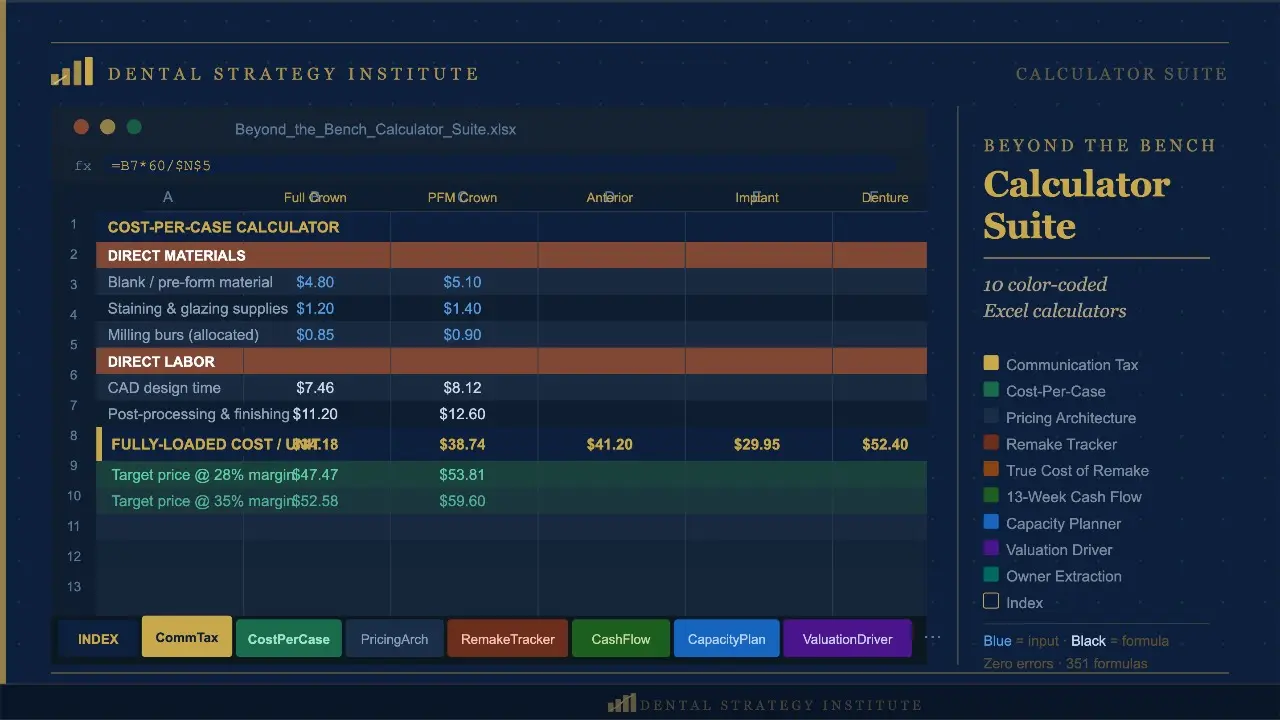
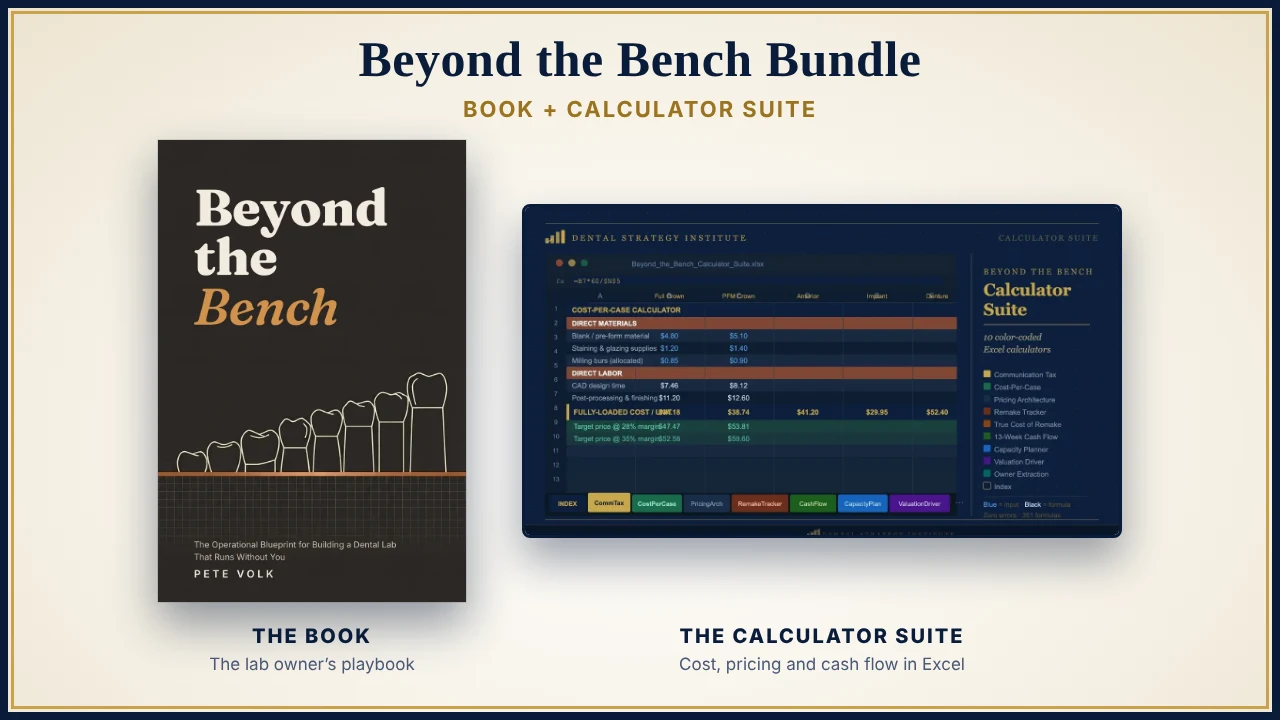
Yes. The Beyond the Bench Calculators cover lab pricing, capacity and owner-independence math, and the Beyond the Bench Bundle pairs the book with them.
How do I get it?
After you pay, a download link lands in your inbox. Keep the email and you can come back to it any time.
What if it isn't right for me?
Email me within 15 days of buying and I'll refund you. Read it, use the tools, and decide. No forms, no argument.
Is this a subscription?
No. It's a one-time price. You won't be billed again.
Who wrote it?
Pete Volk, CEAS, a 25+ year veteran of dental equipment and practice design who has also worked on DSO strategy and practice valuation.
I have a question before I buy.
Send it through the contact page and I'll answer it myself.
$47