RDHAP Explained: California's Alternative Practice Hygienist, From Requirements to Pay
Picture a patient who hasn't left her care facility in months. Her gums are bleeding, and the nearest appointment might as well be on the moon. In California, a hygienist with the right license can go to her.
That license is the Registered Dental Hygienist in Alternative Practice, or RDHAP. It's a California credential, so hygienists elsewhere should start with the scope of practice by state pages.
What it takes to qualify
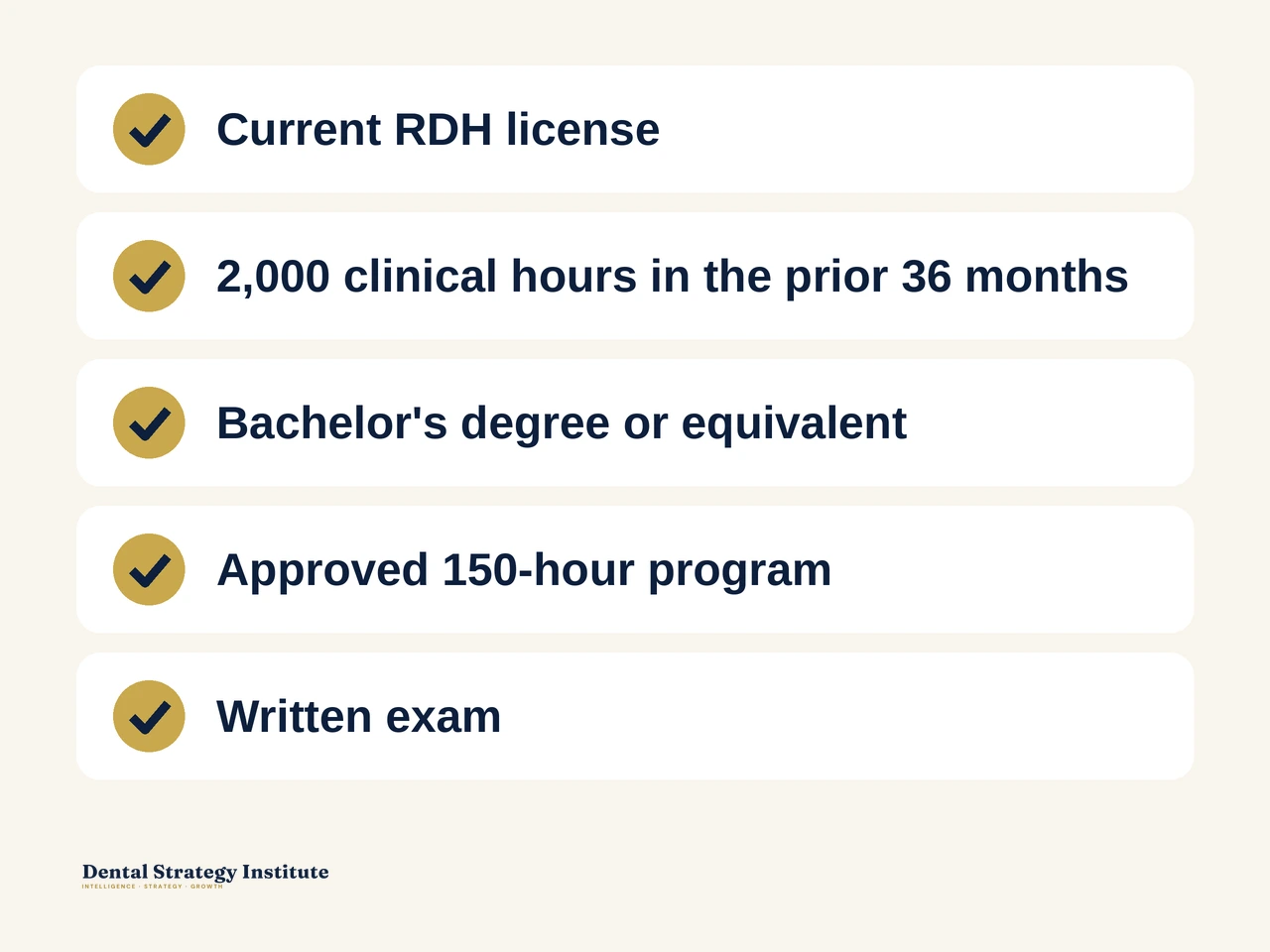
The Dental Hygiene Board of California lists a current RDH license, at least 2,000 hours of clinical practice in the 36 months before you apply (in California or another state), a bachelor's degree or its equivalent, an approved 150-hour program, and a written exam.
Programs include West Los Angeles College and University of the Pacific's online course. Check current cost and start dates with each school, because those move.
Where you can work
State law names the settings, including homes of homebound patients, schools, residential facilities and other institutions, certain dental health professional shortage areas, and dental offices. Duties and supervision differ by procedure and setting, so read the code sections that apply to yours.
The prescription rule trips people up
Timing matters here. According to the board's instructions, once you've been treating a patient for 18 months or more from the first service date, you need written verification that a California-licensed dentist or physician examined that person, including a prescription for hygiene services. A prescription can't stay valid longer than two years. Build a tracking system on day one. Your future self will thank you.
So what does an RDHAP earn?
I wish I could hand you one clean statewide average. I haven't found a current one I'd trust. What I did find are real pay figures from specific employers, and they run from about $38 to $80 an hour.
The Kern County Superintendent of Schools salary schedule for 2025-26 puts its RDHAP position at $38.35 to $48.78 an hour. At the other end, a part-time listing from an RDHAP practice in Stanislaus County showed $70 to $80 in 2026. Job ads disappear, so treat that one as a snapshot. Two employers can't tell you what the license is worth everywhere, and neither proves it earns a premium.
Owning the practice is a different animal. A Journal of Dental Hygiene study, built on an October 2014 survey, found that 13 full-time RDHAPs reporting gross practice income averaged $108,308. Average full-time net was $91,900, with answers running from zero to $180,000. (Yes, zero.) The gross and net questions may have drawn different people, so don't divide one by the other and call it a margin. Those numbers are old and self-reported, and I wouldn't call them a 2026 salary.
For scale, the Bureau of Labor Statistics lists a $98,100 median annual wage for dental hygienists overall as of May 2025. That figure covers the whole occupation and says nothing specific about RDHAPs.
Try your own numbers. Suppose you collect $150 per visit, see 20 patients a week and work 46 weeks. That's $138,000 collected. Every one of those inputs is made up for illustration. Out of that total come supplies, mileage, insurance, billing help, equipment, unpaid drive time and taxes. What happens if half your visits are Medicaid? Run that version too.
Before you spend a dime
Call three facilities in your area and ask who handles their residents' hygiene now. Their answers tell you more than any course brochure. Then read the business basics of independent hygiene practice, and see On Your Own: The Independent Hygienist if you want the longer path laid out.
Educational content only. Confirm current law with the Dental Hygiene Board of California.