
Starting an Independent Hygiene Practice: The Business Basics Nobody Teaches You in School
Jul 19, 2026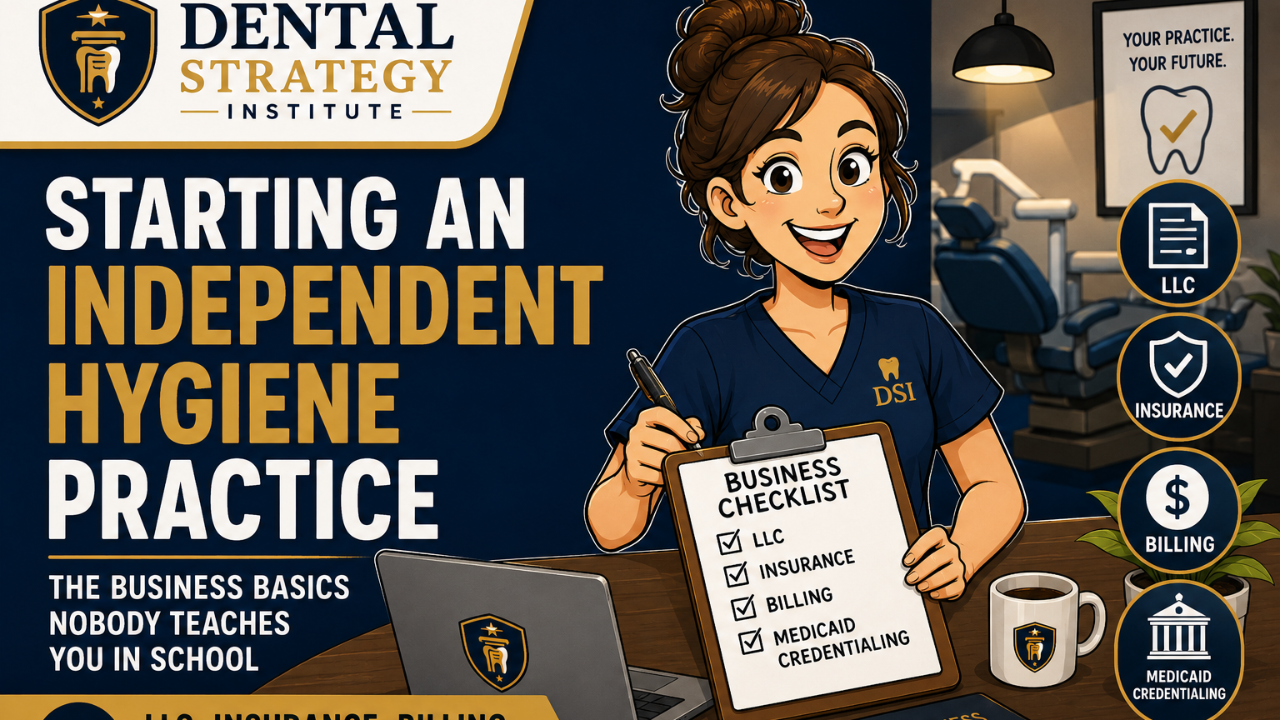
By Pete Volk, founder of Dental Strategy Institute, with clinical review by Susan Volk, RDH.
You can scale a perfect root, read a full-mouth series, and catch early perio a dentist would've missed. And you have no idea how to form an LLC. That gap isn't a failing on your part — nobody taught you the business half, because the schooling was never built to. It's the one thing standing between a lot of talented hygienists and their own practice, and it's learnable in an afternoon.
What does it take to start an independent hygiene practice? Four things, roughly in order: a legal entity (usually an LLC), your own professional liability insurance that covers unsupervised practice, insurance or Medicaid billing credentials under your own NPI, and basic clinical infrastructure like sterilization and documentation. A lean mobile or space-sharing model can launch for $10,000–$25,000; a standalone leased space costs considerably more.
Read what follows as the moment you stop being only a clinician and start being an owner. None of it is beyond you. It's a checklist, done in order, and by the end of it the "I don't know how to run a business" story you've been telling yourself just isn't true anymore.
Before any of this matters, though, confirm your state actually permits it. Only four jurisdictions — Colorado, Maine, New Mexico and California — clearly contemplate a hygienist owning the practice, and another thirty-nine allow direct access under a permit or collaborative agreement, which is a different animal entirely. Check your state in the scope of practice lookup, then read what the categories actually mean. Thirty seconds now saves three months of planning around a model your board won't allow.
Pick Your Legal Structure Before You Do Anything Else
For most solo independent hygiene practices, an LLC is the standard choice, and for good reason — it separates your personal assets from business liability without the tax complexity of an S-corp, at least at first. Some hygienists later convert to an S-corp election once income justifies the added paperwork (a conversation for your accountant, not this post). What matters right now is doing this step before you sign a lease, buy equipment, or take your first patient — not after, when a client relationship or an equipment lease is already sitting in your personal name.
Registering the LLC itself is usually a same-week process through your state's Secretary of State website and costs somewhere in the neighborhood of $50 to $300 depending on the state. The part people skip is the operating agreement — even as a single-member LLC, having one in writing matters if you ever bring on a partner, apply for a loan, or need to prove the business is genuinely separate from you personally in a legal dispute.
Insurance: You Need More Than Your Old Employer Policy Covered
As an employee, your practice's malpractice policy covered you. As an independent hygienist, you need your own professional liability policy — and you need to confirm it actually covers independent, unsupervised practice, because some policies marketed to hygienists are written assuming a supervising dentist relationship and quietly exclude the exact scenario you're building. Worth noting that a good number of states make liability coverage a condition of the permit itself — Alaska, Arkansas, Indiana, Kansas, Montana, Nebraska, Oregon, Pennsylvania, South Carolina, Virginia and Wyoming among them. On top of professional liability, budget for general liability if you're seeing patients in a physical space you lease or own, and workers' comp the moment you hire even a single part-time assistant.
Billing Is Where Most New Independent Practices Actually Struggle
This is the facet almost nobody warns you about clearly enough. Getting credentialed with insurance plans as an independent hygienist — separate from a dentist's group NPI — is a slower and more state-dependent process than most people expect. Medicaid credentialing is often faster and more hygienist-friendly than commercial insurance, which is why many successful independent hygiene practices build their initial patient base around Medicaid-eligible and underserved populations rather than trying to compete for commercial-insurance patients from the outset.
If cash-pay or membership-model billing is part of your plan instead — which a growing number of independent hygienists are choosing specifically to sidestep the insurance credentialing maze — you'll want a clear, simple fee schedule and a payment collection system in place before your first patient walks in, not built reactively after the first awkward "so, how do I pay you?" conversation.
Equipment and Space: Smaller Than You Think, But Not Free
You don't need a full operatory build-out to start. Mobile hygiene setups, portable equipment, and shared or sublet space arrangements with an existing practice are common ways independent hygienists get started without a six-figure buildout. What you can't skip regardless of setting: sterilization equipment that meets your state board's standards, proper waste disposal contracts (sharps, amalgam if applicable), and documentation software that's actually built for independent practice rather than repurposed from a dental office's practice management system.
Common Questions
How much does it cost to start an independent hygiene practice? Highly variable, but a lean mobile or space-sharing model can realistically launch in the $10,000–$25,000 range including insurance, licensing, portable equipment, and initial marketing. A standalone leased space with full equipment pushes that considerably higher.
Do I need a business plan to get started, or can I just start seeing patients? Legally, in most permissive states, you can start seeing patients relatively quickly once licensed and insured. Practically, skipping a real plan — even a simple one covering your target patient population, pricing, and first-year cash flow — is how a lot of promising independent practices run out of runway in month four.
How many clinical hours do I need before I can qualify? Depends entirely on the state, and the spread is enormous — Colorado and Wisconsin impose no requirement at all, Kansas asks 1,200 for its entry-level permit, Pennsylvania wants 3,600, and Alaska sits at 4,000. Several states also require those hours to fall inside a specific recent window, which catches people returning from a career break. Your state's number is here.
Should I hire an accountant before I launch? Yes, and earlier than you think. The entity structure, tax election, and bookkeeping system decisions you make in week one are much cheaper to get right upfront than to unwind after a year of mixed personal and business finances.
The full financial model and startup checklist — the whole owner's playbook — is the book we're building with Susan Volk, RDH. It's for the hygienist who's ready to stop being only a clinician. Curious whether the numbers work for you? See how independent practice income compares to traditional and temp work. Get on the list and we'll tell you the moment it's ready →
Stay connected with news, offers and updates!
Join our mailing list to receive the latest news, offers and updates from our team.
Don't worry, your information will not be shared.
We hate SPAM. We will never sell your information, for any reason.