
State-by-State: Where Independent Hygiene Practice Is Actually Legal in 2026
Jul 17, 2026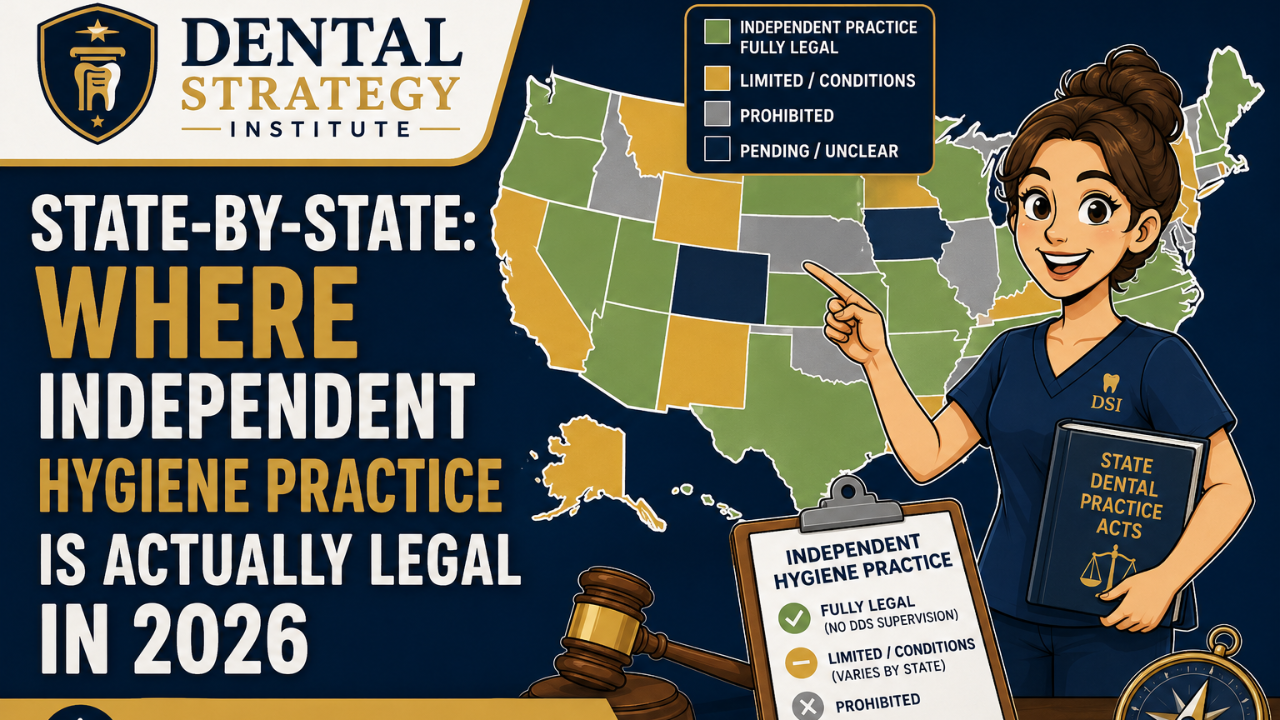
By Pete Volk, founder of Dental Strategy Institute, with clinical review by Susan Volk, RDH.
There's a particular frustration in learning that your career ceiling was set by a state legislature you never voted for. A hygienist in Colorado can build something a hygienist in another state legally can't — same training, same skill, same dream, different zip code. That's a maddening thing to discover. It's also a fixable one, once you know exactly where you stand.
Which states allow independent dental hygiene practice? A small group — including Colorado, Oregon, and Washington — allow something close to a standalone hygiene business with minimal dentist supervision. A larger group permits direct access but attaches conditions, and a meaningful minority still require dentist supervision for most services. Because states amend these laws often, always confirm against current statute text.
Read this as a map, not a verdict. Knowing which bucket your state falls into turns you from someone waiting to find out what's allowed into someone making a deliberate call — stay and work within the rules, push for the collaborative agreement, or seriously weigh a move. That's a position of control, and it starts with the next few paragraphs.
Want your own state's answer right now? The Dental Hygiene Scope of Practice by State lookup gives you four things in about five seconds — direct access status, the supervision your statute actually requires, whether ownership is on the table, and the clinical hours you'd need to qualify. All fifty states plus DC, each with its citation. Free, no email. Then come back here for what that answer actually means.
The Three Rough Categories
Instead of walking through all fifty states one by one — the lookup does that part for you — it's more useful to think in three buckets.
Bucket one: genuine independent practice states. A short list — Colorado, Oregon, Washington, and a few others — where you can, with the right licensing and setup, run something close to your own hygiene business without a dentist as a gatekeeper for most services. Colorado in particular has become something of a model other states study, partly because it's been in place long enough to show real outcomes rather than theoretical ones.
Bucket two: direct access, but with strings attached. This is the largest group. You can see patients without a dentist present, but there's usually a written collaborative agreement, a cap on how long you can practice before a dentist has to see the patient, or restrictions on which populations you can serve without that agreement (public health settings only, for instance, rather than a general private clientele).
Bucket three: supervision-heavy states. A meaningful minority still require a dentist to have examined the patient recently, or to be physically present or immediately available, for most hygiene services. Independent practice in the way we're discussing it isn't really on the table here without a much bigger structural workaround — like partnering with or employing a dentist yourself.
Why the ADHA's Map Isn't the Whole Story
The American Dental Hygienists' Association publishes a helpful annual comparison of state practice acts, and it's a legitimate starting point. But two things trip people up when they rely on it alone. First, it summarizes — and summaries lose the exceptions, the carve-outs for Medicaid populations, the differences between "direct access" and "unsupervised practice" that a state's own statute treats as legally distinct. Second, it's a snapshot, and several states have amended their practice acts in just the last two or three years. If you're building a business plan, read the current statute language yourself, or better, have someone who reads dental practice acts for a living confirm it for you. Our state-by-state lookup works from the February 2025 ADHA chart and keeps each state's statute citation attached, so you can go straight to the primary source rather than trusting anyone's summary — including ours.
The Detail Almost Nobody Checks: Insurance Credentialing
Here's the part that blindsides people. A state can legally allow you to evaluate and treat a patient with zero dentist involvement, and still make it functionally impossible to get paid for that visit through commercial dental insurance, because the insurer's credentialing rules require a supervising dentist's NPI on the claim regardless of what state law technically permits. Medicaid programs, interestingly, are often more hygienist-friendly on this specific point than commercial payers — which is a big part of why a lot of successful independent hygiene practices lean into underserved and Medicaid-eligible populations rather than trying to compete for standard commercial-insurance patients from day one.
What This Means If You're Thinking About Relocating
I've talked to more than one hygienist who was seriously weighing a move to a more permissive state specifically to build an independent career. That's not a crazy idea — but go in with eyes open about cost of living, existing hygiene practice density in that state (some of the permissive states have gotten genuinely competitive), and whether your specific service model — general hygiene, mobile care, geriatric, pediatric school programs — is actually the segment that state's law was built to enable. Worth comparing the hour requirements before you commit to a lease, too: they run from none at all in Colorado and Wisconsin to 4,000 documented hours in Alaska, and the lookup lists each one.
Common Questions
Which state has the most established independent hygiene practice model? Colorado is generally considered the furthest along, both in how long the law has been in place and in how many independent hygiene practices have actually launched and survived there.
Do direct access laws change often? More often than people expect — several states have amended their dental practice acts in the past few years, usually expanding hygienist scope somewhat. Direct access went from 28 states in 2008 to 43 today. Always verify against current statute text, not an article from two years ago (including, frankly, this one).
Can I practice across state lines if I'm licensed in a permissive state? No — hygiene licensure is state-specific, and there's no dental hygiene equivalent of a broad interstate compact yet in most places. You need to be licensed in the state where you're physically treating patients.
You've seen the map. The book we're building with Susan Volk, RDH is the turn-by-turn — state-by-state law, the business setup, and the financial model, in one place, for the hygienist who's ready to stop wondering and start planning. Once you've confirmed what your state allows, the next step is the business side of setting up an independent practice. Get on the list and we'll tell you the moment it's ready →
Stay connected with news, offers and updates!
Join our mailing list to receive the latest news, offers and updates from our team.
Don't worry, your information will not be shared.
We hate SPAM. We will never sell your information, for any reason.