
Can Dental Hygienists Practice Independently? What Direct Access Actually Means
Jul 15, 2026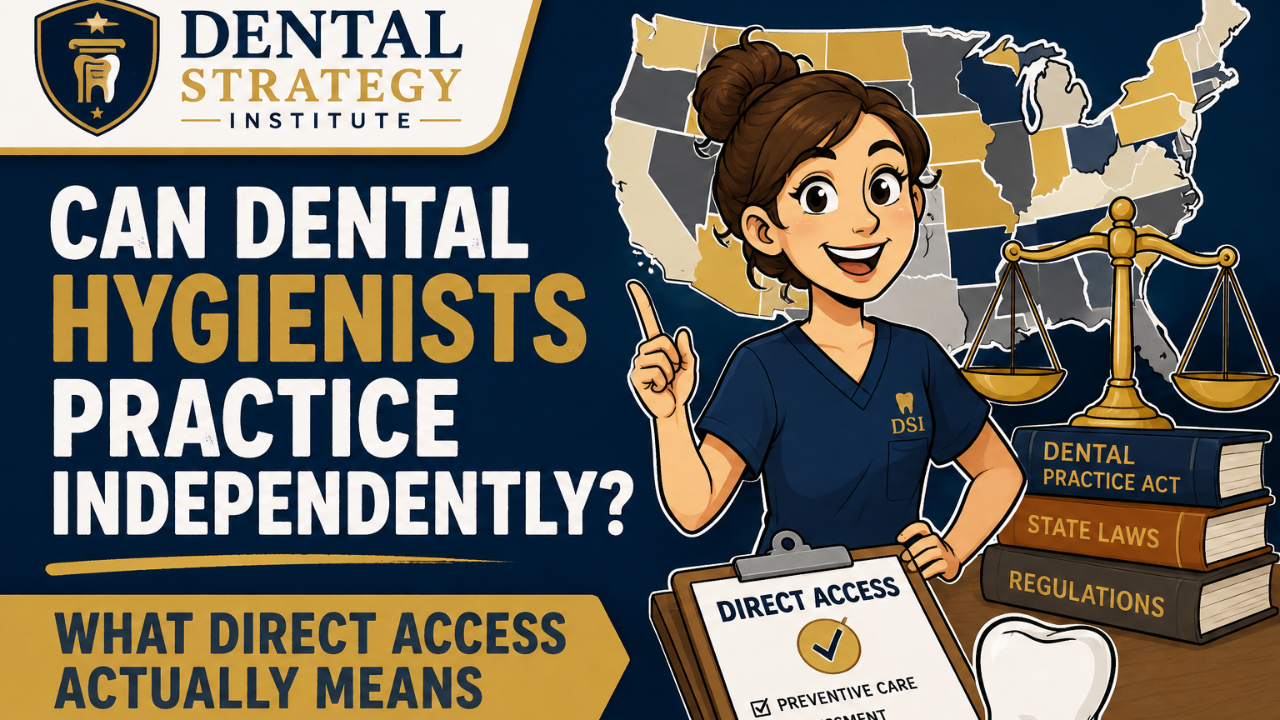
By Pete Volk, founder of Dental Strategy Institute, with clinical review by Susan Volk, RDH.
By year six, most hygienists have done a quiet kind of math. Not the paycheck math — the other kind. How many more years your neck and shoulders have in them. How many more identical Tuesdays sit between now and retirement. Whether "good hygienist" is the whole story you get to tell about your career.
Can a dental hygienist practice independently? In some states, yes — you can evaluate, treat, and bill patients without a supervising dentist on-site, under what's called a direct access law. Forty-three of the fifty-one U.S. jurisdictions recognize direct access in some form, though only a handful go far enough to let you own the practice itself. Whether it's realistic comes down to where you're licensed.
Want the answer for your state before you read another word? The Dental Hygiene Scope of Practice by State lookup gives you direct access status, the supervision your statute actually requires, whether ownership is permitted, and the clinical hours you'd need — with citations, for all fifty states plus DC. Free, no email.
Here's what I want you to notice before we get anywhere near statutes and credentialing. The hygienists who went independent started exactly where you are — good at the clinical work, worn down by the pace, unsure whether "on my own" was even allowed. On some ordinary week, one of them decided to find out. That's the whole leap. Everything after it is logistics, and logistics we can handle together.
What "Direct Access" Actually Means
Direct access is the legal term for a hygienist's ability to see, treat, and bill patients without a dentist physically examining them first or being on-site. It doesn't mean you're practicing dentistry — you're still bound by your scope of practice as an RDH. It means the leash gets longer. Some states let you evaluate a patient, clean their teeth, take X-rays, apply sealants and fluoride, and bill for it, all without a supervising dentist in the building. Other states still require a dentist's prior exam, a standing written order, or on-site supervision for nearly everything.
The American Dental Hygienists' Association tracks this state by state, and the honest truth is the map looks like a patchwork quilt sewn by fifty different tailors who never talked to each other. A handful of states — Colorado, Oregon, Washington, California with its RDHAP designation — have built genuinely workable independent practice pathways. A larger group allows direct access for preventive services but caps what you can bill insurance for without dentist involvement. And a meaningful chunk of the country still ties you tightly to a supervising dentist for almost everything beyond the basics.
Direct Access Isn't the Same as "Independent Practice"
Here's where people get tripped up, and I don't blame them — the terminology is genuinely confusing. Direct access means you can treat a patient without a dentist present. It doesn't automatically mean you can open your own business, hang a shingle, and build a client base the way a solo dentist would. Some states that allow direct access still require an affiliation agreement with a supervising dentist, or restrict what services you can independently bill. Others genuinely let you build a standalone hygiene practice — your own LLC, your own patients, your own P&L.
The gap between those two things is wider than most people expect. Forty-three jurisdictions recognize direct access. Four contemplate a hygienist actually owning the practice: Colorado, Maine, New Mexico and California. If you're picturing a full independent practice — think mobile hygiene, school-based sealant programs, senior care facility contracts, or a storefront hygiene clinic — check which category your state falls into before you build a business plan around it. I've seen hygienists get three months into planning before discovering their state requires a supervising dentist relationship that changes the entire economics of the venture.
Why This Matters More Right Now Than It Did Five Years Ago
A few things converged. The hygienist shortage gave a lot of RDHs leverage they didn't have before — and leverage tends to make people ask "what else could I be doing?" Teledentistry expanded what's practically possible for remote supervision arrangements. And a wave of states have quietly modernized their direct access statutes in the last few years, often without much fanfare outside dental policy circles. The count has climbed from 28 states in 2008 to 34 in 2011, 40 in 2017, and 43 now.
None of that means independent practice is easy money. It means the door is open in more places than it used to be, and it's worth knowing exactly how far it opens where you actually live.
What To Check Before You Get Excited
Three things, in this order. First, your state's direct access statute — not a summary of it, the actual regulation, since summaries go stale and states amend these more often than you'd think. Our lookup gives you the citation so you can go read the primary text. Second, whether your state requires a formal collaborative or supervisory agreement with a specific dentist, and what that agreement typically costs or requires in practice. Third, how insurance credentialing works for independent hygienists in your state — because in some places you can legally treat a patient but can't actually bill their dental plan without a dentist's NPI attached to the claim, which changes your entire revenue model.
Common Questions
Do I need a dentist's permission to see patients under direct access? Not in the way people assume — you don't need one physically present or reviewing each patient. But most states still require some form of documented relationship with a supervising or collaborating dentist, even under a direct access model.
Can I bill dental insurance as an independent hygienist? Sometimes, and it varies enormously by state and by the specific insurance plan. Medicaid billing rules for hygienists are often more permissive than commercial insurance rules, which is part of why a lot of independent hygiene practices focus on underserved and Medicaid populations first.
Is direct access the same in every state that allows it? No. Some states allow direct access only for public health settings — schools, nursing homes, community health centers — and not for a private storefront practice. Read the actual language, not the headline.
Where We're Headed With This
This is the first piece in a series on what it actually takes to build an independent hygiene career, not just whether the law technically allows it. Next up: the business side of starting an independent hygiene practice — the LLC, the insurance, the billing infrastructure nobody teaches in hygiene school. And if you want the fifty-state picture in one place, here's how the map breaks down.
This series is the map. The book we're building with Susan Volk, RDH is the full expedition — state-by-state law, business setup, and the financial model, in one place. It's for the hygienist who's done wondering whether she's allowed to want more and is ready to go build it. If that's the direction you're headed, get on the list and we'll tell you the moment it's ready →
Stay connected with news, offers and updates!
Join our mailing list to receive the latest news, offers and updates from our team.
Don't worry, your information will not be shared.
We hate SPAM. We will never sell your information, for any reason.