Dental Practice Loans: What Lenders Want to See Before They Say Yes
You found the practice. The seller seems decent, the hygiene schedule is full, and you've already pictured your name on the door. Then a banker asks for three years of tax returns and the mood changes.
Lenders care about one question above the rest: after this practice pays its bills, pays you, and pays the new loan, is there money left over?
The number that decides it
It's called debt service coverage. A 1.25 ratio means $1.25 of available cash for every $1 of loan payments. An ADA News column from June 2026 puts the usual floor at 1.25 on a global basis, which counts your personal debt too, student loans included. The same column mentions a cash reserve at closing of roughly $50,000 to $75,000 and calls both guidelines.
Here's the part people miss. Your own pay comes out first. A practice can look rich until somebody subtracts a dentist's salary.
A worked payment
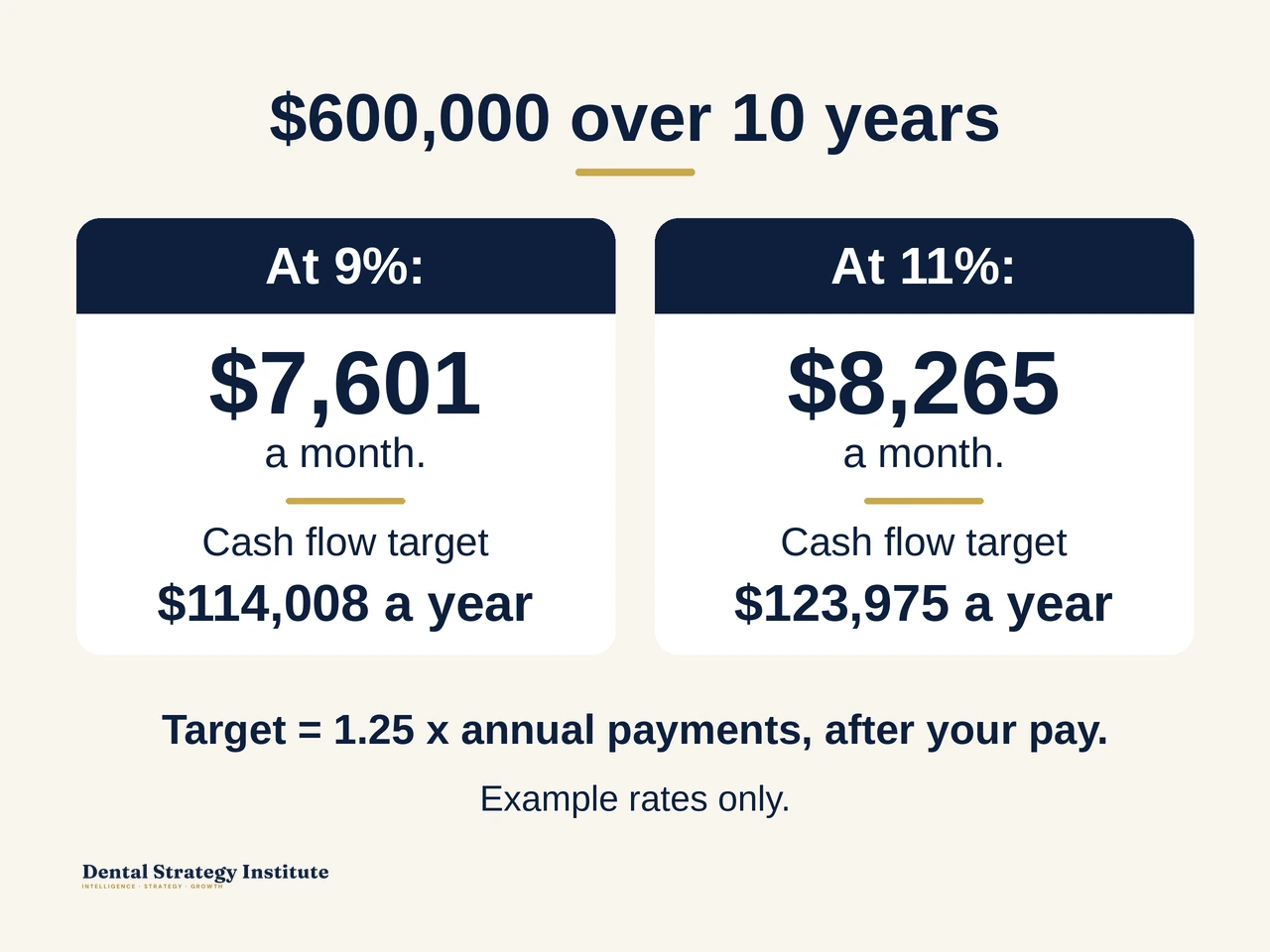
Say you borrow $600,000 over 10 years. At 9% the payment runs about $7,601 a month, or $91,207 a year. Coverage of 1.25 means roughly $114,008 of annual cash flow left after your pay. At 11% the payment climbs to about $8,265 and the target moves to around $123,975. Those rates are examples, so ask for a real quote. (Two points of interest. Real money.)
Conventional or SBA?
Dental-specific banks handle many acquisitions with their own conventional loans, and SBA loans and seller notes show up in some deals. Terms vary a lot, so get more than one offer.
SBA 7(a) rules tightened for applications received on or after October 1, 2026. A first-time acquisition now needs at least 1.25 coverage, and projections alone can't justify the deal. Plan on an equity injection of 10% of total project cost on a complete change of ownership. A seller note can cover up to half of it only if it sits on full standby for the life of the loan. Most deals also need an independent business valuation, with a narrow exception for some smaller loans.
What to have in the folder
Expect requests for three years of tax returns and P&Ls, current interim statements, production by provider, payer mix, your personal financial statement, and the lease. Check that lease early. A loan that runs 10 years and a lease that runs out in four make lenders twitchy.
Before you fall in love with a price, run it through the free Dental Practice Valuation Calculator. Then read what EBITDA means in a dental practice so the seller's add-backs don't sneak past you. Building from scratch instead? The math differs, and we cover it in how to finance a dental office build.
Educational content only. Rules and lender policies change, so confirm them with your lender and CPA.