
Dental Equipment Depreciation: What It Means, How to Calculate It, and Why It Matters in a Practice Sale
May 27, 2026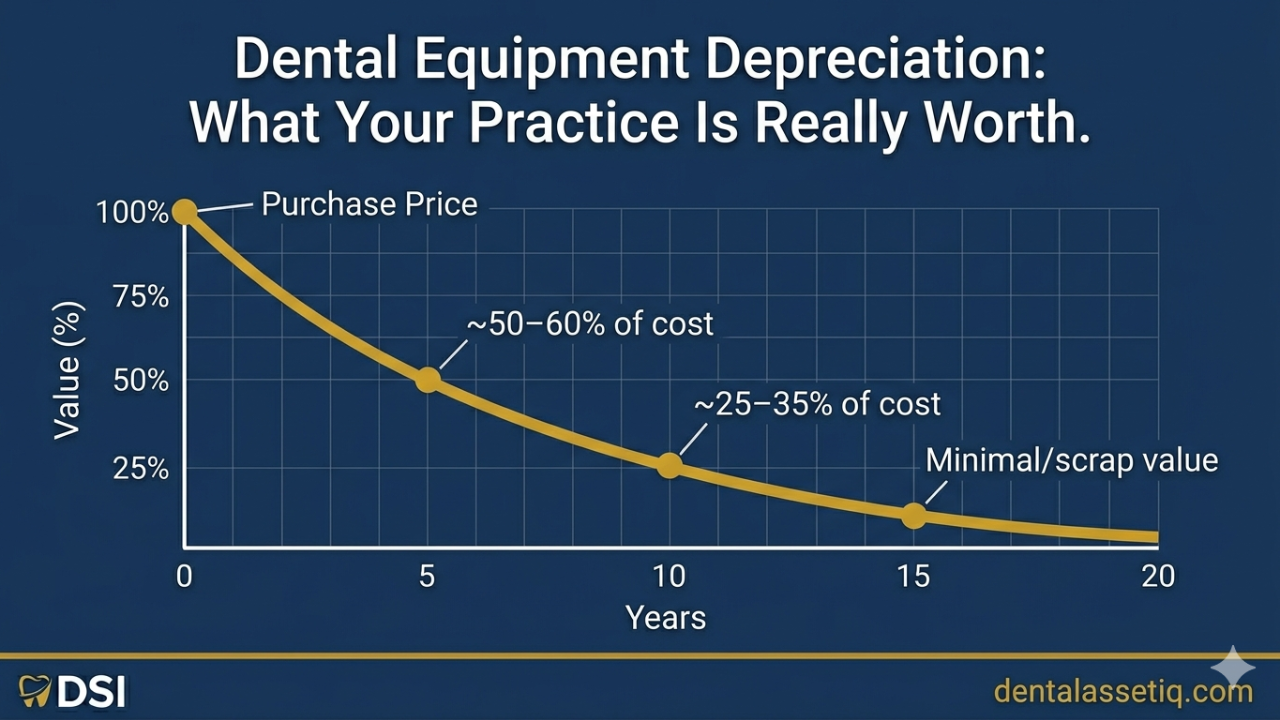
Walk into almost any dental practice transaction and you'll find the same blind spot. The seller has a number in mind — usually based on collections and EBITDA — and the equipment is essentially an afterthought. The buyer's due diligence team walks through the operatories, notes that the chairs are older, flags the compressor age, and quietly adjusts their offer.
The seller has no idea why the number came in lower than expected.
Equipment depreciation is a real, calculable factor in dental practice valuation. And most practice owners go into a sale having never thought about it with any precision.
How Depreciation Works in Dental Equipment
For tax purposes, dental equipment is typically depreciated over five to seven years under Modified Accelerated Cost Recovery System (MACRS) rules. Section 179 allows immediate expensing of the full purchase cost in year one, which is why most dental practice owners have fully depreciated equipment on their books long before it reaches end of service life.
The tax depreciation schedule and the real-world market value depreciation schedule are different things — and this is where the confusion starts.
Your accountant may show a dental chair as having zero book value — fully depreciated in year one via Section 179. But that chair, at year six, has real market value. A well-maintained A-dec 511 with a Continental delivery system that's six years old sells on the secondary market for $3,500 to $6,000. That's real asset value that the book says doesn't exist.
The reverse is also true: a twelve-year-old chair may have been kept on the books at some depreciated value, but its actual fair market value is near zero, and a buyer is going to treat it as a replacement liability, not an asset.
Dental Equipment Fair Market Value Depreciation: The Real Curve
|
Age Range |
Typical FMV as % of Original Cost |
|
0–2 years |
55–70% |
|
3–5 years |
35–55% |
|
6–9 years |
20–40% |
|
10–14 years |
10–25% |
|
15+ years |
0–10% |
These ranges vary by equipment category, manufacturer, condition, and market. CBCT units depreciate more slowly because of high replacement cost. Intraoral cameras and sensors depreciate faster. Brand matters — A-dec and Midmark chairs hold secondary market value better than budget-tier alternatives.
Why This Matters in a Practice Sale
In a dental practice appraisal, the fair market value of the equipment contributes to the total practice value — but the more important effect is on buyer risk perception.
A buyer looking at a practice where the average operatory chair is fourteen years old isn't just noting that the chairs are old. They're calculating a capital replacement liability: roughly $10,000 to $18,000 per operatory chair, multiplied by the number of operatories, as near-term capital expenditure after close. That liability gets factored into the offer price — either as a direct deduction or as a negotiated credit.
In a DSO acquisition scenario, the due diligence team will run equipment age as part of their asset assessment. Practices with newer equipment or documented replacement plans receive more favorable asset values. Practices with aged fleets may see purchase price adjustments that exceed the actual replacement cost — because the buyer is also pricing in the disruption of coordinating replacements post-close.
Depreciation vs. Condition: The Gap That's Often Missed
Depreciation is age-based. Condition is maintenance-based. They're related but not the same.
A well-maintained ten-year-old chair in full working order with documented service history is worth significantly more than a ten-year-old chair with deferred maintenance, worn upholstery, and a hydraulic system that runs slow. Both have the same depreciation profile on paper. Only one gets close to the higher end of the fair market value range.
This is why pre-sale equipment preparation matters — and why an independent equipment appraisal before you list your practice gives you a defensible basis for value rather than accepting the buyer's number unchallenged.
Section 179 and the Asset Basis Problem
If you've been aggressively using Section 179 to expense equipment in the year of purchase, your tax records may show zero or near-zero asset value for equipment that's actually worth something. That's fine for tax purposes. It's a problem if you're trying to establish asset value in a sale and you're relying on your balance sheet to do it.
The solution is a third-party equipment appraisal — an independent fair market value assessment that documents what your equipment is actually worth regardless of what the books say. DentalAssetIQ provides this for individual equipment items and full practice fleets, using current secondary market data and condition-adjusted valuations.
For DSO Groups: Fleet Depreciation as a Capital Planning Input
At the group level, fleet-wide depreciation tracking is a capital planning function. Knowing the weighted average age and depreciated value of equipment across all locations tells you two things: what your total asset base is worth, and what your replacement liability looks like over the next three to five years.
Groups that have this visibility can build it into their capital budgets proactively. Groups that don't are responding to failures one at a time — which is always more expensive.
FAQ
How is dental equipment depreciated for tax purposes? Dental equipment is typically depreciated over 5–7 years under MACRS. Section 179 allows full immediate expensing in the purchase year. Bonus depreciation provisions have varied year to year — consult your accountant for the current rules. Note that tax depreciation and fair market value depreciation are different calculations.
Does dental equipment depreciation affect practice sale price? Yes, materially. Buyers factor equipment age into both the asset value assessment and their estimate of post-close capital expenditure requirements. Older equipment fleets reduce practice valuations both directly (lower asset value) and indirectly (higher buyer risk discount applied to the purchase price).
What is the fair market value of used dental chairs? Fair market value for used dental chairs varies significantly by brand, age, and condition. A well-maintained A-dec or Midmark chair at 6–9 years typically sells for 20–40% of its original cost on the secondary market. At 10–14 years, that drops to 10–25%. Chairs at 15+ years have minimal resale value regardless of brand.
How do I get a dental equipment appraisal before selling my practice? An independent equipment appraisal documents fair market value for all major equipment items based on current secondary market data and condition assessment. DentalAssetIQ provides equipment-specific valuations that are defensible in practice sale negotiations. See dentalassetiq.com for details.
Stay connected with news, offers and updates!
Join our mailing list to receive the latest news, offers and updates from our team.
Don't worry, your information will not be shared.
We hate SPAM. We will never sell your information, for any reason.