
What Your Dentist's Fees Are Actually Telling You (And What They're Not)
Jul 20, 2026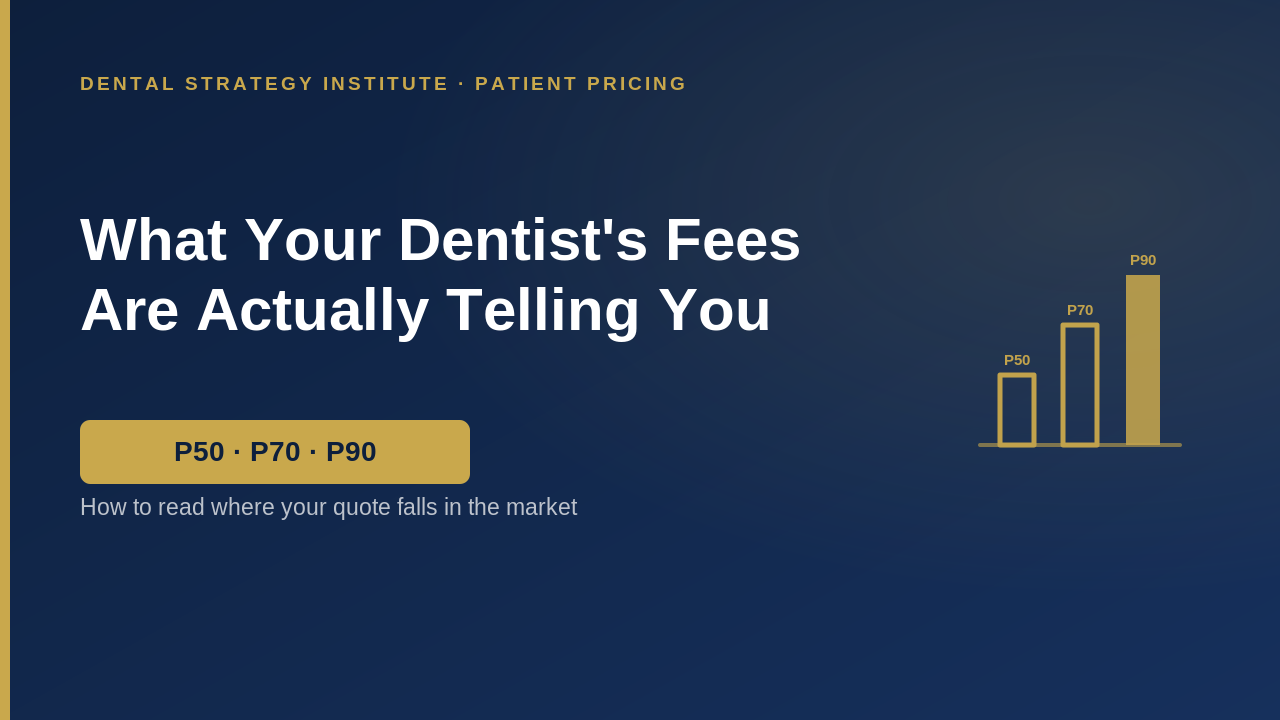
A dental quote is more than a number. It's a data point — and like all data points, it means more in context than in isolation.
After 25 years working inside the dental industry, I've watched the same scene play out thousands of times: a patient receives a treatment plan, experiences sticker shock, pays without question, and walks away either relieved or resentful — with no way to know which reaction was warranted.
That needs to change. Here's how to actually read what a dental fee is telling you.
Fees Are Set at the Practice Level — Not by Any Standard
There is no regulatory body that sets dental fees. The ADA publishes CDT codes — the standardized billing codes for every procedure — but the dollar amounts attached to those codes are entirely at the discretion of each practice.
What does influence pricing?
- Geographic cost of living. A crown in Manhattan costs more than a crown in Columbus, Ohio. Rent, staff wages, and overhead are simply higher.
- Practice overhead and equipment investment. A practice with a CBCT scanner, same-day crown milling, and a full team of hygienists has higher fixed costs than a two-chair office with a part-time hygienist.
- Lab relationships. Some practices use premium domestic labs; others use offshore labs at a fraction of the cost. The crown looks the same on the outside.
- Market positioning. Premium practices charge premium fees. That's a legitimate business decision — but patients deserve to know where they sit on that spectrum.
The Three-Tier Framework Every Patient Should Understand
When dental insurers and health economists analyze fee data, they organize it into percentile benchmarks:
Below the 50th percentile: Below-average for the market. Not necessarily a red flag — could be a newer practice, a promotion, or simply an efficient operation. Worth asking what's included.
50th to 70th percentile: The normal range. Most fairly priced practices land here. If your quote is in this band, you're likely being treated fairly.
70th to 90th percentile: Above average. Not unreasonable — premium practices, specialists, and high-overhead markets often land here. But you're entitled to understand why.
Above the 90th percentile: The top decile of pricing in your market. This doesn't mean the dentist is unethical, but it does mean you should ask for context before signing.
What DentalQuoteCheck.com Gives You
For the first time, patients have a free, independent tool to place their quote on this spectrum — instantly, for their specific ZIP code and procedure.
DentalQuoteCheck.com uses benchmark data calibrated to real geographic markets. Enter your CDT code (or choose from plain-English procedure names), your ZIP, your quote, and your insurance status. You get back a clear verdict: where your quote falls relative to P50, P70, and P90 for your market.
It doesn't tell you whether to accept the quote. That depends on factors the tool can't see — your relationship with the dentist, the clinical rationale, the quality of materials being used.
What it does tell you is whether the conversation is worth having.
The Shift Toward an Informed Dental Patient
The dental industry is not immune to the broader consumer shift toward price transparency. Patients who googled their drug prices learned they were overpaying. Patients who compared hospital facility fees started asking harder questions.
Dentistry is next. The practices that adapt — by pricing fairly, communicating value clearly, and welcoming informed patients — will be the ones that thrive.
Understanding how fees work isn't a threat to the dentist-patient relationship. It's the foundation of a better one.
Dental Strategy Institute provides education and strategic resources for dental professionals and informed consumers. Pete Volk is founder and a 25-year industry veteran.
Stay connected with news, offers and updates!
Join our mailing list to receive the latest news, offers and updates from our team.
Don't worry, your information will not be shared.
We hate SPAM. We will never sell your information, for any reason.