
How DSOs Should Plan Capital Expenditures Across Multiple Locatio
May 28, 2026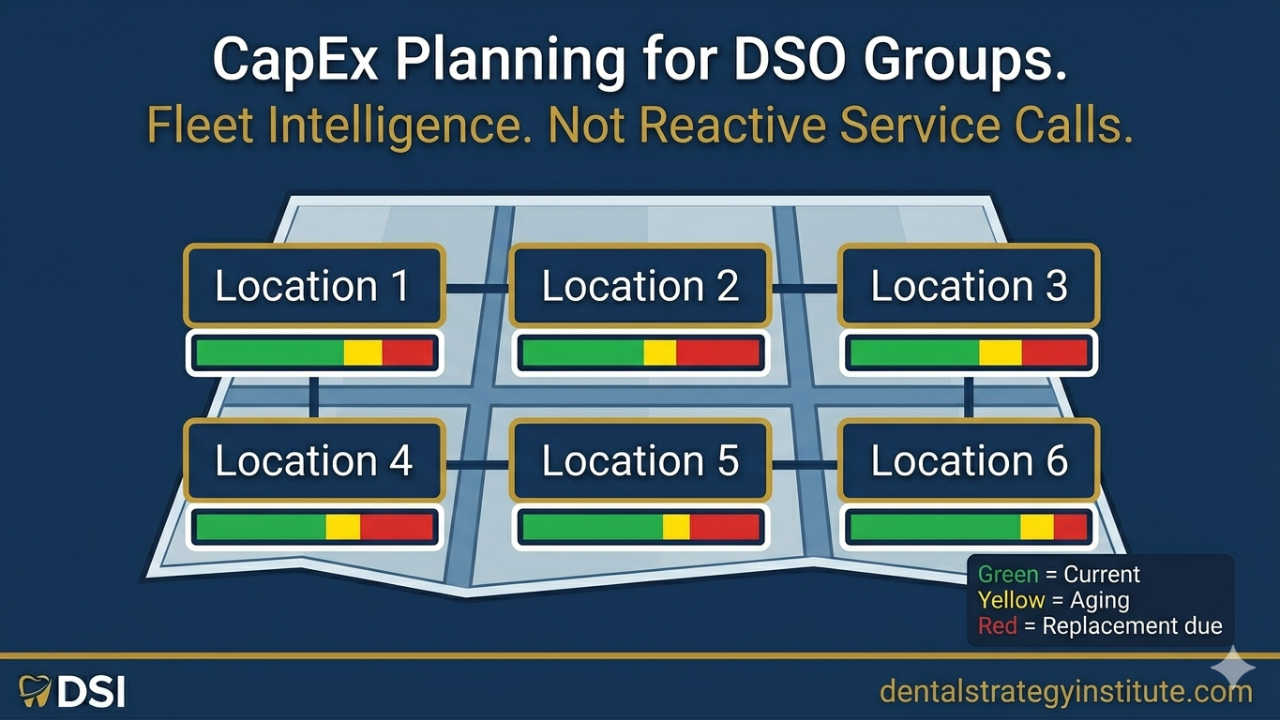
Here's how equipment capital planning works in most dental groups: a chair breaks at Location 7. Someone calls the service company. The service company comes out and says the pump motor is gone. The office manager calls the regional director. The regional director calls the CFO. The CFO asks why this wasn't in the budget. Nobody has a good answer.
That's reactive capital management. And it's extraordinarily expensive — not just because unplanned equipment purchases cost more than planned ones, but because every reactive replacement comes with the hidden cost of production downtime, staff disruption, and rushed vendor decisions.
The groups managing capital most efficiently have one thing in common: they built a system before they needed it.
Why CapEx Planning Is Different at Scale
For a solo practitioner, equipment capital planning is manageable by instinct. You know how old your chairs are, you remember when the compressor was installed, and you can make reasonable replacement predictions from memory.
At ten locations, that approach starts to fail. At twenty, it's completely broken. Equipment age data is scattered across service invoices, verbal history from office managers, and whatever your dealer rep remembers from their last visit. There's no fleet-level visibility, no consolidated aging report, and no systematic way to forecast replacement demand.
The result: CFOs are constantly surprised by capital requests they should have seen coming.
The Four Components of a DSO CapEx Plan
A functioning capital expenditure plan for a dental group has four components.
Component 1: The Asset Register This is the foundation. Every piece of major equipment at every location, documented with three data points: the install date or estimated age, the original cost or replacement cost, and the current service status. It doesn't have to be sophisticated — a well-maintained spreadsheet is better than nothing. But increasingly, groups are moving this to purpose-built platforms like DentalAssetIQ that track lifecycle data and surface replacement forecasts automatically.
The asset register answers one question: what do we own, how old is it, and where is it?
Component 2: The Lifecycle Model Apply the lifespan benchmarks from [Post 1 of this series] to your asset register. Flag any equipment that is within three years of expected end of service life as "watch," any equipment past its expected lifespan as "replacement pipeline," and any equipment with documented service issues as "priority."
This creates a rolling 36-month replacement forecast. Instead of reacting to failures, you're anticipating them.
Component 3: The Annual CapEx Budget Use the replacement forecast to build a capital budget with a 12-month horizon and a 36-month outlook. For each item in the replacement pipeline, document the estimated replacement cost and the proposed timing.
A group with forty locations and five chairs per location — two hundred chairs — should be able to forecast chair replacement demand within a reasonable confidence interval based on fleet age data alone. If the average fleet age is twelve years, and chairs have a 15–20 year expected lifespan, you know roughly what the replacement cadence should look like over the next five years.
Budget this. Don't wait for the service call.
Component 4: The Standardization Decision This is the strategic layer that separates operationally mature groups from growing ones. Equipment standardization — selecting preferred manufacturers and configurations across the group — produces compounding benefits: negotiated pricing based on volume, consistent parts and service training, predictable maintenance schedules, and simplified operator training.
Groups that standardize on two or three chair platforms across their fleet have materially lower lifetime equipment costs than groups that allowed every acquisition to retain whatever the selling doctor preferred. The transition cost of standardization is real — but the ongoing operational savings and negotiating leverage with manufacturers typically outweigh it within three to five years. I cover the full standardization case, and what the lack of one actually costs a group, in Why DSOs Are Flying Blind on Equipment.
What DSO CFOs Should Be Asking About Equipment
Five questions that a CFO or COO should be able to answer for their equipment fleet:
- What is the weighted average age of our equipment fleet by category (chairs, compressors, vacuum systems, imaging)?
- How many units in each category are within three years of expected end of service life?
- What is our projected equipment replacement spend over the next 24 and 36 months?
- What is our current spend rate on equipment repairs — and what percentage of repair costs are on assets past their expected lifespan?
- What would our equipment fleet value in a transaction context, based on current fair market values? This is the question most groups answer worst, and the one a buyer's diligence team asks first — see The Hidden Liability in Every Dental Practice Sale for how that number actually gets built.
Most groups can't answer all five today. The ones that can are managing capital significantly more efficiently than the ones that can't.
The Standardization Opportunity With Manufacturers
One underused lever: volume-based purchasing agreements with equipment manufacturers. A group with forty-plus locations buying chairs and delivery systems at scale has real negotiating power — if they're purchasing strategically rather than reactively through individual dealer relationships at each location.
The prerequisite for that negotiation is standardization. You can't negotiate a volume agreement if every location is buying different products from different vendors. The asset register and standardization decision aren't just operational tools — they're the foundation for a procurement strategy.
FAQ
What is CapEx in a dental practice? Capital expenditure (CapEx) in a dental practice refers to spending on major equipment and facility improvements — items with useful lives beyond one year that are capitalized on the balance sheet rather than expensed immediately. Dental chairs, imaging equipment, compressors, and vacuum systems are the primary CapEx categories. Proper CapEx planning means budgeting for these replacements before they become urgent.
How often should DSOs replace dental equipment? There's no single answer — replacement timing depends on equipment category, age, condition, and service history. As a general framework, DSO groups should budget for equipment replacement on a rolling basis informed by fleet age data and the lifespan benchmarks for each category. Most well-managed groups develop a 3–5 year rolling replacement forecast.
What is dental equipment standardization? Dental equipment standardization is the practice of selecting preferred manufacturers and configurations for major equipment categories across all locations in a dental group. Standardization reduces training complexity, simplifies parts and service logistics, enables volume purchasing agreements, and creates more predictable maintenance schedules. It is one of the highest-ROI operational decisions available to growing DSO groups.
Related Reading
- Adding Operatories vs. Building New: When Dental Office Expansion Actually Pays Off — the same capital-planning discipline applied to the build/expand decision itself.
- Why DSOs Are Flying Blind on Equipment — the standardization case in full, and what it's costing groups that haven't made the call.
- The Hidden Liability in Every Dental Practice Sale — what happens when this same fleet shows up in an acquisition.
Building this out at your organization? DSI's resources for DSO operators gather the books, calculators, and frameworks for running a multi-location group.
Stay connected with news, offers and updates!
Join our mailing list to receive the latest news, offers and updates from our team.
Don't worry, your information will not be shared.
We hate SPAM. We will never sell your information, for any reason.