
How to Read a DSO Earn-Out Agreement — What Every Clause Is Actually Doing to Your Money
Apr 16, 2026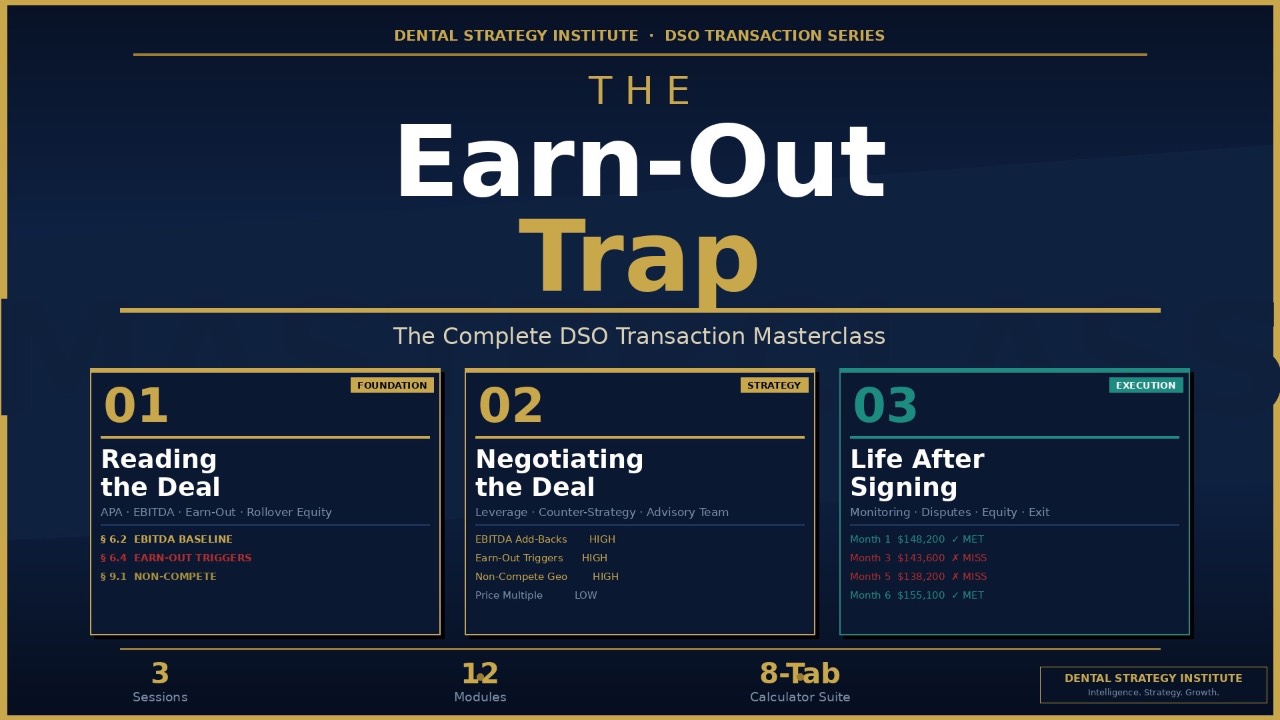
You got the letter of intent. The number looks right. The buyer's team has been professional, the process has moved quickly, and everyone keeps telling you this is a strong deal.
Then the Asset Purchase Agreement arrives — three hundred pages of legal language — and somewhere in Article 6 is the earn-out provision. The clause that governs whether you receive the deferred portion of your purchase price. The clause that, in many DSO transactions, contains the actual financial risk of the deal.
Most dentists read it once, forward it to their attorney, and trust that someone is watching out for them.
Here's the thing. Your attorney is watching out for you on the legal enforceability of the document. Nobody is necessarily watching out for the commercial reasonableness of the earn-out structure unless you know what to ask for. And knowing what to ask for requires understanding what these clauses actually say.
This post walks through the five earn-out provisions that matter most. Not in legal language — in plain English, with enough specificity that you can read any DSO earn-out agreement and understand exactly what it's doing to your money.
The Trigger Metric
The trigger metric is the performance measure against which your earn-out is evaluated. It is the single most important earn-out term and should be the first thing you look for.
Three metrics appear in DSO earn-out agreements: net collections, gross production, and EBITDA at the location level.
Net collections is the most common and most buyer-favorable. It reflects the cash actually received after insurance adjustments, write-offs, and collection activity — all of which the DSO influences through its fee schedules, billing practices, and collection protocols. A DSO that renegotiates its payer contracts after close can reduce your net collections without any change in your clinical output.
Gross production is the most seller-favorable. It measures the value of dentistry you actually produced, before adjustments. A DSO's billing decisions don't affect it. If your earn-out is triggered on gross production, your result is much more directly within your control.
EBITDA at the location level is the most buyer-favorable and the most susceptible to manipulation. The DSO allocates overhead to your location — management fees, shared services, equipment depreciation — and your EBITDA is calculated after those allocations. Without a specific contractual cap on what can be allocated and at what level, this metric can be moved by the buyer without changing your clinical production at all.
What to look for: the word "net collections" where you expected "production." The difference matters enormously. Push for gross production as your trigger metric. If the buyer insists on net collections, you need fee schedule protection language.
The Baseline
The baseline is the historical performance level against which your earn-out is measured. The standard DSO formulation looks something like this: "Seller shall receive the Earn-Out Payment if net collections for the Measurement Period equal or exceed ninety percent of the Prior Year Baseline."
The Prior Year Baseline sounds neutral. It is not neutral. The buyer's attorneys chose it carefully.
If your practice had an unusually strong year in the year before close — perhaps you added an associate, expanded your hygiene schedule, or had a particularly productive production run — that peak year becomes your earn-out baseline. You now have to match a performance level that was achieved under conditions that no longer exist, in a practice you no longer control.
The seller-favorable baseline is a two-year average, which smooths anomalous peaks. Better still, push for an integration adjustment — a provision that reduces the baseline by five to ten percent for the first two quarters after close to account for the predictable disruption caused by systems integration, billing transitions, and operational changes.
What to look for: "Prior Year Baseline" defined as a single year. Request a multi-year average instead.
The Non-Interference Covenant
This is the provision that is absent from virtually every standard DSO earn-out document and the one that matters most.
The non-interference covenant is a contractual commitment by the DSO that they will not take actions specifically designed to prevent you from achieving your earn-out threshold. Without it, the buyer can reduce your hygiene staff, renegotiate your fee schedules, change your scheduling templates, and redirect your patient referrals — all of which reduce your collections — with no contractual obligation to compensate you for the impact on your earn-out.
A well-drafted non-interference covenant specifies what actions are prohibited: staffing reductions below agreed minimums, fee schedule reductions above a defined percentage, material changes to scheduling capacity, and redirection of referrals to affiliated providers. Each prohibition should carry a remedy — typically an adjustment to your earn-out threshold equal to the quantified impact of the prohibited action.
What to look for: any version of this protection. Its absence from the standard document doesn't mean it's unavailable — it means you have to ask for it specifically.
The Dispute Mechanism
Standard DSO earn-out agreements include a provision that makes the buyer's earn-out calculation "final and binding absent manifest error." This means that unless you can prove an obvious mathematical mistake, you have no right to challenge the calculation.
No audit right. No independent review. No ability to question whether the number is correct. Just the buyer's calculation, presented as fact.
The dispute mechanism you need has five components: a delivery deadline for the buyer's calculation; a window for your review and objection; an audit right that allows you to examine the underlying records; an independent accounting firm to resolve disputes; and an interim payment provision that requires the undisputed portion to be paid while the dispute is resolved.
All of these are standard in sophisticated M&A transactions. None of them are standard in DSO acquisition documents. They are available. You have to request them before you sign.
What to look for: "final and binding" without qualification. If that phrase appears in your earn-out provision without a corresponding dispute mechanism, you are signing away your ability to challenge the calculation regardless of what the number is.
The Measurement Period
The measurement period is the timeframe over which your earn-out performance is evaluated. Typical structures are one year, two years, or three years, with annual or semi-annual payment intervals.
Two things matter here that most dentists don't consider. First, when does the measurement period begin? If it begins on the closing date — which is standard — then the first measurement period includes the integration disruption that almost always follows a DSO acquisition. Your billing system changes, your staff is managing new protocols, your patients are experiencing a different practice experience. Collections during this period are almost always below your historical run rate.
Second, are the measurement periods independent or cumulative? An independent period structure means each year is evaluated on its own — a miss in Year One doesn't affect Year Two. A cumulative structure means missed thresholds can be recovered in later periods. Independent periods are significantly more favorable to sellers.
What to look for: a closing-date start that drops you into a measurement period before integration is complete. Push for a sixty-day or ninety-day post-close grace period before the first measurement period begins.
What to Do With This Information
Reading these five provisions in your own earn-out agreement is the starting point, not the destination. Identifying that your earn-out uses net collections as a trigger metric, or that there is no non-interference covenant, or that the calculation is final and binding — that information is only valuable if you act on it before you sign.
After the LOI is signed and the exclusivity period begins, your leverage to change these provisions drops significantly. The time to negotiate is in the pre-LOI window, when you still have walk-away power and competitive alternatives.
The Earn-Out Trap covers each of these provisions in full chapter-length depth — with the specific language to negotiate, real-world composite cases showing how each trap plays out, and the deal scorecard framework for evaluating any DSO offer across all eight material dimensions. It's available on Amazon or via the link in the text above.
If you're in an active transaction, the free introductory course covers the foundational framework in sixty minutes. No credit card. Start there
Stay connected with news, offers and updates!
Join our mailing list to receive the latest news, offers and updates from our team.
Don't worry, your information will not be shared.
We hate SPAM. We will never sell your information, for any reason.