
What Is Myofunctional Therapy, and Why Are So Many Hygienists Switching to It?
Jul 21, 2026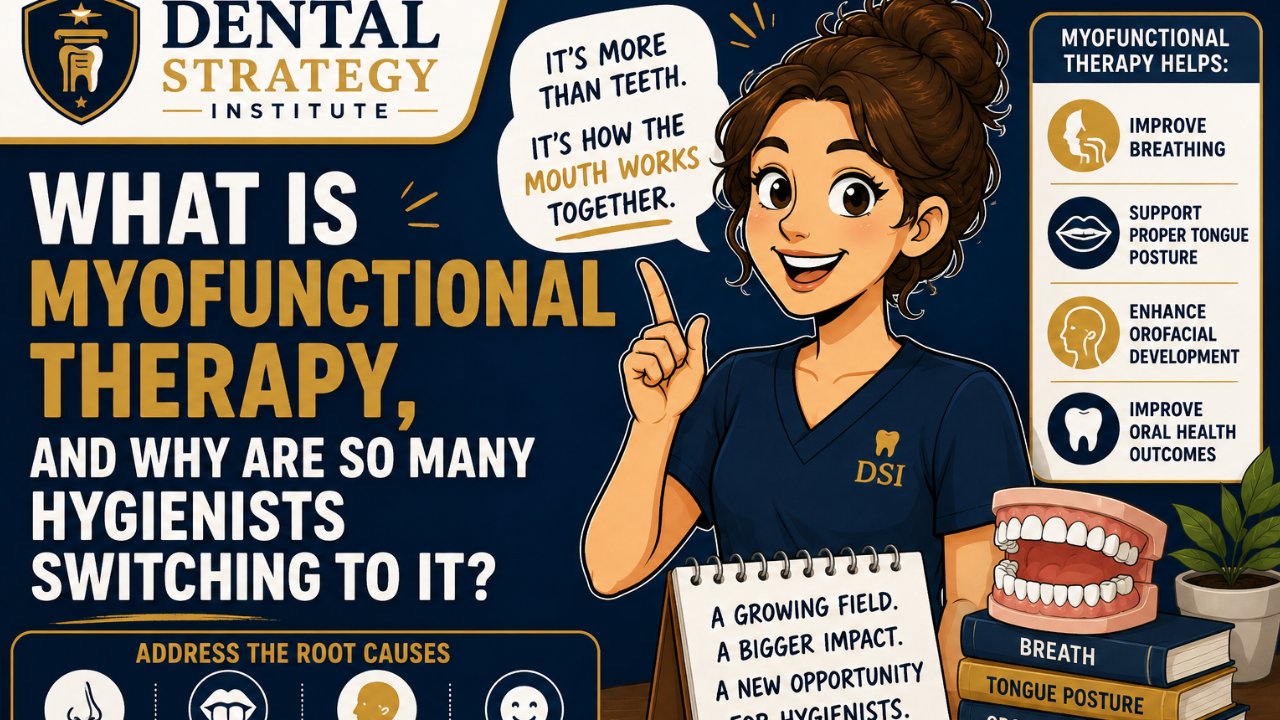
By Pete Volk, founder of Dental Strategy Institute, with clinical review by Susan Volk, RDH.
Somewhere around the thousandth prophy, a lot of hygienists start to wonder if this is the whole job — the same forty-five minutes, the same room, the same pace, forever. If that wondering has started for you, it's not restlessness for its own sake. It's a good clinician sensing there's more range in her than the schedule allows. Myofunctional therapy is one of the places that range goes.
What is myofunctional therapy? It's a program of targeted exercises that correct dysfunction in the muscles of the face, mouth, and throat — things like improper tongue posture, mouth breathing, and orofacial habits tied to malocclusion, orthodontic relapse, and sleep-disordered breathing. Think physical therapy, but for the oral and facial muscles. Hygienists are drawn to it because it uses clinical skills they already have, with a calmer pace than chairside work.
Here's the part worth sitting with: you already have most of what this takes. The eye for tongue posture and mouth breathing, the comfort working in the oral cavity, the patience to coach a patient through something — that's you, today. Myofunctional therapy isn't starting over. It's the same clinician, pointed at deeper, slower, more sought-after work.
It's now one of the more common answers I hear when I ask hygienists what they're thinking about doing next — right up there with independent hygiene practice, and often layered on top of it.
What Myofunctional Therapy Actually Is
Myofunctional therapy addresses dysfunction in the muscles of the face, mouth, and throat — things like improper tongue posture, mouth breathing, tongue-tie effects, and orofacial habits that contribute to problems ranging from malocclusion and relapse after orthodontic treatment to sleep-disordered breathing and, in children, certain speech and feeding issues. It's a series of targeted exercises, not unlike physical therapy, but for the oral and facial muscles instead of the knees or shoulders.
The reason it's landed so squarely in dental hygiene's lane is straightforward: hygienists are already trained to look inside the mouth, understand oral anatomy, and recognize the signs — tongue thrust, mouth breathing, low tongue posture — that a general dentist or physician often isn't specifically trained to flag. Orthodontists have been sending patients for myofunctional therapy for years to prevent relapse. Sleep physicians are increasingly interested in it as a complement to CPAP and oral appliance therapy. Pediatric dentists want it for early intervention. Hygienists sit at the exact intersection of clinical knowledge and patient-facing time that makes this a natural specialty to build.
Why Hygienists Specifically Are Drawn to It
Part of it is simply burnout with the pace of a traditional hygiene schedule — the six-patients-a-day grind wears on people, and myofunctional therapy sessions typically run longer, with fewer patients per day and more relationship-based work. Part of it is scope: a myofunctional therapy practice, unlike traditional hygiene in most states, isn't nearly as tangled up in dental supervision requirements, since it's generally classified and regulated differently than direct dental treatment. And part of it, honestly, is that it pays well relative to the training investment required, especially once you build a referral relationship with local orthodontists and sleep specialists.
What It Actually Requires to Get Started
You don't need to go back to school for years. Most myofunctional therapy certification programs are built specifically for people who are already dental or medical professionals — hygienists, SLPs (speech-language pathologists), and some dentists — and run anywhere from a few months to about a year depending on the program's depth and whether it includes mentored casework. Programs like the Academy of Orofacial Myofunctional Therapy and the International Association of Orofacial Myology are the two most commonly referenced credentialing bodies, though there are several serious programs beyond those two worth researching directly rather than taking my word for which is "best" — that decision depends heavily on your state, your target patient population, and honestly which program's teaching style clicks for you. I walk through how to choose a certification program and build your first caseload in the next post.
Building Your First Caseload
This is where most new myofunctional therapists underestimate the runway. Referral relationships take time to build — orthodontists and sleep physicians want to see case outcomes before they trust you with a steady referral stream, and that trust doesn't happen after one lunch-and-learn presentation. The hygienists who've built successful myofunctional practices almost universally describe a slow first six to twelve months of relationship-building followed by a referral pipeline that becomes largely self-sustaining once a handful of local providers see consistent results.
Common Questions
Do I need to leave my hygiene job to do myofunctional therapy? Not necessarily — many hygienists start by adding myofunctional therapy as a part-time or side practice, building the caseload gradually before deciding whether to transition fully.
How long does certification take? Most credible programs run from a few months to roughly a year, depending on the depth of training and whether supervised casework is required for certification.
Is myofunctional therapy covered by insurance? Rarely as a standalone billed service under medical or dental insurance, though this is slowly evolving in some markets. Most myofunctional therapy practices operate on a cash-pay or package-pricing model.
Do I need a referring dentist or physician to see patients? Typically not in the way traditional dental treatment requires supervision, since myofunctional therapy is generally classified outside standard dental practice acts — but always confirm your specific state's regulatory treatment before assuming.
The complete guide to building a myofunctional therapy career — certification, caseload, and the business side — is what we're developing with Susan Volk, RDH. It's for the hygienist who's realized she has more range than the schedule ever asked for. Get on the list and we'll tell you the moment it's ready →
Stay connected with news, offers and updates!
Join our mailing list to receive the latest news, offers and updates from our team.
Don't worry, your information will not be shared.
We hate SPAM. We will never sell your information, for any reason.