
Dental Equipment Maintenance Schedules: What Gets Skipped and What It Costs
May 31, 2026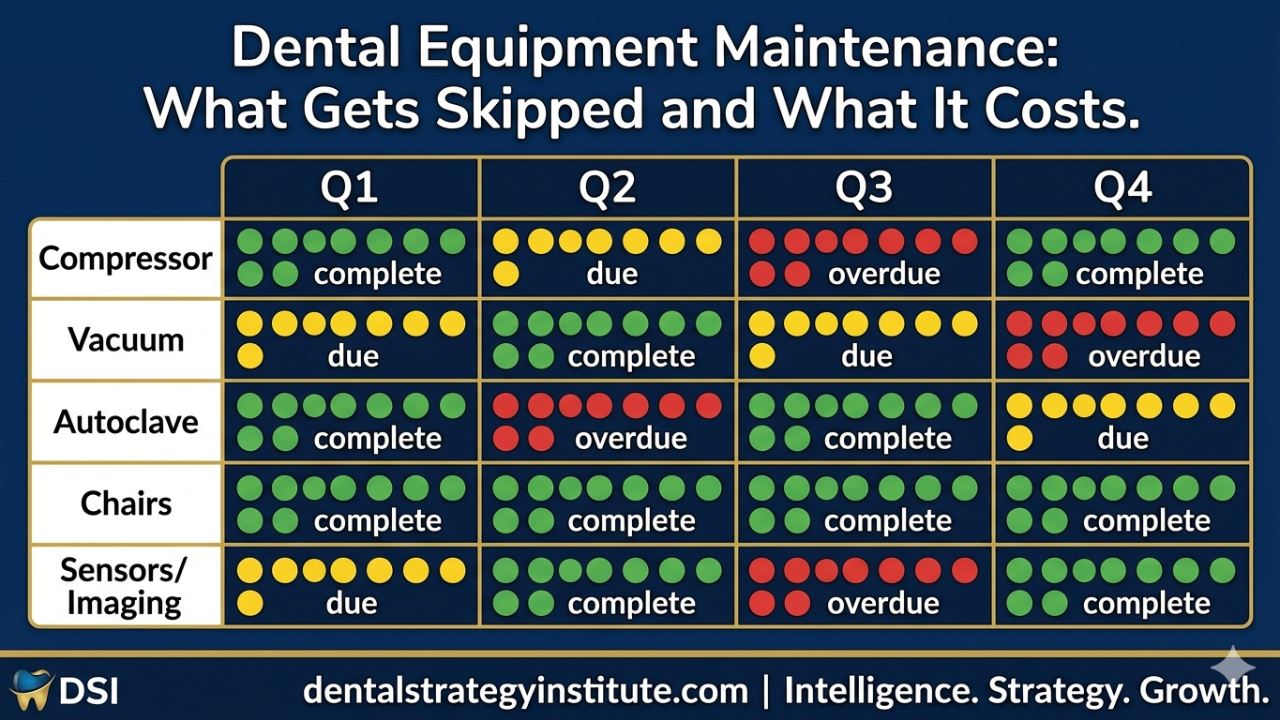
Every equipment manufacturer ships their product with a recommended maintenance schedule. It's in the manual. The manual lives in the filing cabinet. The filing cabinet hasn't been opened in three years.
That's not unusual. It's the default state of dental practice maintenance management — and it's quietly expensive in ways that accumulate over years rather than appearing as a single obvious cost.
Deferred maintenance shortens equipment life, increases repair frequency, creates OSHA and infection control compliance exposure, and reduces practice value when it comes time to sell. The annual cost of a proper preventive maintenance program for a typical multi-operatory practice is a few thousand dollars. The cumulative cost of not having one is typically much higher.
Here's what a proper dental equipment PM schedule actually looks like.
Why Maintenance Gets Skipped
The honest answer: it's not urgent. A compressor that's two months past its annual service date still runs. An autoclave with a neglected gasket still passes its cycle. Nothing breaks the day you skip the service call.
The cost is invisible and deferred — which means it never competes effectively with the hundred urgent things that fill a dental practice calendar. The dental assistant didn't show up. The crown came back wrong. The billing team has a backlog. The filter maintenance reminder email from the compressor company gets archived.
Nobody gets fired for skipping a PM service. Until the compressor goes down during a double-booked Tuesday and you're trying to reach your service rep to explain that you're out of commission for two days.
The Dental Equipment Maintenance Schedule: By Category
Dental Compressor Monthly: Check filter condition, drain condensate trap, verify operating pressure and temperature are within spec. This is a five-minute task that prevents moisture contamination and catches early pressure issues. Quarterly: More thorough filter inspection, check belts (oil-lubricated units), verify automatic drain valve function. Annually: Full PM service by authorized technician — filter replacement, belt inspection and replacement if needed, oil change (oil-lubricated units), full system diagnostic. Budget $300–$600 per unit.
Vacuum System (Wet Ring) Monthly: Check separator, clean trap, verify suction performance. Quarterly: Separator flush, check water supply line, verify waste line flow. Annually: Full service — impeller inspection, motor check, seal inspection, water flow calibration. Budget $400–$800.
Autoclave / Sterilizer Weekly: Spore test (biological indicator test). This is not optional — it's the clinical standard and in many states it's a regulatory requirement. Monthly: Clean chamber, check door gasket condition, verify cycle parameters. Quarterly: Descale chamber (hard water markets especially). Annually: Full PM service — gasket replacement, heating element check, pressure and temperature calibration. Budget $300–$600.
Dental Chair Annually: Full hydraulic PM — check cylinder seals, lubricate pivot points, verify electric/hydraulic function, inspect upholstery for cracking. Budget $200–$400 per chair. Every 3–5 years: Hydraulic fluid flush on older units.
Digital Imaging (Sensors, Pan, CBCT) Annually: Software updates, sensor cord inspection, image quality test. CBCT units typically require authorized service for full annual PM — budget varies widely by model and service contract.
Handpieces Per-use: Lubrication per manufacturer protocol. Annually: Bearing inspection and rebuild as needed through an authorized repair service. Budget $80–$200 per handpiece.
The Compliance Dimension
OSHA's bloodborne pathogen and infection control standards have implications for sterilization equipment maintenance that go beyond equipment performance. An autoclave that hasn't been spore-tested regularly, or one with a documented gasket failure that wasn't addressed, creates infection control compliance exposure.
Most state dental boards have specific maintenance record requirements for autoclaves. A practice that can't produce sterilization maintenance records on inspection is looking at regulatory action, not just an equipment issue.
Document everything. Maintenance records for autoclaves and handpiece sterilization should be kept for a minimum of three years. In a practice sale, these records are part of the due diligence package — and their absence raises questions buyers will factor into their offer.
What Deferred Maintenance Costs — A Real Math Example
Let's put numbers to it. A multi-operatory practice has four compressors across two locations — one four-operatory and one five-operatory space. Proper annual PM for those two compressors runs approximately $1,000 to $1,200 per year.
Skip PM for three consecutive years: $3,600 saved.
One compressor fails prematurely at year nine instead of year twelve. Replacement cost: $8,500. Lost production during a two-day installation window (four operatories offline): approximately $9,600. Total: $18,100.
Three years of PM savings: $3,600. Cost of the early failure: $18,100. Net cost of deferred maintenance on one compressor: $14,500.
That math holds across most major equipment categories. The PM program is almost always the better economic choice.
For DSO Groups: Systematizing Maintenance Compliance
At the group level, maintenance compliance needs to be a system, not a request. Service due dates should be centrally tracked, service completion should be centrally verified, and non-compliance should be flagged before it becomes a failure event.
Groups that have built this layer — whether through a purpose-built platform like DentalAssetIQ or through a rigorous internal operations process — have materially lower equipment repair costs and better performance in equipment due diligence during transactions.
FAQ
How often should dental equipment be serviced? Most major dental equipment categories require annual preventive maintenance service by an authorized technician. Compressors, vacuum systems, and autoclaves should receive full PM service annually. Autoclaves additionally require weekly spore testing. Dental chairs benefit from annual hydraulic inspection. Some equipment — dental sensors and CBCT units — may have manufacturer-specific service intervals.
What is preventive maintenance for dental equipment? Preventive maintenance (PM) for dental equipment refers to scheduled service intervals designed to catch wear indicators and potential failure points before they cause equipment failure or patient care disruption. PM typically includes filter replacement, lubrication, calibration, gasket inspection, and full system diagnostics. It differs from reactive service, which responds to a failure that has already occurred.
What are OSHA requirements for dental equipment maintenance? OSHA's bloodborne pathogen standards require that dental practices maintain sterilization equipment in proper working order and document sterilization processes. Autoclave maintenance records — including spore testing logs — are typically required for compliance inspections. State dental boards may have additional specific requirements for sterilization equipment maintenance documentation.
Does dental equipment maintenance affect practice value? Yes. Documented maintenance history is a positive factor in dental practice appraisals and DSO due diligence processes. Equipment with complete service records commands a higher condition rating and therefore a higher fair market value. Practices with documented deferred maintenance may receive buyer risk discounts beyond the equipment replacement cost itself.
Stay connected with news, offers and updates!
Join our mailing list to receive the latest news, offers and updates from our team.
Don't worry, your information will not be shared.
We hate SPAM. We will never sell your information, for any reason.