
What Is My Used Dental Equipment Worth? How to Value What You Own
May 29, 2026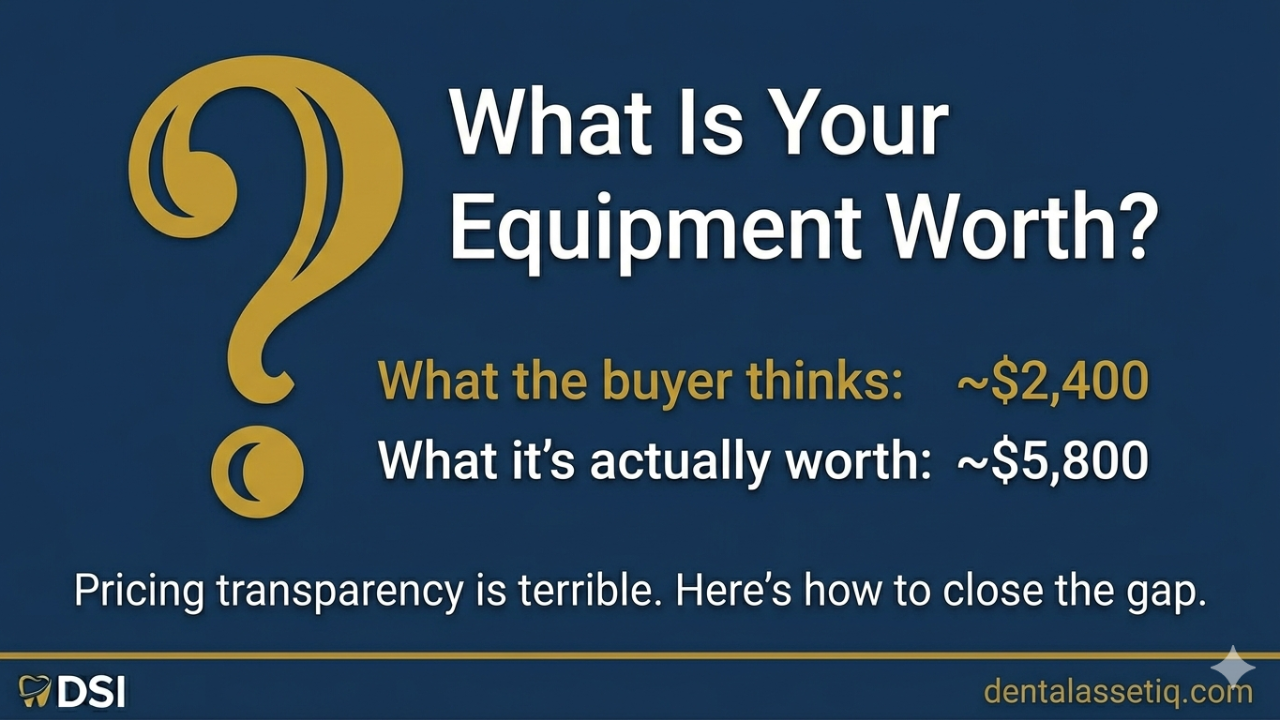
Let me tell you how most used dental equipment pricing works in a practice sale.
The buyer's team walks through the operatories. They take notes. They go back to the office and apply rough age-based estimates to the equipment list — numbers drawn from a dealer rep's memory and whatever feels right based on the last transaction they worked on. Those numbers become the equipment value line in the asset schedule.
The seller has no independent basis to challenge any of it.
This is not a knock on buyers or their teams. It's an accurate description of a market with almost no pricing transparency. There's no dental equipment blue book. There's no standardized valuation methodology widely used in the industry. There's no Kelley Blue Book equivalent for a Midmark chair.
That information gap costs sellers money — and it's entirely fixable.
How Used Dental Equipment Value Is Actually Determined
Fair market value for used dental equipment is driven by five factors.
Manufacturer and model. Brand matters enormously in the secondary market. A-dec and Midmark chairs hold value better than budget-tier alternatives. Dexis and Carestream sensors have stronger secondary market demand than some regional brands. Planmeca and Carestream CBCT units have more active buyers than older or less-supported platforms.
Age. The depreciation curve from Post 3 of this series applies directly. Equipment in the 0–5 year range retains 35–70% of original cost. Equipment at 10+ years retains 10–25%. These are ranges, not fixed numbers — condition can move the value within the range.
Condition. This is where most valuations diverge from the depreciation curve. A ten-year-old chair with full service records, recent upholstery replacement, and documented functional check is worth materially more than a ten-year-old chair that was never serviced and shows visible wear. Condition documentation is the difference between the low end and the high end of the fair market value range.
Completeness. A delivery unit with the original mounting arm, handpiece holders, and control module is worth more than one that's been cannibalized for parts over the years. A CBCT unit with the acquisition software, positioning guides, and original documentation commands a premium over the bare hardware.
Market timing and buyer pool. Dental equipment values fluctuate with market conditions — specifically with how many qualified buyers are actively looking for similar equipment. Startup practice formation activity, DSO expansion pace, and the general health of dental practice lending all affect secondary market demand.
Benchmark Values by Category
These are representative fair market value ranges for well-maintained equipment in average condition. Excellent condition and favorable brand can reach the high end or above. Poor condition and unfavorable brand will fall below the low end.
|
Equipment |
Age Range |
FMV Range |
|
A-dec / Midmark Chair (premium) |
3–7 years |
$4,000–$8,000 |
|
A-dec / Midmark Chair (premium) |
8–12 years |
$1,500–$4,000 |
|
Budget-tier Chair |
3–7 years |
$1,500–$3,500 |
|
Budget-tier Chair |
8–12 years |
$400–$1,500 |
|
Dental Compressor (oil-free, 2+ op) |
3–8 years |
$2,500–$5,500 |
|
Wet Vacuum System |
3–8 years |
$1,500–$4,000 |
|
Digital X-Ray Sensor (Dexis/Carestream) |
2–6 years |
$1,500–$4,000 |
|
CBCT Unit (Planmeca/Carestream/CS) |
3–8 years |
$20,000–$60,000 |
|
Panoramic X-Ray (digital) |
3–8 years |
$4,000–$12,000 |
|
Autoclave (Midmark/Tuttnauer) |
3–8 years |
$800–$2,500 |
The Liquidation Value vs. Fair Market Value Distinction
Two valuation concepts matter in dental transactions.
Fair market value is what a willing buyer would pay a willing seller in an arm's-length transaction, with reasonable market exposure. It assumes you have time to find the right buyer and aren't under pressure to sell quickly.
Liquidation value is what you'd receive if the equipment had to be sold quickly — at auction, through a liquidator, or as part of an expedited practice wind-down. Liquidation values are typically 30–50% of fair market value, sometimes less. Auction results for dental equipment are notoriously low.
In a practice sale, you generally want to be arguing fair market value, not liquidation value. Getting there requires documentation and — ideally — an independent appraisal.
Getting a Defensible Number
There are three ways to establish equipment value before a sale.
The dealer estimate: call your equipment dealer, walk them through your list, and ask for rough values. This is free and fast, and it's often wrong in both directions. Dealers know current catalog prices and have some sense of the used market, but they're not appraisers and their estimates can reflect their inventory needs as much as actual market value.
The independent appraisal: hire a certified equipment appraiser to value your practice assets. This produces a defensible, documented value and is appropriate for transactions above a certain size. It has a cost — typically $500 to $2,000 depending on practice size.
AI-powered market valuation: DentalAssetIQ provides data-driven fair market valuations for dental equipment based on current secondary market data, condition inputs, and brand/model adjustments. It's the fastest route to a defensible number without the full appraisal cost — and it's the tool I'd start with before any practice sale or equipment transaction.
FAQ
What is my dental equipment worth when selling a practice? Dental equipment value in a practice sale depends on manufacturer, age, condition, and completeness. Premium brand chairs (A-dec, Midmark) at 3–7 years in good condition typically range from $4,000–$8,000. Imaging equipment holds value better due to high replacement cost. A full practice equipment package typically contributes 5–15% of total practice value, though this varies significantly.
Is there a dental equipment blue book? There is no single standardized dental equipment valuation resource equivalent to Kelley Blue Book for vehicles. Pricing transparency in the used dental equipment market is poor. The most reliable approach to getting a defensible fair market value is an independent appraisal or an AI-powered valuation tool like DentalAssetIQ that aggregates secondary market data.
What affects dental chair resale value the most? Brand is the biggest factor — A-dec and Midmark chairs hold value significantly better than budget alternatives. After brand, age and condition are the primary drivers. Documented service history, recent upholstery replacement, and full functionality at time of sale all support the higher end of the value range.
What is liquidation value for dental equipment? Liquidation value — what equipment sells for at auction or through a rapid-sale liquidator — is typically 30–50% of fair market value, sometimes less. Dental equipment auctions routinely produce prices that bear little relationship to replacement cost or market value. Avoid forced-sale scenarios whenever possible.
Stay connected with news, offers and updates!
Join our mailing list to receive the latest news, offers and updates from our team.
Don't worry, your information will not be shared.
We hate SPAM. We will never sell your information, for any reason.