
Colorado's New DSO Rules: What Changes January 1, 2027 — and What Doesn't
Jun 25, 2026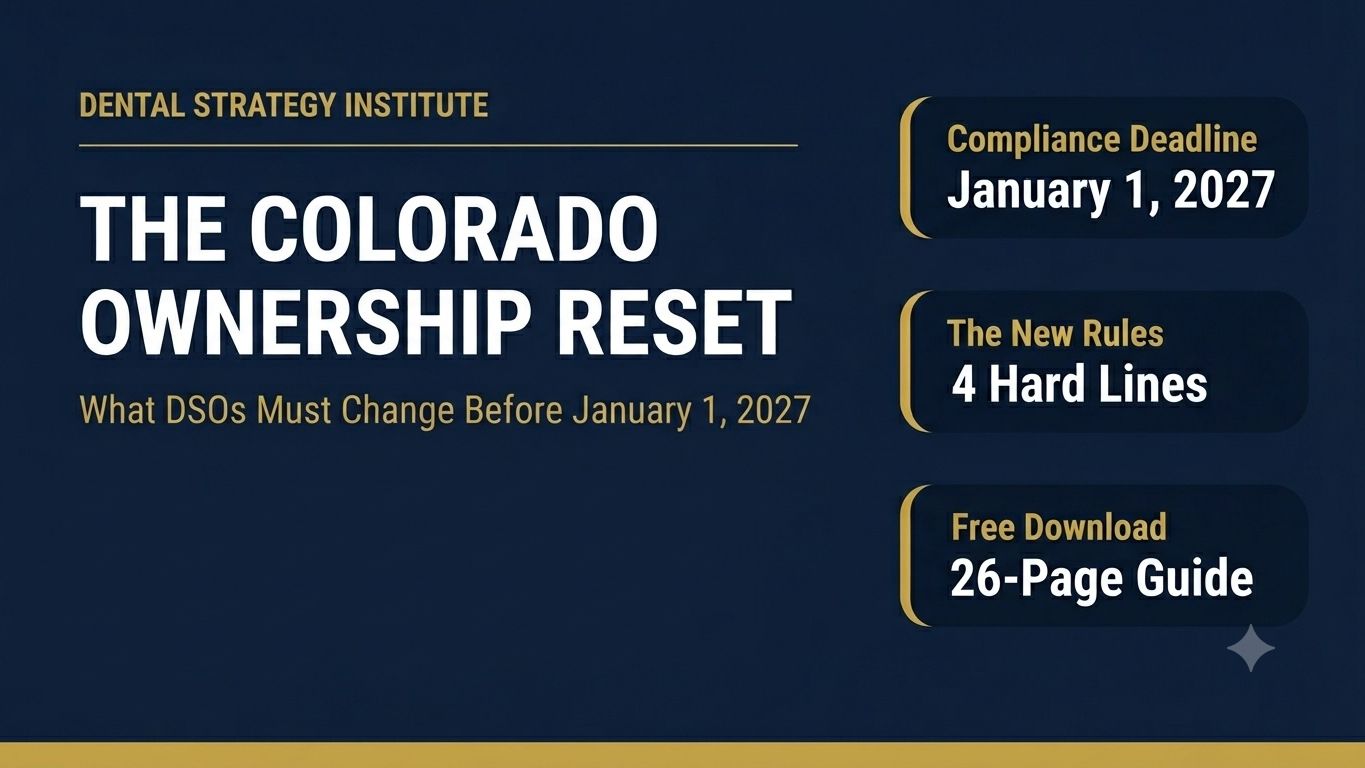
Most of what's circulating about Colorado's new dental rules is wrong in one direction or the other. Either someone is calling it a ban on DSOs — it isn't — or someone is waving it off as business as usual. It isn't that either.
Here's what actually happened, what it means for your structure, and what you need to do about it before January 1, 2027.
The Two Instruments That Actually Bind You
Start here, because getting the source right matters.
Senate Bill 25-194 — the Sunset Dental Practice Act — was signed by Governor Polis on May 5, 2025 and took effect August 6, 2025. It continued the Dental Practice Act to 2034 and, critically, pulled dental professional service corporations under the same ownership limits Colorado imposes on medical practices. That cross-reference — to C.R.S. § 12-240-138 — is where the ownership structure requirements come from.
The Colorado Dental Board's implementing regulations are the operational layer. Those DSO-specific provisions take effect January 1, 2027. They're where the hard lines get drawn. And they're more specific than the statute alone.
The Colorado Dental Association is a membership organization. It advocated during rulemaking, helped shape the timeline, and was vocal about the process. But the rules come from the Board. When you brief your counsel or your operations team, point them at the statute and the Board's regulations — that's what governs.
What the Board Actually Said
Here's the thing that gets buried in most coverage: the Board's regulations explicitly permit DSOs to operate in Colorado. This isn't a prohibition. It's a framework.
The Board said, in effect: DSOs may provide administrative, operational, and non-clinical support to dental practices. Business management services, financial management services, patient account administration — all permitted. But a DSO cannot be the Proprietor of a dental practice.
That word — Proprietor — is doing all the work.
Under C.R.S. § 12-220-104(13), a Proprietor is anyone who employs the licensees, owns the dental office, or owns the equipment used to deliver dental services. And a Proprietor is treated as practicing dentistry. Only a dentist can practice dentistry.
So a DSO that employs the hygienists, holds the premises lease, or owns the dental chairs is — under Colorado law — practicing dentistry without a license.
The Four Hard Lines
Line 1 — The DSO can't own the practice. Only dentists may own dental practices. Only dentists or dental hygienists may own dental hygiene practices, outside narrow exceptions for certain nonprofits or government entities. This is the ownership layer SB 25-194 imported from the medical rules.
Line 2 — The DSO can't hold the premises lease. The practice must hold its own lease. If your standard structure has the management company sign the master lease and sublease space to the PC — a near-universal arrangement — that has to change. The lease moves to the practice.
Line 3 — The DSO can't own the equipment. The practice must own the dental equipment and materials used to deliver care. In the classic model, the MSO owns the hard assets — chairs, delivery units, lights, imaging — and makes them available to the PC through the management agreement. That's now the Proprietor line. Colorado's statute does carve out bona fide sales of dental equipment secured by a chattel mortgage or retain-title agreement, which is the financing path that lets a DSO fund equipment and hold a security interest without becoming the Proprietor.
Line 4 — The DSO can't employ the licensed clinical team. Employing licensees is the third prong of the Proprietor definition. Dentists, hygienists, and dental therapists must be employed by the dentist-owned practice, not the management company. Colorado doesn't license dental assistants, so assistants and front-desk/admin staff can stay with the DSO. But the licensed clinicians have to move to the practice's payroll.
What the DSO Can Still Do
The Board didn't just draw lines — it wrote a permission slip. DSOs may provide business management services if: the DSO doesn't influence the licensee's professional judgment or clinical decisions; the licensee has immediate access to all patient records; and the payment isn't an improper fee-sharing arrangement.
DSOs may provide financial management services, including patient account administration, if: the DSO doesn't interfere with professional judgment; the licensee reviews the accuracy of all procedures billed; and the licensee retains the ability to alter a patient account if an error is found.
That's the lane. Marketing, HR administration, procurement, IT, back-office systems, billing support — all still in the DSO. The management fee, the enterprise value, the investor upside — all still at the MSO level. What moves to the practice side is the ownership, the lease, the equipment, and the clinical payroll.
Colorado modeled these rules closely on New Jersey's. DSOs have operated compliantly in New Jersey for years. There's a proven playbook to borrow.
Where Most Structures Are Exposed
The equipment and lease items tend to catch operators off guard. Most DSO operators know intellectually that the practice entity has to "own" the practice. But equipment on the MSO's books? Lease signed by the management company? Licensed clinicians on the corporate payroll? Those arrangements are everywhere, and they're all now Proprietor territory.
The other high-exposure item is the absentee nominee owner — a single licensed dentist nominally owning a stack of PCs across a platform, never treating a patient in half of them. The active-practice expectations embedded in the medical-practice rules now apply to dentistry. The owner has to actually practice there.
And the bare-percentage management fee — a flat cut of collections with thin or undefined services behind it — looks like fee-sharing when you're in a state that takes fee-splitting seriously. The fee has to map to real, documented services at fair market value.
The Equipment Valuation Problem
Before you can move equipment from the DSO's balance sheet to the practice's, you need a number. A defensible fair market value for every asset you're transferring. That number goes into the sale documents, onto the practice's balance sheet, and it will be called on if anyone ever asks how you arrived at it.
Equipment that's ten years into a twelve-year service life is not worth what's on the books. Most operators don't know the difference.
DentalAssetIQ was built to solve that problem — equipment-specific FMV data, lifespan benchmarks across every major dental asset class, and a depreciation framework designed for practice transactions and compliance transfers. If you're doing the equipment move required by the new rules, that's where to start.
The 90-Day Priority List
You have until January 1, 2027. Here's where to focus first.
Start with the inventory. Map every Colorado entity, owner, lease, and equipment list. Find out who holds the leases, who owns the equipment, and who the licensed clinicians' W-2 employer is. You can't fix what you haven't counted.
Move the lease and equipment conversations to the front. These involve landlords, lenders, and third-party financing — parties you don't control. They take time. The chattel mortgage / retain-title path keeps your equipment economics intact, but it still has to be papered before the deadline.
Engage Colorado healthcare counsel early. This is a structural fix, not a drafting fix. The MSA can't rescue a DSO that still holds the lease, the equipment, or the clinical payroll.
Get the FMV opinion on the management fee. A fee you can defend with a straight face and an independent opinion is your protection against the fee-sharing concern.
Conform the governance. The president of the clinical PC must be a licensee-shareholder-director. Officers and directors must be licensees to the extent possible. The Practice Ownership Form — required by C.R.S. § 12-220-303(2)(a) to be posted at the reception desk and provided on request — should name a licensed dentist-proprietor and match your re-papered structure.
The Economics Still Work
The DSO value proposition was never about owning the dentistry. It was about running the business better and cheaper at scale. Purchasing power, centralized billing and revenue cycle, marketing, recruiting, real-estate leverage, data, back-office efficiency — all of that lives in the management company, all of it is permitted, and all of it still throws off margin.
Want to see what that roll-up math actually looks like once the lease, equipment, and payroll move to the practice side? Run your own numbers through DSI's free DSO Synergy & Roll-Up Calculator — it models adjusted EBITDA and multiple arbitrage the same way a buyer's deal team does.
What changes is the discipline. A real dentist really owns and really practices. The fee is defensible. The lease and equipment live with the practice. The clinical team is on the practice's payroll. Do those things and the model works — in Colorado, and in every strict state that's heading in the same direction.
The operators who'll struggle are the ones who treat SB 25-194 as a compliance exercise rather than a signal. The clean structure is also the most valuable one at exit, the most defensible in an audit, and the most portable to the next state. Build the version that survives what's coming next.
Free Download: The Colorado Ownership Reset
The full 26-page guide covers every piece of this in depth — the four hard lines, an exposure map of the standard DSO control stack, an eight-step adaptation framework, a 90-day action plan, and the compliant control toolkit borrowed from strict-state operators.
→ Download The Colorado Ownership Reset — Free
No credit card. No catch. Download immediately.
Related Reading
Two follow-ups worth reading next: a state-by-state tracker on where corporate-practice-of-dentistry law is moving beyond Colorado, and the case for why DSOs shouldn't pause Colorado deals over any of this — restructure instead of waiting. If you're pricing out what a clean, compliant structure is actually worth at exit, DSI's Dental Office Valuation & Appraisal guide walks through the EBITDA-multiple math buyers use, with a free calculator built in.
Pete Volk is the Founder of Dental Strategy Institute and Director of Strategic Accounts at DCI Edge. He has 25 years of experience in dental equipment, DSO strategy, and practice transactions.
Stay connected with news, offers and updates!
Join our mailing list to receive the latest news, offers and updates from our team.
Don't worry, your information will not be shared.
We hate SPAM. We will never sell your information, for any reason.