
Dental Hygienists & Business Economics: Driving Practice Revenue
Apr 03, 2026
What the Hygienist’s Role Means for Your Practice's Bottom Line
One of the biggest drivers of practice revenue is hygienists -- they're responsible for roughly a third of it. But in most hygiene programs, they don't tell you what that means, or why it should matter to your paycheck, your career, and your place at the table.
As a clinician, you know how to take X-rays, educate patients, remove plaque and more. That's part of the job. But here's what gets left out:
- How overseeing production helps manage overhead and practice revenue
- Why a slow recare schedule not just cause scheduling problems — but also leaks profit
- What your practice’s true financial value is and how to communicate it meaningfully
RDH Magazine states that the hygiene department will contribute 25% to 35% to gross practice production. That is an important financial component -- not just a line item.
These numbers rarely get taught to hygienists. You can be a clinical powerhouse and still miss the leverages you have in a room. If you don't see your numbers, you miss an opportunity to fully advocate for yourself, your patients, and your department's needed resources.
Understand the economics isn't intended to make you into an accountant — it's to know your value. Once you do, it changes a lot including how you show up in conversations with management, prioritize your time, and think about your own career trajectory.
The hygiene department isn't just a support function that's bolted onto the side of a practice — it's weaved into your whole schedule because it's the recurring revenue engine. The sooner you see it that way, the sooner the real conversation about your role can begin.
How Much of the Practice Revenue Does Hygiene Actually Drive?
Most hygienists don't know what their production benchmark their department is measured against should be. The number that determines if they're a profit center or a liability to their department.
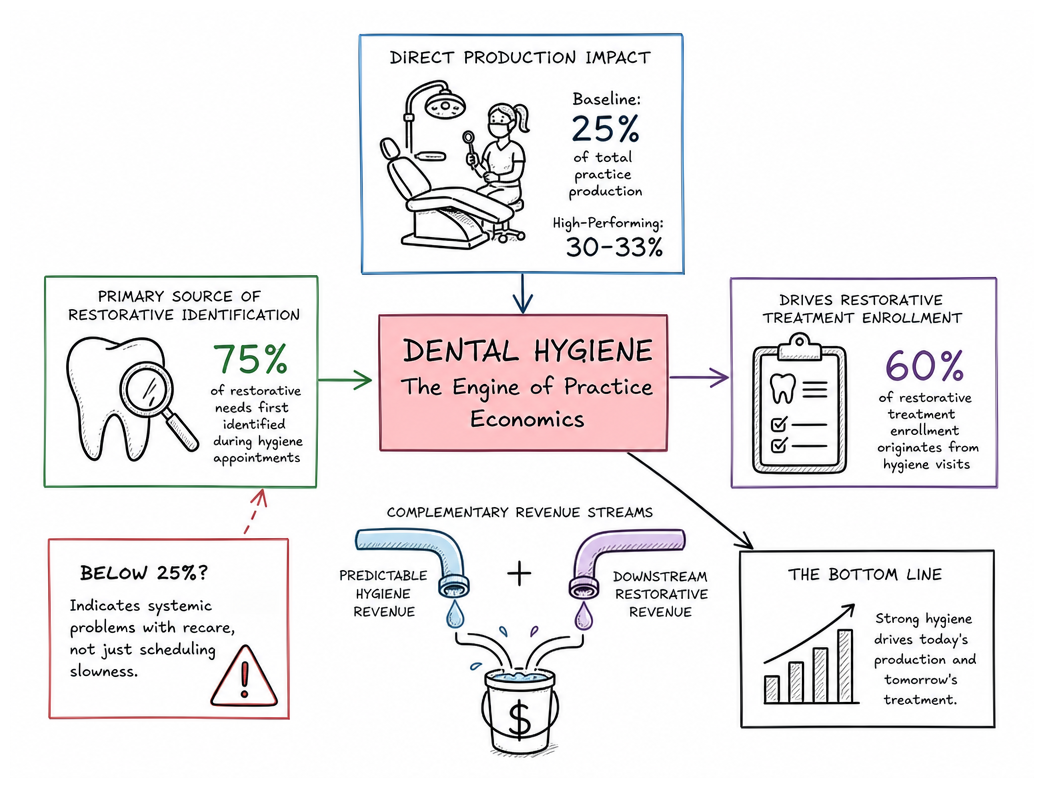
That's the Americans Dental Association baseline of 25 percent. High-performing departments push to 30–33%. Below that line, and you're not looking at a slow schedule. You're looking at a broken recare system.
The benchmarks that mean something:
| Benchmark | Target | Context |
|---|---|---|
| ADA baseline | 25% of total adjusted production | Standard minimum |
| High-performing | 30–33% of total adjusted production | Where strong departments land |
| Restorative enrollment | 60% should originate from hygiene visits | (Not a number most hygienists ever see — it lives in the practice management dashboard, not the operatory.) |
| Restorative discovery | 75% of needs first identified during hygiene | This is where the real work happens |
Recurring revenue is to a subscription business what hygiene is to a dental practice — predictable foundational, and almost impossible to rebuild once you let it erode.
The American Dental Association has found that when hygiene production stays below 25%, it's not usually a clinical failure, but a systems failure. This low rate could be caused by missed recall appointments, gaps in your schedule or shorter visit times with no case discovery. The common point is these things reduce your percentage, but aren’t necessarily the fault of your clinical skills.
Your hygeinists being on the recare schedule probably isn't the question if you're staring at less than 25% right now.
The question is whether your recare machine is actually running—and that's where production literacy starts to separate practices that know their numbers from ones that just hope the schedule fills.
So What Does "Hygiene Production" Actually Mean in Real Life?
Think about this gap for a moment: even if you're the most clinically skilled and a patient favorite with zero complaints, you can still shrink the practice's production numbers. This tells the whole story of this section.
Q: What counts as hygiene production?
A: All of the billable services you provide. This can include things like fluoride treatments, sealants, X-rays, perio therapy, and prophylaxis. Essentially, if a patient's insurance is billed, and it's listed on your ledger, it counts. According to the American Dental Association, hygiene production should be at 25% of your total adjusted production. Most hygenists I know have never even seen their own production report. (Not included in the job description. Should be.)
Q: What's the impact of a hygienist's schedule on the profitability of a practice?
A: It's a lot more direct than many hygienists think - but you won't see it until you look at the numbers. Shortened appointments, missed recare sequences, gaps in the schedule. They don't just slow down the day — they drain patients from the system and slash production percentage. That revenue doesn't come back, whether your hygiene chair is sitting empty for two days a month or operating 15 minutes short for each patient. This loss in predictable income also means diminished case flow for restorative.
Q: What happens when hygiene production falls below 25%?
A: That's a sign you have a broken recare system -- not a slow market. Your practice unfortunately loses its foundation, that baseline, steady recare income that pays the bills between bigger cases. But also, less hygiene means less restorative needs coming in -- either because hygiene isn't creating the case through identification, or because they're not building the trust needed for treatment acceptance.
Q: If you're a strong clinician, are you instantly a high producer?
A: Not always. If you’re the hygienist in the practice with the best patient satisfaction scores, that doesn’t automatically translate to strong production numbers — and that gap matters. Clinical skill and production literacy are two separate things. A hygienist can do everything perfectly during recleanings and exams and still come up short financially if appointments stack over, recare leaks patients, or scheduling runs loose. Production literacy is a clinical skill, not just a management skill, and it can change how you show up at work.

Your Paycheck, Your Benefits, Your Responsibility
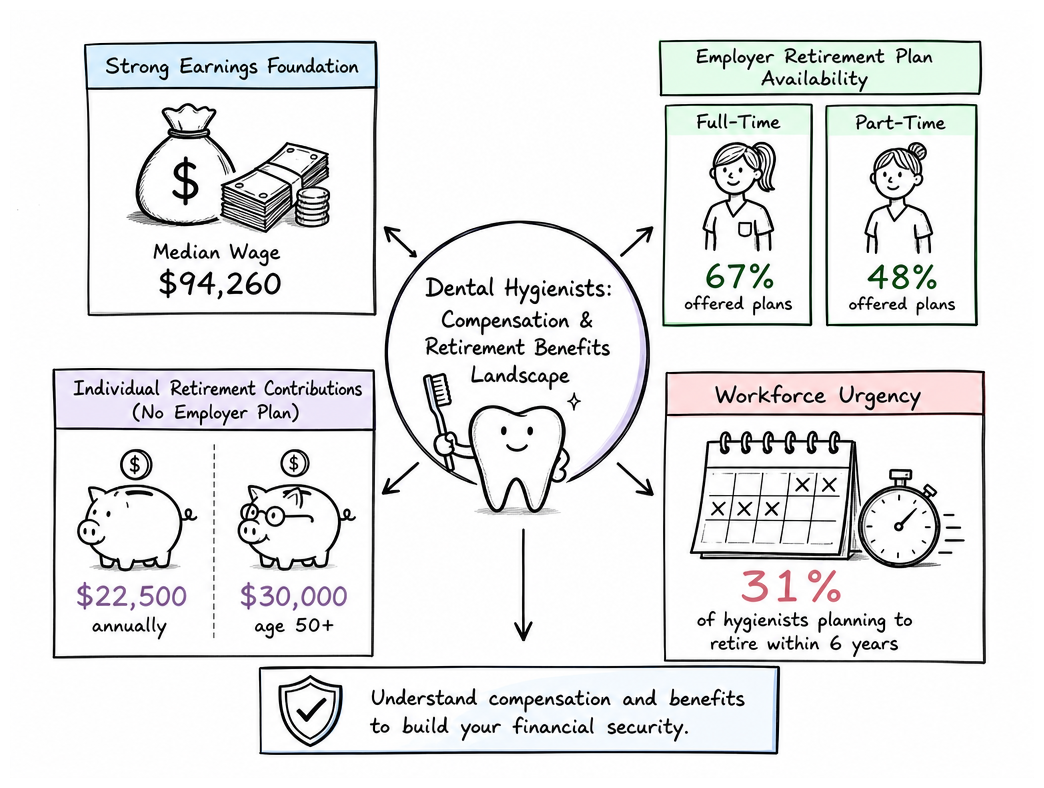
Dental hygienists make real money - In fact, according to the U.S. Bureau of Labor Statistics, dental hygienists make a median of $94,260 per year. But if you're part of the 33 percent without a retirement plan or any other savings strategy to speak of, pretty much almost all of that amount is besides the point.
That gap looks like this: among full-time hygienists, 67 percent are offered retirement plan through their employer. For part-time hygienists, that number drops to 48 percent. If your employer isn't offering a plan, or you don't have one, you are solely responsible for paying for continuing education, taxes, an emergency fund, retirement, and everything else.
As per Teero, you can save a maximum of $22,500 in your 401(k) for 2025. If you're 50 or above, you can tack on catch-up contributions of $7,500, or $30,000 total. While that's the max contribution, most hygienists don't come close — not because they can't, but because no one built the habit.
Here's a tangible way production literacy affects your wallet: If you understand how production translates to compensation, you approach the conversation with a different mindset. While a hygienist may not even be asking for a raise, if they can explain how their production contributes to the 25-35 percent benchmark, they're showing them the math. My bet is that this difference in framing might just create a different outcome than anything else in the room.
The strain on the workforce continues to escalate. A survey from Becker's Dental Review revealed that 31 percent of hygienists intend to retire within six years. As this threatens to shrink the workforce, financial literacy goes from a nice-to-have to a survival skill. Practices that retain top performers are not just paying them; they are beginning transparent conversations about cash flow, potential profit, and how money works in the business.
Why Does Being Business Literate Affect How You Show Up at Work?
Here's the reality: hygienists are responsible for about 30% of all practice revenue. But when that revenue's decided on — or when it gets talked about — they're hardly ever in the room.
But, when it comes to understand the economics, that changes.
RDH Magazine states that hygiene can contribute anywhere from 25–35% of gross practice production. (Notice how many practice valuations that benchmarks shows up on.) That percentage - it's real. It can help you with leverage in your compensation conversation, an understanding of what a full schedule means financially and how you can be involved in practice strategy talks.
More than anything, this makes me view my daily job this way:
- Recare retention is revenue protection Keeping patients coming back isn't just about making them happy as a customer — it's about keeping 25–35% of the revenue stream for the practice. If they're not coming back, you're missing revenue. When you see it this way, recare is a business priority rather than a clinical action item.
- Stop being oblivious to your schedule. When you book 6-8 patients a day but don't know what your practice should be producing, in dollars, you're really flying blind. Now, you know where you are against the benchmark--and if you're carrying your weight, or under-leveraged.
- Say Goodbye to Guesswork in Pay Negotiations. When you understand the practice's margin and know how to communicate your production contribution, you're going to enter benefit and pay talks with data (not hope).
- Many new doors open from here. Independent practice, DSO roles, practice ownership — they all start here. Business fluency isn't optional in those spaces; it's the foundation.
Knowing the numbers is like reading a map — the job is the same, but you can navigate it intentionally.
The Dental Strategy Institute develops resources to help dentists make this exact transition - going from a clinical producer to someone who understands the full picture of practice economics. My guess is that the compounding growth of this phenomenon occurs much quicker than most hygienists expect, especially once those conversations stop being guesses and start being backed by data.
Business literacy is an important skill that separates hygienists that thrive from those who don't -- no matter whether they stay in their current role, go leadership, or decide to go it alone.
What's Next for Hygienists?
To put things in perspective, the rate of growth anticipated in hygienist employment (7% through 2034) is higher than the average for all occupations. (No typo.) But most professionals entering this field will have zero clarity on how a practice actually makes money. Sit with that gap for a second.
If you are a hygienist who can explain what your chair produces - you negotiate differently, you evaluate opportunities differently, and even move differently. That's the whole story of what business literacy does for your career, more than any single credential could tell you.
What we encourage you to do next:
- Find out the standards for production at your practice and where hygiene actually sits against them — one dialog like this could change how you're valued in salary talks
- Think of dental hygiene business knowledge as a continuing education priority, not an optional extra — it will be the foundation for whatever path you take moving forward
- Start asking questions about recare protocols, patient retention metrics, and how your department feeds the practice bottom line
- Whether you stay put, go independent, or step into a leadership seat, business fluency is the common thread
Long term success for hygienists comes down to being able to view the whole picture — patient care and the economics of your practice.
I'm guessing that professionals who skip this step still have jobs - but they just won't have leverage. The ones who don't? They're taking career moves not just based on availability, but intent. This isn't just overhead thinking — it's professional evolution.
Stay connected with news, offers and updates!
Join our mailing list to receive the latest news, offers and updates from our team.
Don't worry, your information will not be shared.
We hate SPAM. We will never sell your information, for any reason.