
Dentists Are Buying Software Instead of Operatories in 2026
Aug 07, 2026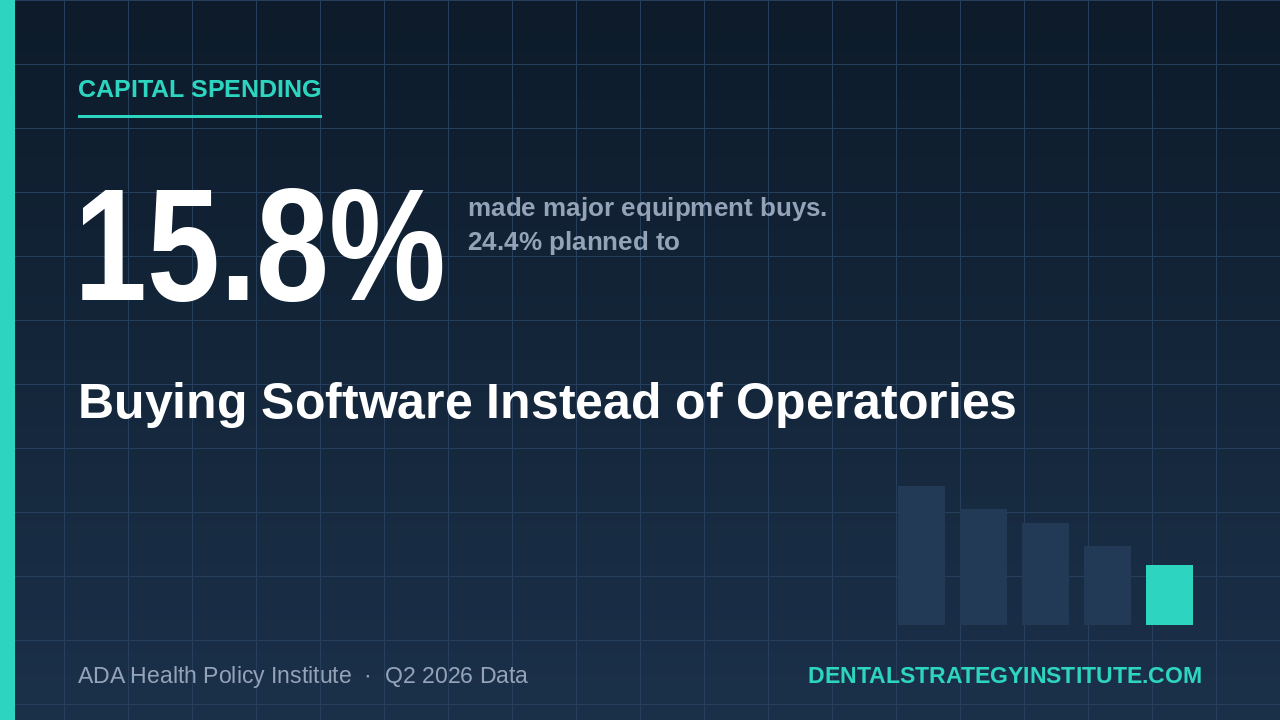
I spent twenty-five years on the manufacturing side of this industry, which means I've sat through a lot of forecast meetings where somebody held up a survey showing dentists planned to buy equipment. Those forecasts were usually wrong in a predictable direction.
The ADA's Q2 2026 report just published the cleanest evidence I've seen for why.
The follow-through gap
In Q4 2025, the Health Policy Institute asked owner dentists what they planned to do in 2026. Six months later they asked the same panel what they'd actually done. Here's how the capital line items landed.
Major equipment purchases: 24.4% planned, 15.8% executed. A shortfall of roughly 35%.
New software investment: 16.9% planned, 17.5% executed. They beat their own plan.
Adding staff: 42.3% planned, 39.4% executed. Close to target, and the highest follow-through rate of anything on the list.
Read those three together and you get a clear hierarchy of what dentists protect when money gets tight. People first. Software second. Operatories last.
Why equipment is always the flex
Capital equipment has a property that makes it uniquely easy to defer: nothing bad happens this quarter if you don't buy it.
Skip a hire and your schedule breaks next week. Skip a practice management upgrade and your claims sit longer, your recall lapses, your front desk complains loudly and daily. Skip replacing a nineteen-year-old chair and the chair goes up and down tomorrow exactly like it did today.
The cost of deferral is real but it's deferred, which is a very different thing psychologically. It shows up as a service call, then as downtime, then as a patient who noticed the upholstery, then eventually as a diligence finding when you try to sell. None of it arrives in the month you made the decision.
Add the financing environment and the picture sharpens. Equipment purchases usually require credit, and credit decisions in a year where you're watching a 4-point gap between your cost growth and your reimbursement growth feel a lot heavier than a software subscription you can cancel.
Which brings me to the part that actually changed.
Software won because the ask got smaller
The reason software beat plan while equipment missed isn't that dentists suddenly love technology. It's that the two purchases stopped resembling each other.
Equipment is capital. It's a five-figure or six-figure commitment, it's financed, it's depreciated, and it sits on your balance sheet for a decade. Software is now overwhelmingly a monthly operating expense. No capital committee, no lender, no depreciation schedule. If it doesn't work you turn it off.
In a year when 43% of dentists are already running AI for something, the software line has also quietly absorbed a category of spending that didn't exist five years ago. Imaging AI, claims automation, note-taking tools, scheduling assistants. Those live in the software budget and they're marketed as margin recovery, which is precisely the pitch that lands when your reimbursement index is up 19% against 27% inflation.
So a practice under pressure defers the operatory and buys the tool that promises to make the existing operatory more productive. Given the economics in this report, that's a defensible call. I'd probably make the same one.
The compounding problem nobody prices
Here's what worries me about a second or third consecutive year of this.
Equipment doesn't stop aging because you stopped buying it. A practice that defers replacement in 2024, 2025, and 2026 isn't sitting still. It's accumulating a capital deficit, and that deficit has three costs that all arrive at once.
Service expense climbs first, and it climbs quietly, spread across invoices small enough that nobody adds them up. Then reliability starts costing you production, usually on the day you least wanted an operatory down. Then, whenever you decide to transition, a buyer's equipment diligence turns your deferred capital into a purchase price reduction. Every buyer I've ever worked with treats aging equipment as a dollar-for-dollar deduction plus a risk discount on top.
We wrote about this specifically in the hidden liability in every dental practice sale, because equipment is routinely the least documented and most casually valued asset class in a transaction. The 2026 deferral data suggests that problem is getting materially worse across the independent market.
Aesthetics matter too, and I say this as someone who spent a career around operatory design. Patients can't evaluate your clinical work. They absolutely can evaluate whether the room looks like 2026 or like 2009, and they'll form a quality judgment from it whether you think that's fair or not.
The DSO side is doing the opposite
This is where the market splits, and the split is widening.
Group practices treat equipment as portfolio capital rather than an annual decision. There's a replacement schedule, a standardized formulary, a credit facility, and a capital plan that runs on lifecycle data instead of on how the last quarter felt. When a chair hits end of life in a DSO location, it gets replaced because the model says so, not because the doctor decided this was the year.
That difference is invisible for about eighteen months and then it isn't. A group refreshing on schedule while independents defer produces a compounding gap in operatory condition, technology capability, and patient experience across the same local market. Three years of that and the practices are no longer competing on equal footing for the same patients.
The sample skew in this survey matters here, and it cuts in an interesting direction. The ADA's panel leans toward solo and small group owners. So the 15.8% follow-through figure almost certainly describes independent behavior more than group behavior. My read is the real number is bimodal: groups executing close to plan, independents well below it, averaging out to something that looks like general weakness but is actually a divergence.
If you operate a group, that's your opening. If you own a practice, that's your warning.
What I'd actually do with this
Independents should stop treating equipment as an annual yes-or-no and start treating it as a schedule. Build a simple replacement plan with age, expected life, and current condition for every major asset, then fund it as a monthly reserve rather than a lump decision you dread every January. Deferral becomes much less tempting when the money's already set aside. Our dental office build tool is useful for scoping this, and DentalAssetIQ covers valuation and lifecycle in more depth.
Group operators should look at the acquisition implication. Every independent practice in your pipeline has been deferring capital for three years, and their asking price probably doesn't reflect it. Equipment diligence has rarely been worth more than it is right now.
And if you sell into this market, understand what the data is telling you. The budget didn't disappear. It moved. It moved to the line item that promises productivity from assets already on the floor, and it will keep moving there until the reimbursement side of this equation starts behaving differently.
Which, based on everything else in this report, is not a 2026 story.
Source: ADA Health Policy Institute, "The State of the U.S. Dental Economy, 2nd Quarter 2026 Update," based on owner dentist responses across the Q4 2025 and Q2 2026 survey waves.
Stay connected with news, offers and updates!
Join our mailing list to receive the latest news, offers and updates from our team.
Don't worry, your information will not be shared.
We hate SPAM. We will never sell your information, for any reason.