
Hygiene Capacity Utilization: What the Benchmark Data Says and How to Close the Gap
Jun 17, 2026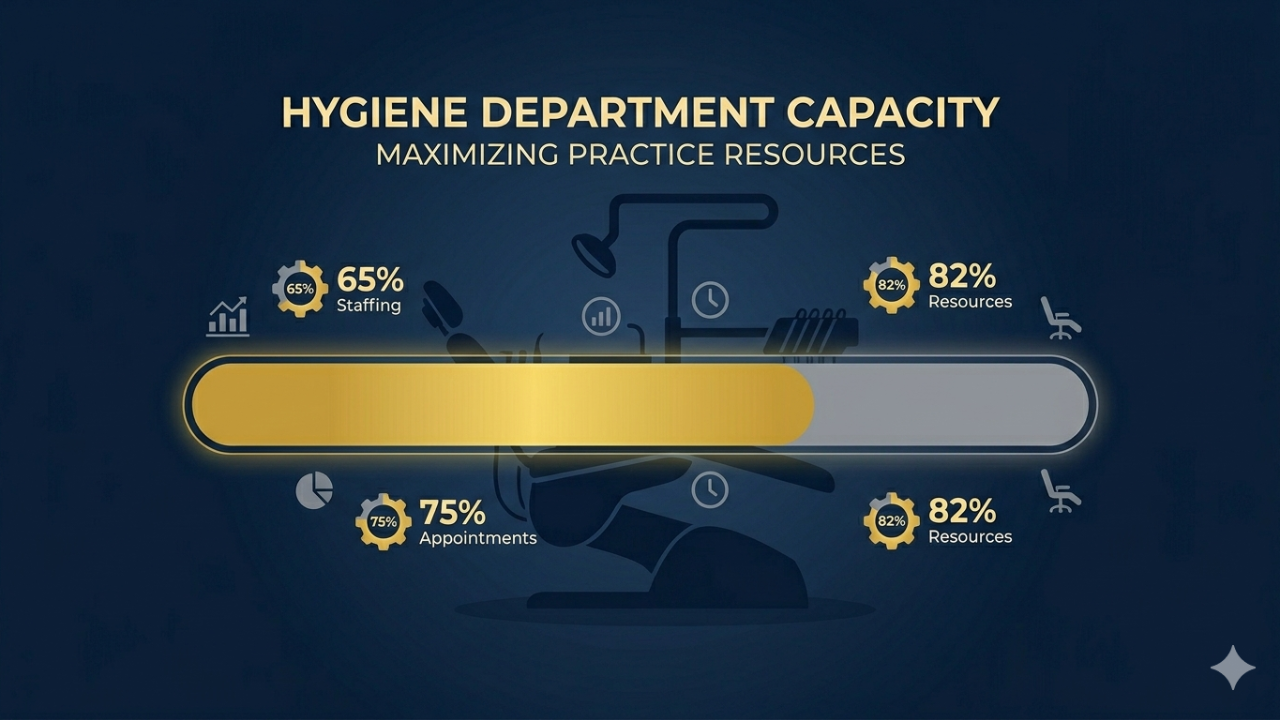
The hygienist shortage is the most discussed operational problem in dentistry right now. But the conversation almost always focuses on hiring — finding hygienists, paying them more, offering better schedules.
What gets talked about less is the math of what unfilled hygiene capacity actually costs you per week, per month, per year. And how most practices dramatically underestimate that number.
The Hygiene Capacity Problem in Numbers
Hygiene production typically represents 28–38% of total practice production in a well-run general practice. That means a practice collecting $2M annually should be generating $560,000–$760,000 from hygiene alone.
When hygiene chairs sit unfilled, you're not just losing the hygiene production. You're losing:
- The hygiene revenue itself
- The doctor exam fees attached to hygiene visits
- The restorative treatment that hygiene visits diagnose and schedule
The rule of thumb: every unfilled hygiene hour costs the practice 2–3x the hygiene production rate when you account for downstream production.
What Good Hygiene Utilization Looks Like
The DSI Benchmark Index tracks hygiene capacity utilization — booked hygiene hours ÷ available hygiene chair hours — as a core metric across all contributing practices.
Here's what the data shows:
| Percentile | Utilization Rate | |---|---| | P10 (bottom 10%) | Below 55% | | P25 | 65% | | P50 (median) | 75% | | P75 | 85% | | P90 (top 10%) | 93%+ |
If your hygiene chairs are booked at 70% or below, you're leaving meaningful revenue on the table — and the Hygiene Capacity Optimizer will tell you exactly how much.
The Reappointment Rate: The Metric Most Practices Don't Track
Reappointment rate — patients leaving their hygiene appointment with their next appointment already scheduled — is the single highest-leverage number in hygiene management.
Why it matters more than new patient volume: A practice with 45% reappointment rate has to work three times as hard to maintain the same active patient base as a practice with 75% reappointment rate. Every patient who leaves without a scheduled return appointment has a 30–40% chance of falling out of your active patient base within 18 months.
Benchmark data:
- P25: 55% reappointment rate
- P50: 65%
- P75: 75%
- P90: 85%+
If yours is below 50%, your front desk checkout process is the first place to look.
Perio Revenue: The Underperformance That Compounds
Perio share of hygiene revenue — what percentage of hygiene production comes from perio procedures like SRP and perio maintenance — benchmarks at 18% at the median for general practices.
Most practices running below 10% perio share are either underdiagnosing periodontal disease, underselling perio treatment, or both. Given that roughly 47% of adults over 30 have some form of periodontal disease (CDC data), a practice with 5% perio share almost certainly has a clinical documentation and case presentation gap.
The Assisted Hygiene Question
One of the most common questions DSI gets from practice owners: Should I add a dental assistant to hygiene?
The short answer: it depends on your current utilization and hygienist productivity multiple.
If your hygienist is already running at 90%+ utilization and producing 2.5x or more of their compensation, adding an assistant to allow expanded appointment capacity is almost always ROI-positive. If utilization is below 75%, the problem isn't capacity — it's demand, reappointment, or scheduling efficiency.
The Hygiene Capacity Optimizer models both scenarios with your actual numbers.
Common Questions
What is a good hygiene productivity multiple? Hygiene production ÷ hygienist total compensation. The median benchmark is approximately 2.1x. Top-quartile practices run 2.7x+. Below 1.6x and the hygiene department is a financial drag — usually caused by low utilization or underpriced hygiene services.
How do I calculate my open hygiene hours per week? Available hygiene chair hours per week minus booked hours. If you have 3 hygienists each working 32 hours/week but only 72 hours booked, you have 24 open hours per week — worth approximately $2,400–$3,600 in lost weekly production at standard hygiene rates.
What's causing the hygienist shortage? Supply constraints from fewer hygiene graduates, expanded employment options (DSOs, corporate practices, temp agencies), and wage competition. The practices capturing available hygienists are offering flexibility, strong production bonuses, and schedules that work for part-time preferences. The benchmark data on C2 (hygienist hourly wage) by region gives you a clear picture of where your wages sit competitively. For hygienists weighing whether employed capacity constraints are worth working around at all, see Going Independent: What Every Dental Hygienist Should Know Before Leaving the Chair.
Does the DSI Hygiene Capacity Optimizer work for pediatric practices? Yes, though the benchmark comparisons are most accurate for GP practices. Pediatric hygiene utilization patterns differ — reappointment rates tend to be higher (parent-driven scheduling), but perio share will be lower by nature.
Related Reading
- Going Independent: What Every Dental Hygienist Should Know Before Leaving the Chair
- Myofunctional Therapy as a Career: What It Actually Pays
- What Is a Good Production Per Operatory Number?
- How to Exit Your PPO Contracts Without Losing Patients
- The Real Cost of Staying In-Network
Find out exactly how much your open hygiene hours are costing you.
The DSI Hygiene Capacity Optimizer calculates your utilization rate, reappointment rate, perio share, and productivity multiple — then models the revenue recovery from closing your capacity gap.
Run Your Free Hygiene Capacity Analysis →
Takes under 5 minutes. Free. Your data is never shared.
Stay connected with news, offers and updates!
Join our mailing list to receive the latest news, offers and updates from our team.
Don't worry, your information will not be shared.
We hate SPAM. We will never sell your information, for any reason.