
North Carolina Just Opened the Gate — And Park Dental Walked Through It in 34 Days
Aug 12, 2026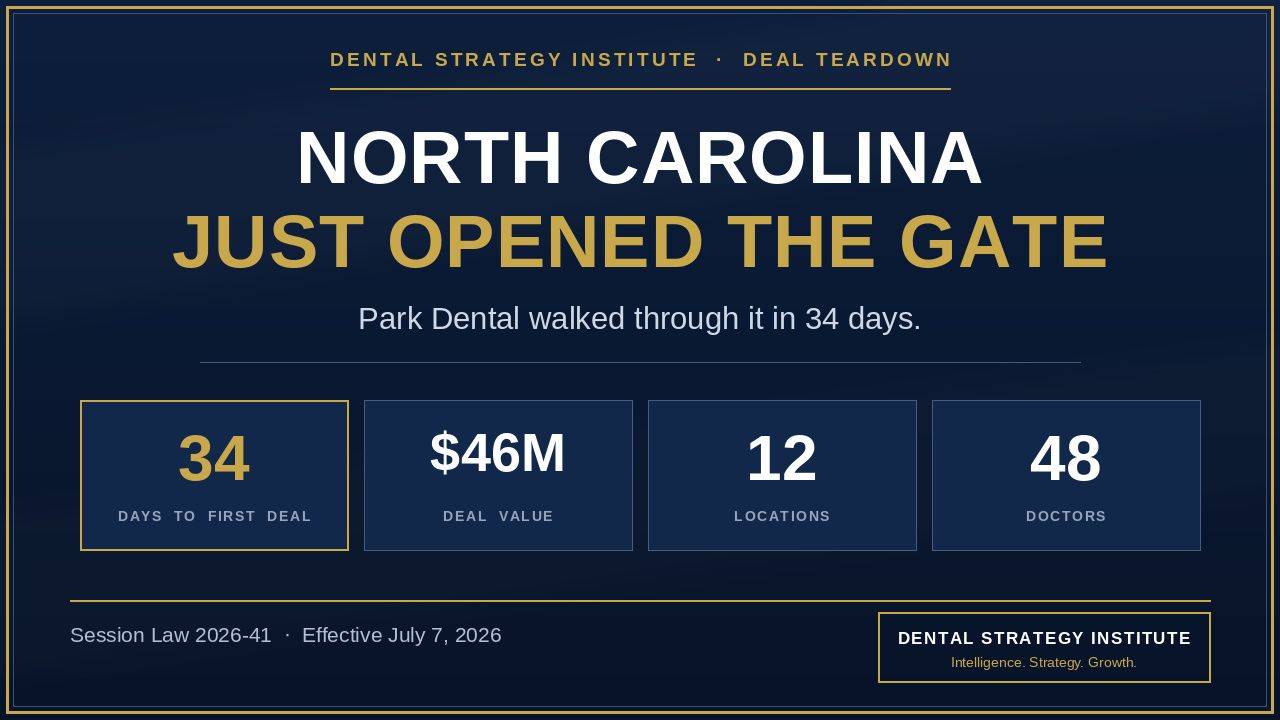
Thirty-four days.
That's how long it took. North Carolina's new law killing the dental board's pre-approval requirement for management agreements took effect on July 7, 2026. On August 10, Park Dental Partners announced it was buying Village Family Dental — twelve locations, forty-eight doctors, eastern North Carolina — for up to $46 million. First real move into the state by a publicly traded DSO since the rules changed.
I don't think that's a coincidence, and I doubt you do either.
If you own a practice or a group in North Carolina, this is the moment your market changed. Not in some abstract policy-wonk way. In the concrete, your-phone-is-going-to-ring way. So let's talk about what actually happened, what didn't happen, and what a reasonable person should do about it.
The thing that changed
Back in 2012, North Carolina passed Session Law 2012-195. If you were practicing then you probably remember the noise around it. The law required that any management agreement between a dentist and a management company get submitted to the North Carolina State Board of Dental Examiners for compliance review — before you signed it. The board could issue advisory opinions. It could audit. It could investigate. The agreement had to spell out services, compensation methodology, all material terms, plus a conspicuous warning telling you to go get a lawyer.
Fourteen years that stood. And it worked more or less exactly as intended, which is to say it made North Carolina a genuinely annoying place to close a DSO transaction.
Session Law 2026-41 gutted the front end of it. Effective July 7, management arrangements are now executable "without pre-approval, approval, determination of compliance or review by the Board." The board can no longer make the validity of your management agreement contingent on its own blessing.
Here's what survived, and this part matters more than the headlines suggest. Written agreements are still required, still have to specify services and compensation methodology and material terms. Clinical control still can't sit with a non-licensee. The board keeps every bit of its investigative and enforcement authority — it can still audit you, still act on complaints, still enforce the Dental Practice Act. What you lost was the gate. What you kept was the cop.
That's a meaningful distinction and I'd hate for anyone to read this and think North Carolina turned into the Wild West. It didn't. The scrutiny just moved from before the deal to after it, which is a different risk profile entirely — and arguably a worse one if your paperwork is sloppy, since now nobody tells you it's wrong until they're already investigating you.
The thing that didn't change
Worth saying plainly, because I've already seen people get this wrong in a couple of LinkedIn posts this week.
North Carolina did not legalize non-dentist ownership of dental practices. Dentists still have to own the practice. The state Senate did try — there was budget language that would have opened ownership to private equity and hedge funds — and the House stripped it out of its own spending plan back in May 2025. Senate Bill 599, the companion effort to restructure the dental board and shift appointments from the profession to elected officials, stalled in House Rules and never came back.
The North Carolina Dental Society fought both of those hard, and on those two fronts they won.
So the structure hasn't changed. A DSO entering North Carolina still operates through the same management services architecture it uses in every other restrictive state: dentist-owned professional entity on the clinical side, management company on the business side, tied together by an agreement. What changed is that you no longer have to walk that agreement past the board before it means anything.
Sounds procedural. It isn't.
Why a gate nobody talks about mattered so much
Every buyer I've ever known prices risk into a deal, and regulatory uncertainty is the most expensive kind. It doesn't just cost money — it costs time, and time kills transactions.
Picture the pre-July version of this deal. Park signs with Village. The management agreement goes to Raleigh. Now the closing calendar depends on a board's queue and a board's opinion, and if that board comes back with changes, everybody's lawyers reopen documents that both sides thought were done. Financing commitments have expiration dates. Sellers get cold feet. Diligence goes stale.
Now look at the actual Park–Village agreement. The 8-K sets an outside date of 120 days after August 7 — roughly December 5. Either side can walk after that. Try running that clock through a board review process and tell me you're comfortable.
Some national buyers simply skipped North Carolina. Others came in but discounted their offers for the friction. That discount was real money out of North Carolina sellers' pockets for fourteen years, and nobody ever itemized it on a term sheet.
That's gone now. And the first buyer through the door was a company that, by any measure, had every reason to move fast.
Park's timing tells you what they think
Look at what Park Dental Partners actually is, because the timing makes more sense once you do.
They're small. Nasdaq-listed since December 2025, about $94 million of market cap on roughly 4.5 million shares, with something like 248 million dollars of trailing revenue. Before this deal: 222 doctors, 87 locations, three states. They carry about $11.5 million of debt against guided EBITDA of $21–23 million — call it half a turn of leverage.
Half a turn. In an industry where the leveraged platforms built on 2019-era money are choking. Dental Care Alliance just wiped out more than $1.1 billion of debt in a lender-led restructuring, with institutional creditors taking majority ownership. That's not an outlier story anymore, it's the cohort.
So you've got a buyer with a clean balance sheet, $24.4 million of cash, an undrawn revolver, and public currency — sitting there watching a state with roughly ten million people suddenly get a lot easier to transact in. Of course they moved in thirty-four days. I'd have moved in thirty-four days.
What that tells you about the next eighteen months should be obvious. Park is not the only buyer who noticed.
The honest bull case for eastern North Carolina
Now, the part where I try not to be reflexively cynical, because there's a real thesis here and it deserves a fair hearing.
Village Family Dental sits in Fayetteville, Hope Mills, Eastover, St. Pauls, Raeford, and Laurinburg. That's Cumberland, Robeson, Hoke, and Scotland counties, plus Fort Bragg. Lower-income territory, heavy military population, and — since North Carolina expanded Medicaid in December 2023 — several hundred thousand newly covered adults across the state who didn't have dental coverage before.
Here's the interesting wrinkle. North Carolina Medicaid reimburses at roughly 34 cents on the dollar, a rate that hasn't moved since 2008. House Bill 60 would push it to 46 percent and has been sitting in Appropriations since February 2025 going nowhere. The consequence is that close to 60 percent of North Carolina dentists don't take Medicaid patients at all.
Read that as a buyer and it's not a warning. It's a moat.
If most of your competition has voluntarily walked away from a payer class, and that payer class just got dramatically larger, and you're one of the few groups in the region with twelve locations and twenty-two specialists already built to absorb the volume — you have something close to a regional monopoly on newly funded demand. Low rate per procedure, but enormous procedure volume and almost no competition for it. That's a genuine business, and it's a business that gets meaningfully better the day Raleigh finally raises the rate.
Village has been in Fayetteville since 1985. Forty-one years. Five owner-doctors, twenty-six general dentists, twenty-two specialists. That's not a distressed seller taking whatever's offered. That's a scaled, entrenched operator that chose its moment.
And the honest bear case
Reimbursement set by a legislature is not the same thing as reimbursement set by a market. Eighteen years without a rate increase should tell you how urgently North Carolina's General Assembly treats dental Medicaid. Buy a revenue stream priced in Raleigh, and you've taken on political risk that no operating improvement can hedge.
Current 2026 deal benchmarks put Medicaid-heavy practices a full one to two turns of EBITDA below comparable fee-for-service groups. Whether Park got that discount — or paid fee-for-service prices for a Medicaid book — is a question neither company has answered. Park redacted the EBITDA schedule in its 8-K, and nobody disclosed payer mix.
Military markets carry their own quirk too. TRICARE dental is stable revenue with a transient patient base, and base population is a federal budget decision. Predictable, but not yours to control.
I lean bullish on this particular deal, for the record. The moat argument is stronger than the rate argument is weak, and forty-one years of local brand equity in a market where most competitors won't serve the majority payer is genuinely hard to replicate. But anyone selling you certainty on eastern North Carolina dental economics is selling you something.
What North Carolina owners should actually do
Let me be direct about the part that affects you.
The gate is open, buyers know it, and there's a window. In every consolidation wave I've watched — and I've watched a few now — the sellers who transact in the first twelve to eighteen months get better terms than the ones who wait for the market to "mature." Early deals are competitive. Buyers are trying to establish a beachhead, they want a flagship, and they'll pay for speed and certainty. Late deals are cleanup. By then the buyer already has scale in your market and your practice is a tuck-in, which is a much less flattering position to negotiate from.
Park just planted a flag in eastern North Carolina and said out loud that it intends to build a regional platform there. Read that sentence again if you practice within an hour of Fayetteville. You're either a partner in that platform, a competitor to it, or an acquisition target for it, and you get some say in which — but only for a while.
None of that means sell. I want to be careful here, because urgency is exactly the emotion a buyer wants you feeling, and the worst deals I've seen came from dentists who transacted because the market was hot rather than because it was their moment. Plenty of North Carolina dentists should be running an internal succession to an associate instead, and would end up with better after-tax economics and dramatically better terms.
What it means is get ready. Which is a different thing entirely.
Know your adjusted EBITDA before someone else calculates it for you. Understand your payer mix as a buyer will underwrite it, because in this state that number moves your multiple by one to two turns. Get your management agreement reviewed by counsel now — remember, the board lost its pre-approval power but kept every bit of its enforcement authority, and post-execution enforcement is a nastier surprise than a pre-closing correction ever was. And if anyone puts a term sheet in front of you, decompose the headline number before you let yourself feel anything about it.
That last one is where most sellers lose the most money, and it's got nothing to do with North Carolina.
The number that isn't the number
Park's offer for Village is "up to $46 million." Watch how that comes apart.
Base consideration is $39.1 million, and $9.2 million of that is restricted Park stock rather than cash. The remaining $6.9 million is contingent — up to $4.6 million tied to EBITDA performance across two measurement periods, and up to $2.3 million paid over five annual periods tied to employment. Then there's a working capital peg of $3,075,963 and three separate escrows coming off the top.
Cash actually crossing the table at closing is somewhere around $29.9 million before escrows. That's about 65 percent of the headline, and 65 percent is on the good end of the range for deals like this.
That's the part I'd want a North Carolina dentist to internalize before the calls start. The gate opening is real and it's in your favor. More buyers means more competition means better terms, and that's a genuinely good thing for sellers in this state after fourteen years of paying a friction discount nobody ever named.
Just don't let a bigger headline number distract you from a smaller real one. Those two figures have never been the same, in any state, under any regulatory regime. All that changed in July is how quickly you'll get the chance to find out.
Going deeper on deal structure. Everything in that last section — earn-outs, rollover equity, escrows, working capital pegs, and the gap between the headline and the wire transfer — is what The Earn-Out Trap covers clause by clause. If a term sheet is coming your way, read it before you sign anything.
The Dental Strategy Institute publishes independent analysis of dental transactions and deal structure. We're not investment advisors, we're not attorneys, and nothing here is a recommendation to buy, sell, or hold anything. If you're evaluating a transaction, hire people who owe you a fiduciary duty.
Sources
- Holland & Knight — North Carolina Removes Prior Review Requirement for Dental Management Agreements
- McGuireWoods — North Carolina Eliminates Board Pre-Approval for Dental Management Arrangements
- UNC School of Government — Dentistry Management Arrangements (SL 2012-195)
- North Carolina Health News — Dentists press lawmakers on private equity rules, Medicaid reimbursement rates, self-governance
- North Carolina Health News — Is NC dental profession oversight/business model about to change?
- Park Dental Partners 8-K, filed August 7, 2026
- Park Dental Partners — Agreement to Acquire Village Family Dental
- Park Dental Partners Q1 2026 earnings transcript
- CT Acquisitions — Dental & DSO M&A Multiples 2026
- Dental Economics — Dental Care Alliance's restructuring signals a new era for DSOs
Stay connected with news, offers and updates!
Join our mailing list to receive the latest news, offers and updates from our team.
Don't worry, your information will not be shared.
We hate SPAM. We will never sell your information, for any reason.