
What Is a Good PPO Write-Off Rate? Dental Benchmark Data and the Drop-Plan Analysis
Jun 19, 2026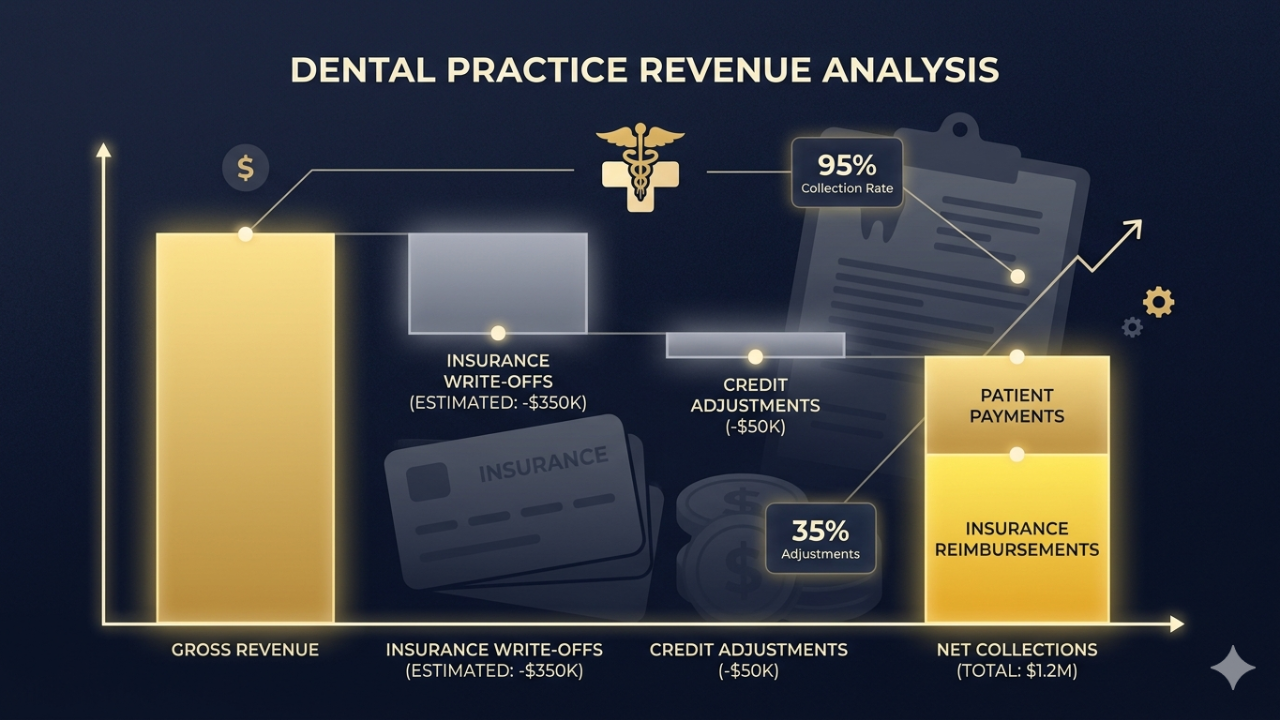
Most dentists know their PPO write-off rate is high. Few know exactly which plans are the worst offenders, what it's actually costing them in annual dollars, and what would realistically happen to their revenue if they dropped one.
That's not a knowledge problem — it's a data problem. The analysis exists. Most practices just never run it.
What a PPO Write-Off Rate Actually Tells You
PPO write-off rate = contractual adjustments ÷ PPO gross production.
At the national median, general dental practices write off approximately 28–32% of their PPO gross production to contractual adjustments. That means for every $100 in PPO production, the practice collects about $68–$72.
What the benchmarks show by percentile:
| Percentile | PPO Write-Off Rate | |---|---| | P10 | 15% | | P25 | 22% | | P50 (median) | 30% | | P75 | 38% | | P90 | 46%+ |
If you're at or above the 75th percentile — meaning your write-off rate is 38% or higher — you're in the bottom quarter of PPO economics. Some plans in that range are genuinely destroying practice value.
The Payor Mix Question
Payor mix — the split between FFS, PPO, and Medicaid patients — is one of the most consequential decisions a practice makes, and most practices let it evolve by accident rather than manage it intentionally.
National median payor mix for general dental practices:
- FFS: ~20% of production
- PPO: ~65% of production
- Medicaid/government: ~5% of production
- Remainder: other/uninsured
Practices in the top quartile on overall financial performance tend to run 30–45% FFS. That's not a coincidence. FFS patients pay full fee, have no network restrictions, and generate substantially higher production per visit.
The payor mix math: If your practice produces $100,000/month and runs 70% PPO at a 32% write-off rate, you're netting about $76,000 from the PPO portion. The same $70,000 in gross production from FFS patients would net the full $70,000 — plus you'd eliminate the administrative cost of insurance billing.
Claim Denial Rate: The Silent Revenue Leak
Claim denial rate — first-submission denials ÷ claims submitted — benchmarks at roughly 8–12% at the national median. Top-quartile practices run below 6%.
Every denied claim costs the practice:
- The delay in payment (typically 2–4 additional weeks minimum)
- Staff time to resubmit (~15–20 minutes per denial on average)
- A percentage of denials that never get resubmitted
At 15%+ denial rate, you likely have a documentation, coding, or eligibility verification problem. The PPO Profitability Analyzer flags where your denial rate sits relative to peers.
The Drop Scenario: What Actually Happens When You Leave a Plan
The most common fear about dropping a PPO plan: "I'll lose those patients and the revenue will disappear."
The data-supported reality is more nuanced:
What typically happens when a practice drops a PPO plan:
- 60–70% of patients on that plan will stay with the practice and pay out-of-network rates or whatever their plan's OON benefit allows
- 15–25% will move to an in-network provider
- 5–15% will become FFS patients (often the highest-value segment)
The revenue calculation: If you're producing $200,000/year from a plan with a 42% write-off rate, you're netting approximately $116,000 from those patients. If 65% stay at your full fee schedule after you drop the plan, you'd collect $130,000 from 65% of the patient volume — and save the administrative overhead of a plan that was destroying 42% of its gross production.
This is exactly what the drop-scenario model in the PPO Profitability Analyzer calculates with your actual plan numbers.
Top Payor Concentration: The Risk Nobody Talks About
Top payor concentration — net production from your largest single payor ÷ total net production — is a risk metric. The benchmark median is around 35–42%.
If your largest single payor accounts for 55%+ of your net production, you are operationally dependent on a vendor that can change reimbursement rates, narrow its network, or exit your market. That's business concentration risk that affects practice value.
Buyers and lenders — especially DSOs and PE-backed groups — look at payor concentration as a risk factor in valuation. A practice with diversified payor mix commands a premium over one that's highly concentrated in a single plan.
Common Questions
How do I find my contractual adjustments by plan? Your PMS Insurance Analysis or Payor Analysis report breaks adjustments by plan. In Dentrix, it's under Reports → Management → Insurance Carrier. In Eaglesoft, it's under Reports → Insurance → Carrier Analysis.
What is a good PPO write-off rate to target? Below 25% is strong. 25–35% is typical. Above 38% should trigger a renegotiation or exit conversation with your dental consultant or DSI.
Should I negotiate fee schedules before dropping a plan? Yes, almost always. Many practices successfully renegotiate PPO fees every 2–3 years. Even a 5% fee increase across a $300,000 PPO book of business is $15,000 in annual revenue. Start there before dropping.
What's the difference between write-off rate and adjustment rate? Write-off rate refers specifically to contractual PPO adjustments. Overall adjustment rate (metric A5 in the DSI framework) includes all adjustments — PPO contractual, professional courtesy, bad debt write-offs, and other discounts. The two should be tracked separately.
Related Reading
- How to Exit Your PPO Contracts Without Losing Patients
- How to Go Insurance-Free: The Practice Transition Framework That Actually Works
- What Is a Good Production Per Operatory Number?
Run your free PPO profitability analysis.
Enter your payor mix, write-off rates by plan, and claims data. Get your write-off rate percentile, denial rate benchmarks, and a drop-scenario model showing revenue at risk vs. potential FFS recovery.
Run Your Free PPO Profitability Analysis →
Takes under 5 minutes. Free. No credit card. Your data is never identified in published benchmarks.
Stay connected with news, offers and updates!
Join our mailing list to receive the latest news, offers and updates from our team.
Don't worry, your information will not be shared.
We hate SPAM. We will never sell your information, for any reason.