43% of Dentists Now Use AI. The Real Story Is Where They Won't.
Aug 06, 2026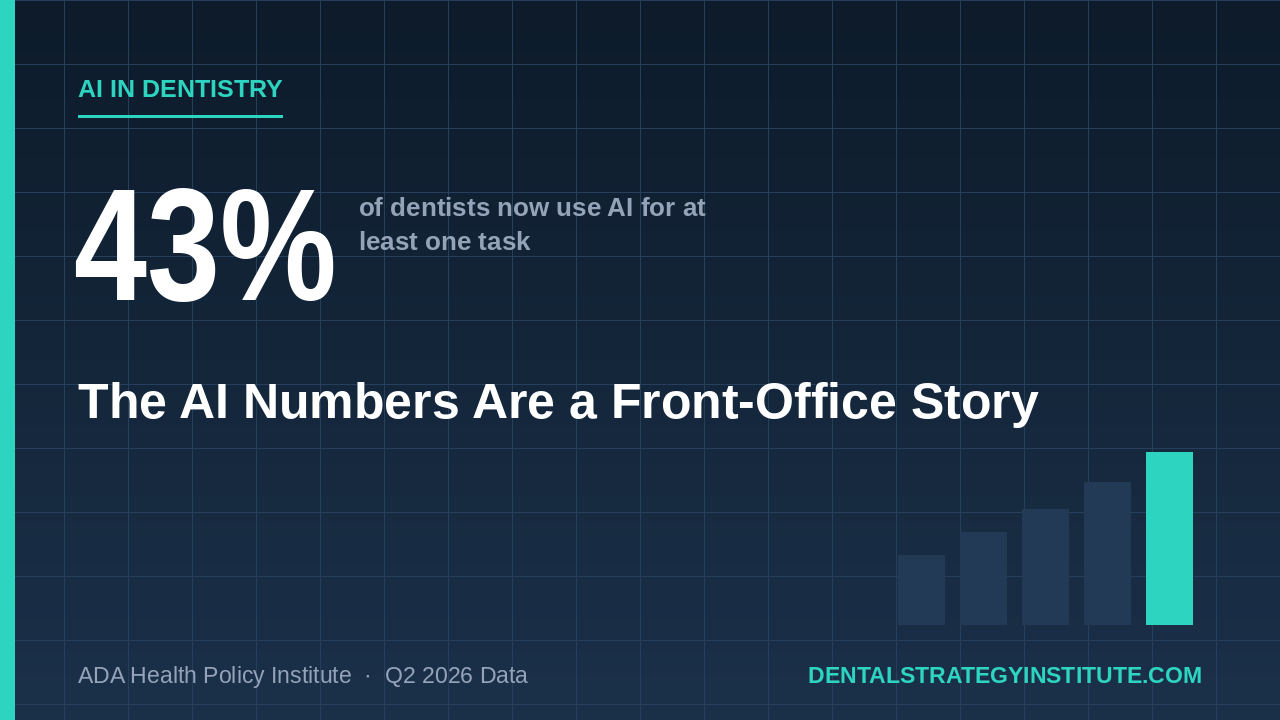
The ADA added an AI section to its Q2 2026 economic report, and the headline number is doing the rounds already: 43.3% of dentists use AI for at least one task in their practice.
Fine. Adoption is real, faster than most people expected, and that's a legitimate finding.
The number I can't stop looking at is a different one, and it's sitting in a row near the bottom of slide 25 where the formatting almost hides it.
The row that contradicts the summary
Ten tasks were listed. For each one, dentists reported whether they currently use AI, plan to, or have no intention of doing so.
Treatment recommendations came in dead last on enthusiasm. Eighty-two point six percent said they don't use AI for treatment recommendations and don't plan to. The ADA's own key takeaway leans on this hard: "Four out of five dentists said they have no interest in using AI for patient treatment recommendations."
But look at the current-use column on that same row. Twelve point nine percent are already doing it.
One in eight. Today. In the category the profession is most publicly opposed to.
And notice what's missing from that row that appears on every other row: essentially no "plan to" bucket. Every other task has a healthy pipeline of dentists intending to adopt. Treatment recommendations has current users and refusers, with almost nobody in between.
That shape tells you something. Nobody sat down and decided to start using AI for treatment planning. They drifted into it, most likely through a tool they bought for something else that quietly expanded its scope.
Adoption without a decision is the actual risk
Think about how this happens in practice. You buy radiograph AI for caries detection. That's an imaging tool, it sits comfortably in the 22.8% who use AI for imaging and diagnostics, and nobody would call it treatment planning.
Then the vendor ships an update. Now it flags lesions by suggested intervention. Now it generates a proposed treatment sequence. Now your software is producing something that walks and talks like a treatment recommendation, and you never made a decision to cross that line because there was never a moment where a decision was presented to you.
Ask a dentist in that situation whether they use AI for treatment recommendations and I'd bet a fair number say no. Which raises an uncomfortable question about whether the 12.9% is the floor rather than the ceiling.
The documentation problem follows immediately. If an algorithm contributed to a treatment decision, what does the chart say? Who reviewed the output? What happens in a malpractice review when the record shows a plan generated by software and no note establishing independent clinical judgment?
I'm not a lawyer and this isn't legal advice. I'm pointing out that a profession where 82.6% say they'd never do this and 12.9% are doing it anyway has not had the conversation it needs to have about charting standards.
The trust gap in imaging
Imaging and diagnostics is the number one AI application in dentistry at 22.8% current use, with another 25.4% planning to adopt. Highest penetration in the survey by a comfortable margin.
It's also where the complaints are loudest.
The verbatim responses the ADA published include this one: "Somewhat skeptical. Our current radiograph AI is consistently wrong." And in the summary of attitudes, skeptical dentists specifically named AI inaccuracies and the potential to drive misdiagnosis and overtreatment.
Highest adoption, loudest dissatisfaction. That combination usually means one of two things is coming. Either a wave of churn as practices abandon tools that didn't deliver, or a slow normalization where dentists learn to treat the output as a second opinion rather than a finding. Probably both, unevenly.
What it definitely means is that the imaging AI market is less settled than the adoption number suggests. A 22.8% penetration rate with that satisfaction profile is not a mature category.
Where the growth is actually going
Skip past the current-use column and look at where dentists say they're headed. The intent data tells a completely different story than the adoption data.
Charting and note taking has the single largest intent pool of any task in the survey, with 34.8% of dentists planning to adopt on top of the 7.4% already using it. Insurance verification is right behind at 32.6% planning and 13.6% current. Billing and claims submission follows at 29.7%.
Timelines run the same direction. Among dentists who plan to adopt but haven't yet, the fastest 2026 implementations are receptionist and front-desk check-in tools at 32.4%, appointment scheduling at 29.6%, practice analytics at 29.3%, and charting at 29.0%.
Imaging, the current leader in adoption, sits at 19.3% for 2026 implementation. Treatment recommendations at 16.9%. Explaining clinical findings to patients comes last at 14.7%.
So the clinical applications got there first and the administrative applications are where the next wave lands.
Which makes sense given everything else in this report. If reimbursement is up 19% against 27% inflation, and you can't raise your fees and can't grow volume in a market where consumer spending rose 1%, then your only lever is the cost of running the place. Front office labor is the most attackable line on that list.
Dentists aren't adopting AI because they're excited about it. They're adopting it because the margin math left them nowhere else to go.
Attitudes are genuinely split, and that's healthy
The open-ended responses paint a profession that's thinking about this more carefully than the trade press gives it credit for.
Twenty-one point five percent described themselves as generally optimistic. Another 17.7% gave a more specific answer: AI is a tool and shouldn't replace clinical judgment. Then 13.8% were flatly opposed, 9.9% skeptical or nervous, and 9.7% reported mixed feelings.
Add the optimists and the conditional supporters and you get roughly 39% in favor with caveats. Add the opposed, skeptical, and mixed and you get about 33% against or unsure. That's a profession genuinely divided, not a profession resisting the future.
My favorite response in the whole document: "AI is a fantastic tool if used responsibly, it should be an aid to a job, not the only source of competency. The operator should always be the one in command of the outcome."
That's a better AI governance policy than most organizations have written.
The DSO split on this is enormous
Everything above describes an average, and I'd argue the average is hiding a bimodal distribution.
Group practices deploy AI centrally. There's an evaluation process, a vendor contract, an implementation team, training, and a governance policy about what the tool is and isn't allowed to do. The business case is built on administrative labor savings multiplied across dozens of locations, which is exactly where the intent data says the value is.
Independent practices buy one tool, get a webinar, and figure it out. That's where "our radiograph AI is consistently wrong" comes from — not necessarily from bad software, but from software deployed without calibration, workflow integration, or anyone whose job it is to make it work.
The analytics gap compounds this. Only 10.1% of dentists currently use AI for practice analytics and business intelligence, with 62.7% saying they never will. Group practices run that analysis as standard operating procedure. So when an independent owner sits down to negotiate with a payer, or to evaluate an acquisition offer, the other side of the table has better information about their own business than they do.
That asymmetry doesn't show up in any of the ADA's charts. It'll show up in transaction outcomes for the next decade.
What to do with this
If you're already running AI on imaging, go find out what your tool is actually producing and whether any of it constitutes a treatment recommendation. Then decide what your chart needs to say about human review. Do that before somebody else decides for you.
If you're in the 26.4% planning to adopt, start with charting or insurance verification rather than anything clinical. The ROI is measurable, the failure mode is an annoyed team member rather than a misdiagnosis, and you'll learn how to evaluate these tools on something with low stakes.
And if you're in the 30.3% who don't use AI and don't intend to, that's a legitimate position that will get more expensive every year. Not because the technology is magic, but because your competitors are using it to take cost out of a business where your reimbursement isn't keeping up with your expenses. The math will find you eventually.
This post is part of our series on the ADA's Q2 2026 dental economy data. Start with the full breakdown: The ADA's Q2 2026 Dental Economy Report: What the Numbers Actually Say.
Source: ADA Health Policy Institute, "The State of the U.S. Dental Economy, 2nd Quarter 2026 Update." AI figures based on 552 private practice respondents surveyed in June 2026.
Stay connected with news, offers and updates!
Join our mailing list to receive the latest news, offers and updates from our team.
Don't worry, your information will not be shared.
We hate SPAM. We will never sell your information, for any reason.