The ADA's Q2 2026 Dental Economy Report: What the Numbers Actually Say
Aug 05, 2026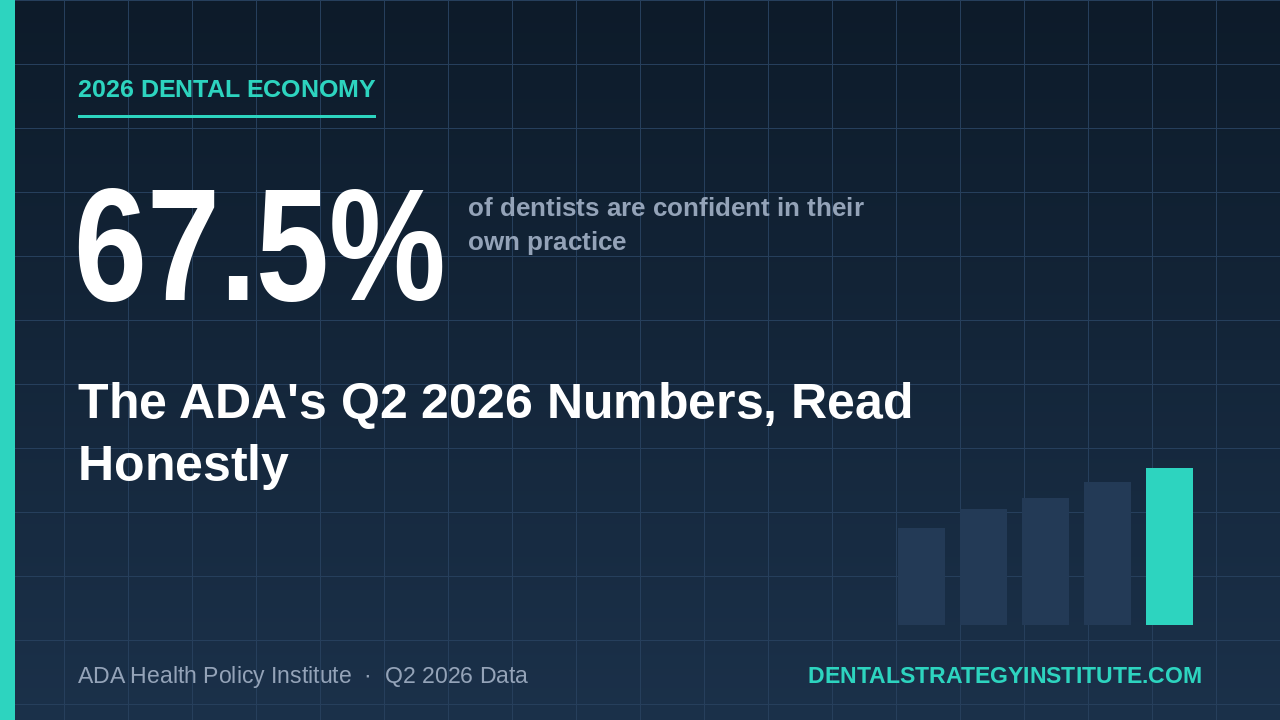
The ADA Health Policy Institute released its Q2 2026 update on the state of the U.S. dental economy in July. Forty-seven slides, four core sections, plus a new section on AI usage in dental practices.
Most of the coverage has focused on two numbers: dentist confidence is up, and 43% of dentists now use AI. Both true, both fine, both the least interesting things in the document.
I read the whole thing twice, including the methodology appendix, which is where a couple of the better stories are hiding. What follows is the version I'd want if I were making decisions with my own money.
The confidence numbers, and the problem with them
Dentists feel better than they did last quarter. Confidence in their own practice reached 67.5%, confidence in the dental care sector 50.2%, and confidence in the U.S. economy 39.7%. All three rose from Q1 2026, continuing a slow recovery from the surge and crash that ran through late 2024 and early 2025.
Now put that next to the University of Michigan consumer sentiment index, which the ADA helpfully includes on the very next slide. It sits at 48.0. That's a historic low.
Dentists are getting more confident. Their patients are as pessimistic as they've been in the history of the series.
That divergence is the tension running underneath every other number in this report, and it's worth asking which group is reading the environment correctly. When the ADA asked confident dentists to explain themselves, the top answer at 39.6% was that dentistry is always needed. Second, at 22.6%, was strong demand and practice busyness. The verbatims are lovely and a little unnerving: "people keep growing teeth and getting cavities," "the need for basic care is recession proof," "it's a stable industry in an unstable world."
That's a belief about biology being used as a forecast about spending. The two aren't the same thing. Teeth kept decaying through 2008 as well, and the sector still took a beating, because a patient who needs a crown and can't pay for one doesn't generate revenue no matter what their molars are doing.
The skeptics, at 25.2% of respondents, gave more concrete answers. Low reimbursement and insurance pressure led at 34.7%. Patients unwilling or unable to prioritize dental care came second at 24.6%. Rising practice costs and a general U.S. downturn tied at 21.2%. The rise of corporate dentistry and DSOs came fifth at 11%.
One respondent summarized the whole report in a sentence: "Economic pressure has been building, at some point people decide routine care is a luxury."
The finding the ADA flagged and then walked away from
Slide 30 contains this admission. Dentists are busier — the share reporting they weren't busy enough fell to 26% from 32% last quarter, and new patient wait times rose to 13.9 days. Meanwhile consumer dental spending grew 1% over twelve months.
The ADA offers three explanations for why those two things coexist, then writes "this merits further analysis" and moves on.
Somebody should analyze it, because none of the three explanations is good news. Either the national spending data doesn't map to practice experience, or patient traffic is rising for lower-value services, or dentists are simply working harder for the same revenue. The most optimistic option on that list is a measurement artifact.
My read is the mix has shifted. Patients are showing up for hygiene, exams, and emergencies while deferring the crown, the quadrant, the implant, and anything elective. Chairs fill with visits rather than dollars. Wait times stretch because the schedule is congested, not because demand is strong.
Which makes production per operatory hour the metric of 2026, and almost nobody in independent practice tracks it. I've broken that argument out in full: The Busyness Paradox.
The fiscal squeeze is worse than the headline
Two indexes get quoted every quarter and almost nobody does the arithmetic between them.
Since January 2021, prices for dental equipment and supplies rose 23%. Hourly earnings for dental office staff rose 23%. Reimbursement across all payer types rose 19%. Inflation ran 27%.
Four points between cost growth and revenue growth sounds survivable. Run it through an actual P&L and it isn't, because those indexes apply to different-sized pieces of your business. Model a 60%-overhead practice, grow wages and supplies at 23%, grow occupancy and general overhead at 27%, grow revenue at 19%, and nominal profit rises about 11% while real profit falls roughly 12%.
The number I'd write on the wall: you need about 5% more production than you're currently doing just to hold real profit flat. Not to grow. To stand still.
And it's accelerating. From January through June of 2026, staff wages rose 2.2% against 1.8% inflation while reimbursement moved 1.1%. Wages speeding up, reimbursement slowing down, inside a single half-year. Full working: The 2026 Fiscal Squeeze.
Slide 19 is the best page in the deck
In Q4 2025 the ADA asked owner dentists what they planned to do in 2026. Six months later they asked the same panel what they'd actually done. Stated intention against recorded behavior, same group. You almost never get that comparison.
Adding staff: 42.3% planned, 39.4% executed.
New software: 16.9% planned, 17.5% executed. They beat plan.
Major equipment purchases: 24.4% planned, 15.8% executed. A 35% shortfall.
Dropping insurance networks: 35% planned, 23.5% executed.
Joining insurance networks: 3.2% planned, 5.6% executed.
Two stories fall out of that table, and both of them cut against the prevailing narrative in dental media.
The first is that capital is rotating out of hardware and into software. Dentists protect payroll, buy the tool that promises to make existing chairs more productive, and defer the operatory. Rational in this environment, and genuinely dangerous by year three, because deferred capital compounds into service costs, downtime, and eventually a purchase price deduction at transition. More on that: Dentists Are Buying Software Instead of Operatories.
The second is that the insurance rebellion is mostly talk. A third of the dentists who said they'd exit a network hadn't done it six months later, while the people joining networks exceeded their own forecast by three-quarters. Both errors run toward insurance rather than away from it, which tells you that in a flat-spending market, volume is beating margin. That one's here: Dentists Said They'd Drop Insurance in 2026.
The AI section is a front-office story wearing a clinical headline
Forty-three point three percent of dentists use AI for at least one task. Another 26.4% plan to. Thirty point three percent say never.
Imaging and diagnostics leads current use at 22.8%, and it's also where the complaints are loudest — one respondent flatly stated "our current radiograph AI is consistently wrong," and skeptics specifically named inaccuracy, misdiagnosis, and overtreatment. Highest adoption paired with lowest satisfaction is not what a mature category looks like.
Forward intent is administrative almost across the board. Charting and note taking has the largest intent pool in the survey at 34.8%, with insurance verification close behind at 32.6% and billing at 29.7%. On timing, the fastest 2026 implementations among planners are front-desk check-in at 32.4%, appointment scheduling at 29.6%, practice analytics at 29.3%, and charting at 29.0%. Imaging sits back at 19.3%.
Then there's the row I keep coming back to. Treatment recommendations: 82.6% say they don't use AI for it and don't plan to, and the ADA's takeaway leans hard on that refusal. But 12.9% are already doing it, and that row has essentially no "plan to" bucket, unlike every other task on the list. Nobody decided to start. They drifted in, most likely through a tool bought for something else that expanded its scope in an update.
One in eight dentists is doing the thing four in five swear they'd never do, and the profession hasn't had a conversation about what the chart should say when that happens. Full analysis: 43% of Dentists Now Use AI.
The decade-long chart that should worry everyone
Slide 13 isn't about 2026 at all, and it's the most important page in the document.
From January 2016 to May 2026, inflation-adjusted consumer spending on physician services rose 46%. Health care overall rose 39%. Dental services rose 24%.
Households spent substantially more on health over that decade. They directed a shrinking share of it toward the dental chair. Annual maximums frozen near 1974 levels, structural separation from the medical system, and the discretionary nature of most dentistry all push the same direction, and none of them reverses on its own. Here's the long view.
Where private practice and DSOs align, and where they don't
The alignment is the arithmetic. Same 23% supply inflation, same wage pressure, same 19% reimbursement growth, same 1% demand growth, same clinical AI liability. Nobody escapes the squeeze by changing their ownership structure.
Divergence is entirely about absorption capacity. Group practices buy through GPOs and don't pay the full 23%. They negotiate payer contracts with volume leverage, which means the 19% average conceals a spread and independents sit on the wrong side of it. They replace equipment on a lifecycle schedule funded by a credit facility rather than on how the year felt. And they run production-per-operatory-hour as routine reporting, while only 10.1% of dentists currently use AI for practice analytics at all.
One advantage runs the other way and independents should defend it hard. An owner can change a scheduling template on a Tuesday. A group needs a pilot and a regional rollout. In a year where mix and throughput are the only levers, speed of adjustment is worth real money.
Then the loop that makes this more than an academic comparison. Margin compression lowers EBITDA, EBITDA drives valuation, lower valuations improve acquisition math, and better acquisition math accelerates the consolidation that 11% of skeptical dentists named as their reason for pessimism. The fear is self-fulfilling and the fiscal squeeze is the mechanism. The full comparison is here.
Read the methodology before you quote the findings
Slide 47 changes how the whole report should be interpreted, and almost nobody gets that far.
Invitations went to 2,432 panel dentists on June 15. Five hundred eighty-nine responded, for an adjusted response rate of 24.3%. Of those, 552 work in private practice, a category the ADA notes includes large group and DSO settings.
Then the disclosure that matters: respondents skew toward ADA members, general practitioners, practice owners, solo and small group settings, mid-to-late career, white, and urban.
This is a private-practice-owner survey wearing an industry label.
Which means the 11% citing corporate dentistry as a reason for pessimism is an owner anxiety index rather than a market read. The 15.8% equipment follow-through probably describes independent behavior, not group behavior — my guess is the real distribution is bimodal, with groups executing near plan and independents well below it. And the AI adoption figures likely understate what's happening inside large organizations with central IT deployment.
None of that makes the report less useful. It makes it a very good instrument pointed at one specific population, and you should read every finding with that population in mind.
The short version
Dentists feel better while their patients feel worse. Chairs are fuller while revenue is flat. Costs have outrun reimbursement for five straight years and the gap widened again this spring. Capital is quietly moving from operatories into software. The insurance rebellion is louder than it is real. AI has arrived through the front office rather than the operatory, and a meaningful minority is using it clinically without having decided to.
Underneath all of it, a decade of losing ground to the rest of health care.
None of this is a crisis. It's a slow compression, and slow compression is harder to respond to than a crisis because there's never a day when it demands your attention. The practices that come out of this well will be the ones that measured production per chair-hour, funded their equipment replacement, priced their contracts honestly, and made those decisions in 2026 rather than in 2029.
Source: ADA Health Policy Institute, "The State of the U.S. Dental Economy, 2nd Quarter 2026 Update," published July 2026. Underlying data from the ADA HPI Economic Outlook and Emerging Issues in Dentistry Poll, U.S. Bureau of Labor Statistics, U.S. Bureau of Economic Analysis, and the University of Michigan Survey of Consumers. Profit modeling referenced above is illustrative.
Stay connected with news, offers and updates!
Join our mailing list to receive the latest news, offers and updates from our team.
Don't worry, your information will not be shared.
We hate SPAM. We will never sell your information, for any reason.