
Same Squeeze, Different Shock Absorbers: Private Practice vs. DSO in 2026
Aug 06, 2026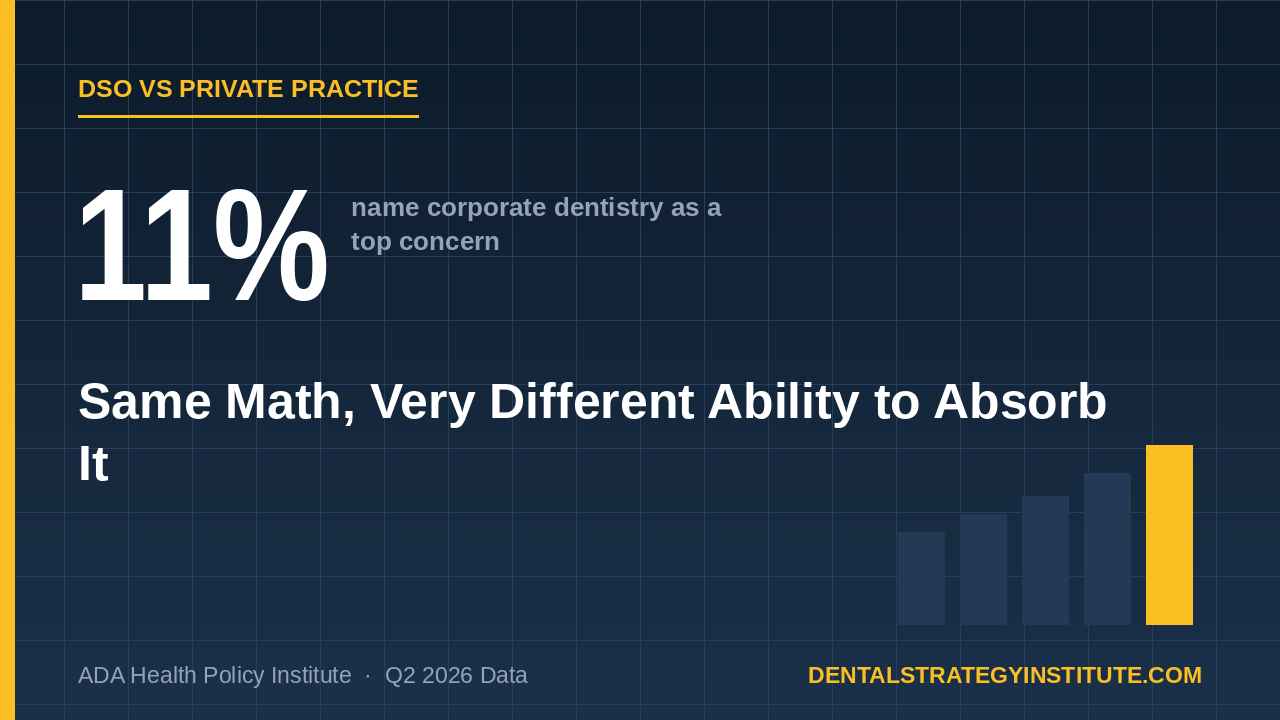
Every time the ADA publishes economic data, the comment sections split into two camps. One says the numbers prove independent practice is dying. The other says they prove corporate dentistry is overhyped and the independents are fine.
Both readings are lazy, and the Q2 2026 report is a good place to explain why.
The economics of 2026 don't favor one model over the other in any simple sense. What they do is apply identical pressure to two structures with very different tolerances, and the outcome depends almost entirely on absorption capacity rather than on anything philosophical about ownership.
Start with what's genuinely shared
The arithmetic doesn't care who holds the deed.
Since January 2021, prices for dental equipment and supplies rose 23%. Hourly earnings for dental office staff rose 23%. Reimbursement across all payer types rose 19%. Inflation ran 27%. Those indexes describe the whole market. A forty-location group and a single-doctor practice in the same state are both operating inside that spread.
The demand picture is shared too. Consumer dental spending grew 1% over twelve months, and 0.4% year to date. That's the total addressable market for everyone. Nobody gets a different denominator.
Labor pressure is shared. From January through June of 2026, dental staff wages rose 2.2% against 1.8% inflation. Dental sector employment grew 1.5% over twelve months after two years of stagnation, which suggests the hiring crisis is easing slightly, though wages are still outrunning inflation. Groups and independents compete for the same hygienists in the same markets.
And the clinical AI hesitancy is shared, because liability is shared. Eighty-two point six percent of dentists want nothing to do with AI for treatment recommendations, and no corporate structure changes the malpractice exposure on that question.
Anyone selling you a story where consolidation escapes the squeeze is selling something. The squeeze is real for everybody.
Where the models actually separate
Absorption capacity is the whole ballgame, and it shows up in five places.
Purchasing. A group buying through a GPO doesn't pay the 23% supply inflation the index describes. Call it 12 to 15% on high-volume consumables. That difference alone is worth close to a full point of revenue in margin, generated by nothing but volume. An independent pays list, or close to it.
Payer contracting. The 19% reimbursement figure is an average, which means somebody is above it and somebody is below it. A group negotiating for forty locations has leverage a solo owner will never have. When you read that index, understand it's a blend concealing a spread, and the independent in a saturated suburb is on the wrong side of that spread.
Capital. This is the one I find most telling in the 2026 data. Owner dentists planned major equipment purchases at 24.4% and executed at 15.8% — a 35% shortfall. Software investment beat plan, 16.9% intended and 17.5% executed. Given that the ADA's panel skews toward solo and small group owners, that deferral is largely an independent behavior. Groups replace on a lifecycle schedule funded by a credit facility, because the model says so rather than because the year felt good. Three consecutive years of that divergence produces a visible gap in operatory condition and patient experience within the same local market.
Data. Only 10.1% of dentists currently use AI for practice analytics, and 62.7% say they never will. Group practices run production-per-operatory-hour and payer profitability analysis as routine operations reporting. So when the mix shifts toward lower-value services — which is my read on why dentists are busier while spending is flat — the group sees it inside a reporting cycle and the independent sees it at tax time.
Speed. This one runs the other way, and independents should take it seriously. An owner who identifies a scheduling problem on Monday can change the template on Tuesday. A group needs a pilot, a regional rollout, and a training cycle. In a year where the only real lever is throughput and case mix, the ability to adjust immediately has genuine economic value. Small is not automatically worse. Small is faster.
The loop nobody talks about
Here's the mechanism that makes this more than a comparison exercise.
Margin compression reduces EBITDA. Practice valuations run off EBITDA. So five years of the fiscal squeeze mechanically lowers what an independent practice is worth, independent of anything the owner did wrong.
Lower valuations improve acquisition math for buyers with patient capital. Better acquisition math accelerates consolidation.
And consolidation was the fifth-most-cited reason for pessimism among skeptical dentists in this survey, at 11%. One respondent wrote: "Dentistry is being taken over by the corporate entities."
The fear is real, and the fiscal squeeze is the mechanism that fulfills it. Not strategy, not conspiracy — just what happens when margin compression meets a market where somebody has cheaper capital and a longer time horizon. If you want the transaction mechanics in detail, our pieces on how to value a dental practice and adjusted EBITDA in a practice sale cover how each dollar of compressed margin translates into purchase price.
Worth noting that this cuts both ways. Compressed independent margins also mean groups are acquiring practices with real operational problems, deferred capital, and thin underlying profitability. Plenty of platforms have discovered that a cheap multiple on a struggling practice is still a struggling practice. Consolidation isn't a guaranteed win either.
The confidence gap between the two
There's a psychological difference in this data that I think is underrated.
When the ADA asked confident dentists why they felt good about the sector, the top answer at 39.6% was that dentistry is always needed. Second, at 22.6%, was strong demand and practice busyness. The verbatims run along the lines of "people keep growing teeth and getting cavities" and "it's a stable industry in an unstable world."
That's faith. Reasonable faith, grounded in a real observation about biology, but faith.
A DSO's confidence comes out of a model. Cohort performance, same-store growth, payer mix analysis, and a capital plan. When conditions change, the model updates and the strategy changes with it.
Faith is durable and it's kept a lot of good dentists going through hard years. It also doesn't tell you when to change course, and 2026 is shaping up to be a year that requires course changes. Meanwhile consumer sentiment sits at 48.0 — a historic low — while dentist confidence in their own practice climbed to 67.5%. One group feels good about a customer base that feels terrible. That gap has to resolve somehow.
What I'd take from this if I owned a practice
Stop competing on the axes where scale wins. You will not beat a group on supply cost or payer leverage. That's structural and no amount of effort changes it.
Compete where speed and relationship win, and be deliberate about it. Case acceptance, continuity of care, the ability to make a judgment call without asking a region for approval. Those are real advantages that don't show up in any index.
Then close the two gaps you can actually close. Instrument your business so you know your production per operatory hour and your net collections by plan, because that information asymmetry is costing you at every negotiation. And put equipment on a funded replacement schedule rather than an annual decision, because deferred capital becomes a purchase price deduction whenever you eventually transition.
And if you operate a group
The opening in this data is obvious and I'd move on it. Every independent practice in your pipeline has deferred capital for three years, and their asking price almost certainly doesn't reflect it. Equipment diligence has rarely mattered more, and our equipment documentation checklist covers what to actually look for.
The risk in this data is less obvious. If the busyness paradox is real — chairs full, revenue flat, mix shifting toward lower-value services — then same-store production per operatory hour is the metric that will tell you first, and a lot of platforms are still running on visit counts and collections. Those two numbers will look fine right up until they don't.
Neither model is winning 2026. One of them just has more room to be wrong.
Source: ADA Health Policy Institute, "The State of the U.S. Dental Economy, 2nd Quarter 2026 Update." Index data from the U.S. Bureau of Labor Statistics; consumer sentiment from the University of Michigan.
Stay connected with news, offers and updates!
Join our mailing list to receive the latest news, offers and updates from our team.
Don't worry, your information will not be shared.
We hate SPAM. We will never sell your information, for any reason.