
Dentists Said They'd Drop Insurance in 2026. Most of Them Didn't.
Aug 08, 2026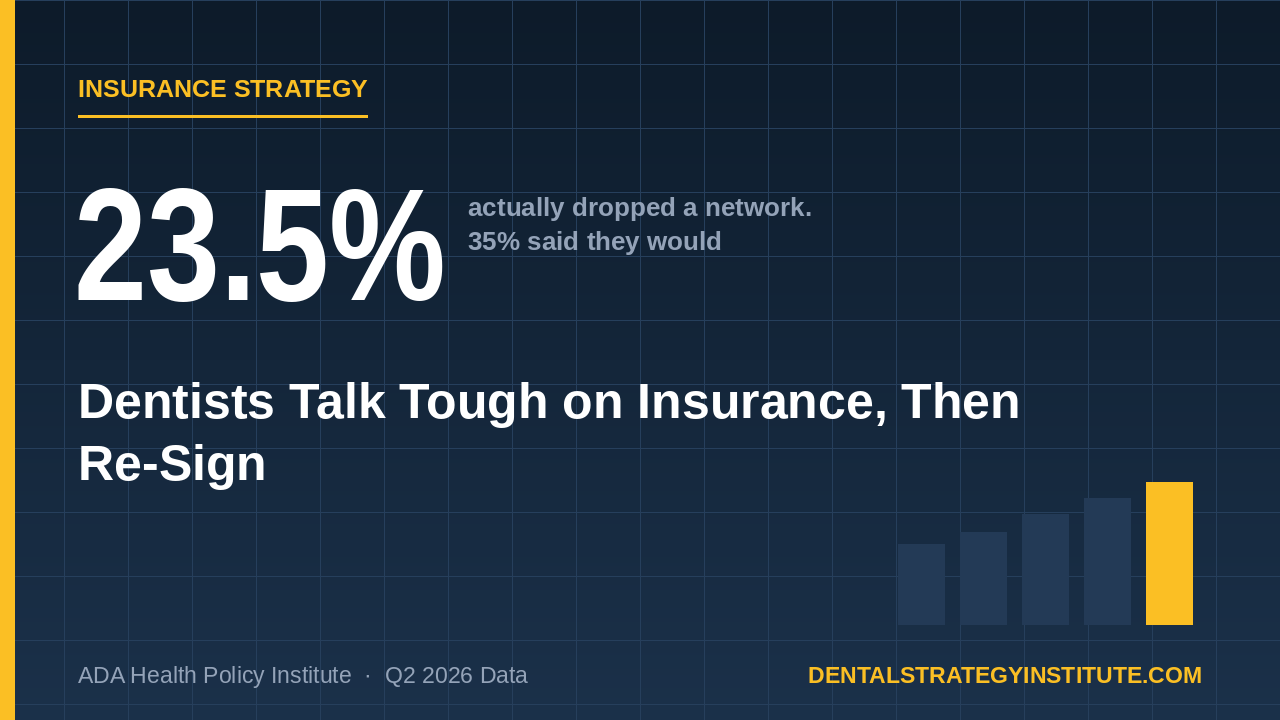
There's a slide in the ADA's Q2 2026 report that almost nobody is writing about, and it's the most revealing page in the deck.
In Q4 of 2025, the Health Policy Institute asked owner dentists what they planned to do in 2026. Then, six months later, they asked the same group what they'd actually done. Same panel, stated intention against recorded behavior.
You don't get that comparison often in this industry. Survey data usually captures what people say and then nobody follows up. This one followed up.
What they said versus what they did
Dropping insurance networks was the headline intention. Thirty-five percent said they were very likely or somewhat likely to exit at least one network in 2026.
By Q2, 23.5% had done it.
That's a shortfall of about a third. Roughly one in three dentists who told a researcher they were getting out of a network hadn't gotten out of a network six months later.
Now the part that makes it interesting. Only 3.2% said they planned to join new insurance networks in 2026. By Q2, 5.6% had.
Joiners exceeded their own forecast by three-quarters. Leavers fell a third short.
Both of those errors run in the same direction, and that direction is toward insurance rather than away from it.
The gap isn't hypocrisy
I want to be careful here, because it would be easy to read this as dentists talking tough and losing their nerve, and I don't think that's what's happening.
Dropping a network is a genuinely hard operational move with a real revenue trough in the middle. You lose patients before you replace them. You need a fee schedule that holds, a case presentation team that can defend it, and enough cash cushion to ride out two or three ugly quarters. Anybody who's done it will tell you the spreadsheet said one thing and the sixth month said another.
So when a dentist tells a surveyor in December that they intend to go out of network, that's a sincere statement about a problem. Low reimbursement was the single most cited reason for pessimism in this survey, at 34.7%, well ahead of everything else. The frustration is real and it's the largest thing on dentists' minds.
Then January comes. Consumer confidence is at 48.0. Dental spending is growing 1% a year. Your schedule has soft spots. And the practice management conversation shifts from "how do we improve margin per patient" to "how do we keep the chairs full."
In a market like that, dropping a network means voluntarily shrinking your funnel at the exact moment your funnel feels fragile.
Most people don't do it. That's not weakness. That's reading the room.
What the joiners understood
The 5.6% who signed on to new networks made a specific bet, and given the rest of the data in this report I'd argue they read the year correctly.
When aggregate spending is flat, growth has to come from share. You can't grow by riding the market because the market isn't going anywhere. Consumer dental spending was up 1% over twelve months and down 0.1% month over month. That's a market where every new patient you gain came from somewhere else.
Network participation is a share-capture strategy. You accept a worse rate per procedure in exchange for placement in front of patients who filter by coverage. In a flat market with anxious consumers, coverage-driven selection gets stronger, not weaker. Households at a 48.0 sentiment reading are absolutely checking whether you're in network before they book.
The out-of-network strategy is a margin-capture strategy, and margin capture works best when demand is strong enough that you can afford to lose the price-sensitive tail. Look at the busyness data and ask whether 2026 is that year. Just 12% of dentists reported being too busy to treat everyone requesting care, down from 16% two years ago, and that figure has sat at 12 or 13% for eight straight quarters. Twenty-six percent still say they're not busy enough.
Very few practices are actually capacity-constrained. Which means very few practices are in a position where shedding patients is safe.
Where DSOs sit in this
This is the split that matters, and it explains a lot about who's winning.
Group practices are, structurally, volume players. Their model runs on throughput, standardized operations, and negotiated rates that improve with scale. When a DSO joins a network it's doing so with contract terms an individual owner can't get, which changes the entire calculation. The same network that's marginal for a solo practice at their negotiated rate can be solidly profitable for a group at theirs.
So the strategy that independents are trying to escape is the strategy groups are optimizing. And in a flat-spending year, the volume play is the one generating growth.
There's a second-order effect worth sitting with. Every independent who drops a network hands local network patients to whoever's still in it, and increasingly that's the group practice down the road with the capacity to absorb them. Going out of network to protect your margin can quietly accelerate the consolidation of your own market.
I'm not saying don't do it. I've watched practices execute an insurance-free transition beautifully and never look back, and their owners are the happiest people in dentistry. I'm saying the ADA data suggests the people who succeed at it are a smaller group than the people who intend it, and the difference between the two is almost entirely preparation.
If you're in the 35% who still want out
Run the numbers before you run the plan. Not a rough estimate of what you'd collect at UCR, but a plan-by-plan analysis of net collections per procedure, patient concentration by carrier, and what percentage of your active base would need to stay for the math to work. Our PPO profitability tool does this calculation, and I'd rather you find out on a spreadsheet than in month seven.
Then be honest about the timeline. The practices that pull this off usually spend twelve to eighteen months building fee-for-service demand before they terminate anything. They drop one plan, not four. They pick the worst-paying contract with the smallest patient concentration and they treat it as a test rather than a philosophy.
The ones who struggle tend to have done it the other way around, terminating on principle in January and building demand in a panic by June.
If you want the full framework we've written it up separately in our guide on going insurance-free, and the PPO exit piece covers the patient retention side specifically.
One note on the data. These figures come from owner dentists in a panel that skews toward ADA members in solo and small group practice, mid-to-late career. That's the population most likely to want out of insurance and least likely to have the scale to make it painless. The gap between intention and action may be telling us as much about who answered the survey as about the strategy itself.
Still, 35% became 23.5%, and 3.2% became 5.6%. The market moved toward insurance in 2026 while the conversation moved against it. That's worth knowing before you plan your year.
This post is part of our series on the ADA's Q2 2026 dental economy data. Start with the full breakdown: The ADA's Q2 2026 Dental Economy Report: What the Numbers Actually Say.
Source: ADA Health Policy Institute, "The State of the U.S. Dental Economy, 2nd Quarter 2026 Update," based on owner dentist responses across the Q4 2025 and Q2 2026 survey waves.
Stay connected with news, offers and updates!
Join our mailing list to receive the latest news, offers and updates from our team.
Don't worry, your information will not be shared.
We hate SPAM. We will never sell your information, for any reason.