
Browse by Topic: DSO & M&A · Practice Operations · Hygiene Career Track · Practice Finance · Regulation & Compliance

Direct answer: collect 98% or more of adjusted production, keep AR over 90 days below 15% of total AR, and submit clean claims within 24 hours of the appointment. The money you lose in collections is pure margin — there's no lab bill, no chair time, no supply cost attached to it. Planet DDS calculat...
Here's the short answer: a healthy hygiene department generates at least 25% of a practice's adjusted production, keeps 90% of recare patients scheduled, and treats periodontal disease at a rate that roughly matches its actual prevalence in the population. CDC data puts periodontitis at 47.2% of adu...
Short version: the fastest revenue in dentistry is already in your database. Recall is keeping active patients on schedule — target 90% of hygiene patients leaving with their next appointment booked the same day. Reactivation is going back after patients who've fallen off, typically 30% to 50% of a ...
The direct answer: effective dental scheduling means building the day around production blocks instead of filling holes chronologically. You set daily production goals by provider, reserve prime-time slots for high-value procedures, protect hygiene capacity, cut your combined no-show and cancellatio...
The direct answer: treatment acceptance improves when you fix diagnosis consistency first, presentation second, and financing third — in that order. National case acceptance medians run 55% to 65%, but the more revealing number is case completion, which averages just 47% industry-wide. Ethical pract...
Here's the short answer: there are ten numbers that tell you almost everything about whether your practice is healthy, and most owners are tracking maybe three of them. Production. Collections. Overhead. Case acceptance. New patients. Hygiene reappointment. Cancellation rate. Production per operator...
Every state now permits some form of hygiene practice outside direct chairside supervision by a dentist — the scope varies widely, but the door that used to be fully closed is, in most places, at least partly open. What hasn't caught up is the business information hygienists need to actually walk th...
Henry Schein put out a tidy little announcement this week about a new leadership structure. They're creating something called the Henry Schein Leadership Team to replace the old Executive Management Committee, folding the global supply chain group into distribution, and three long-serving executives...
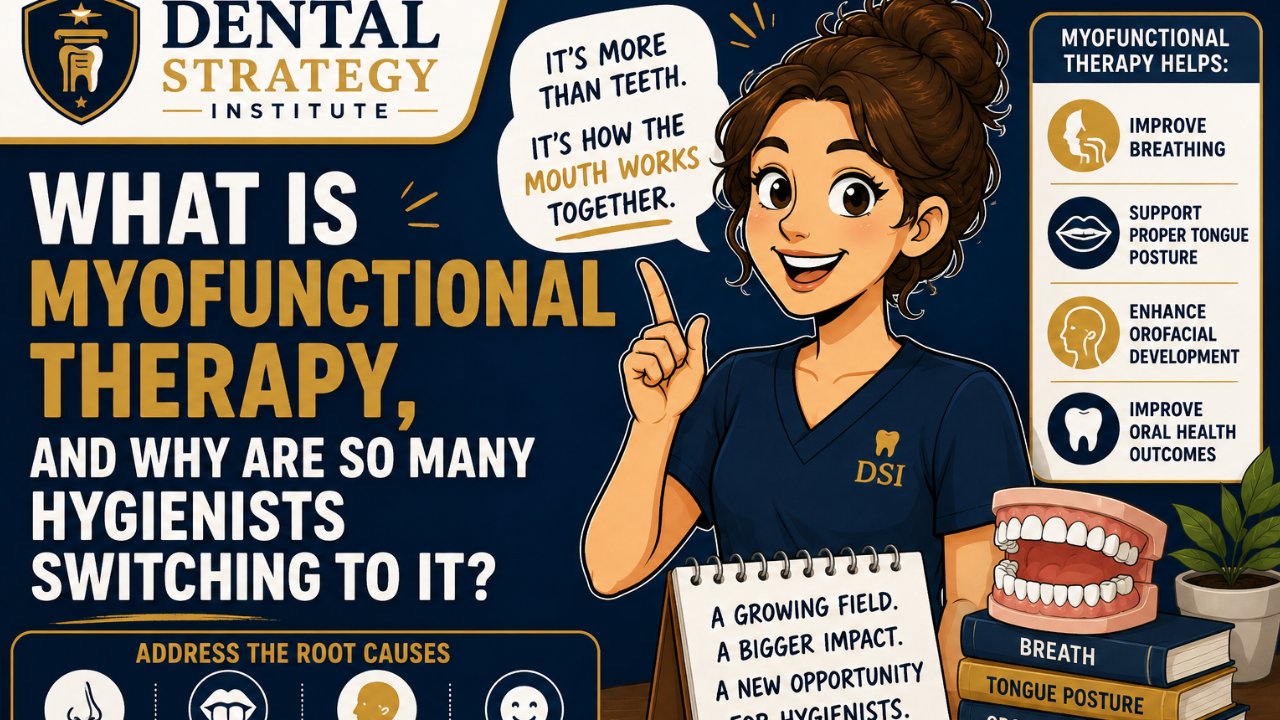
Myofunctional therapy has gone from a niche referral almost nobody in general dentistry had heard of, to a service line that orthodontists, airway-focused dentists, ENTs, and sleep clinics are actively looking to refer patients into — and increasingly, to bring in-house. For a dental hygienist looki...
By Pete Volk, founder of Dental Strategy Institute, with clinical review by Susan Volk, RDH.
Of all the reasons a hygienist talks herself out of going independent, "the paperwork" is the quietest and the most defeating. Not the clinical part — you've got that. The nagging sense that on your own, yo...
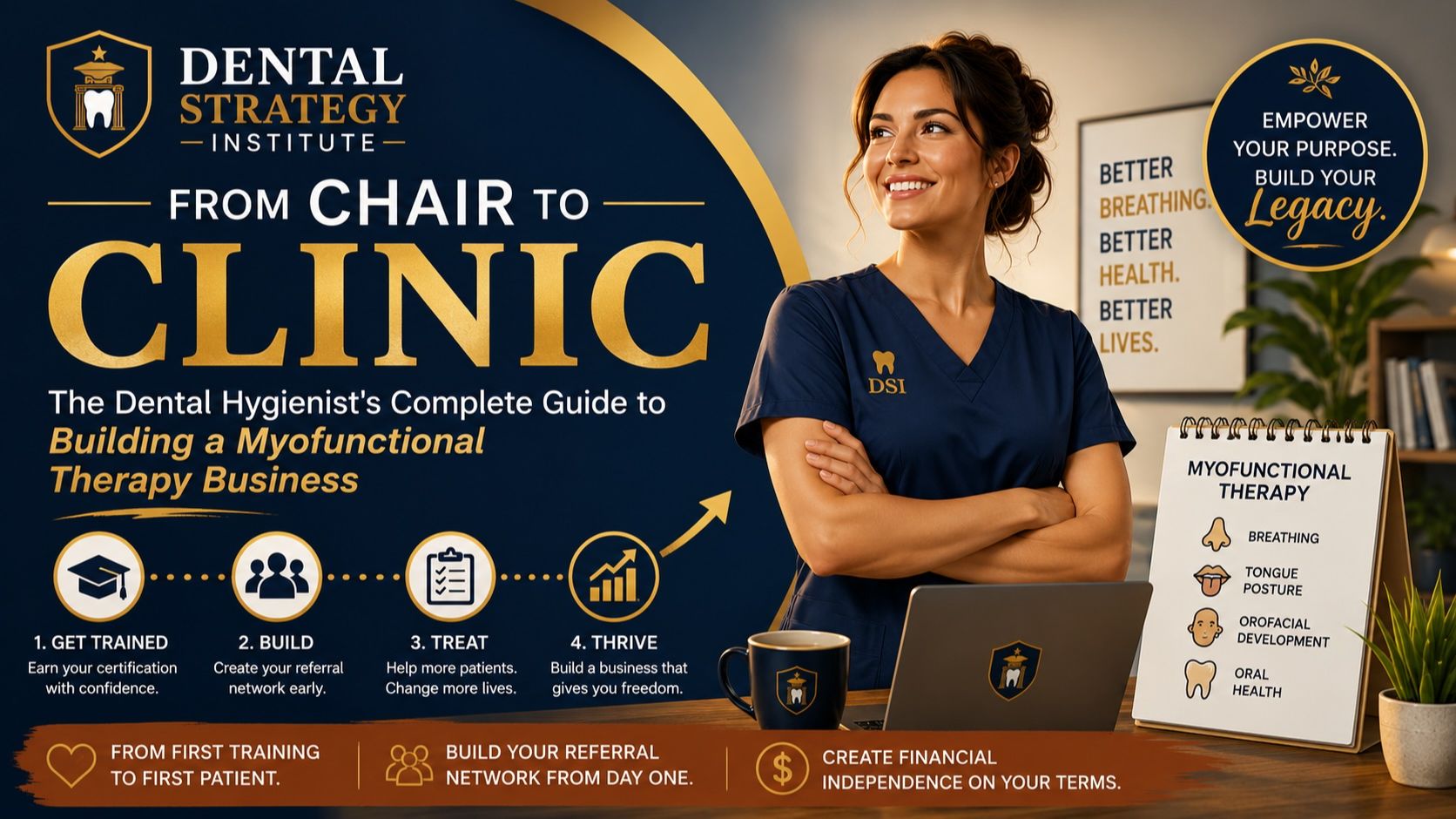
More hygienists are stepping away from full-time chairside work and building something of their own. Orofacial myofunctional therapy has become one of the most compelling paths for making that move — a cash-pay clinical specialty, in genuinely short supply, that draws on skills a hygienist already h...
The ADA's Q1 2026 data shows dental reimbursement rates rose slightly in February. I know how that headline reads — like good news, finally, after years of owners feeling squeezed from every direction. Read past the first line, though, and the long-term picture is a lot less flattering. Rates still ...